
Explore computational approaches for the early assessment of absorption, distribution, metabolism, excretion and toxicity properties of drug-like compounds.
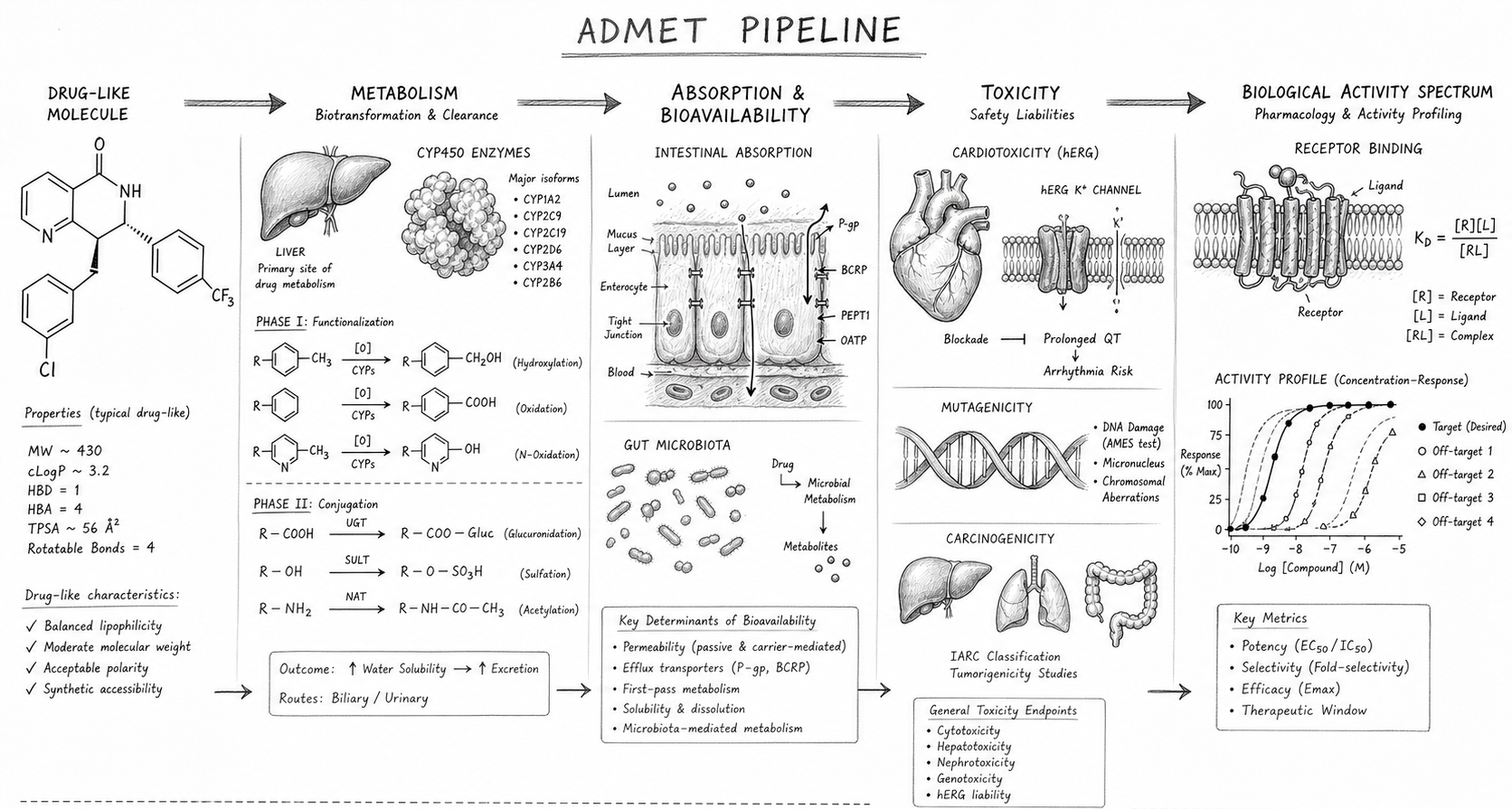
In drug discovery, identifying a potent compound is only the first step. The vast majority of drug candidates that fail in clinical trials do so not because of insufficient efficacy, but due to poor absorption, distribution, metabolism, excretion, and toxicity (ADMET) properties. Addressing ADMET liabilities early in the development pipeline is therefore critical to reducing costs, accelerating timelines, and improving the overall success rate of bringing safe and effective medicines to patients.
Experimental ADMET profiling is resource-intensive and time-consuming. It also requires significant quantities of synthesized material, which is often unavailable at early discovery stages. Traditional assays for evaluating each compound's metabolic stability, cytochrome P450 interactions, mutagenicity, and cardiotoxicity are simply not feasible when screening large chemical libraries. This creates a critical bottleneck between hit identification and candidate nomination.
Leveraging quantitative structure–activity relationship (QSAR) models and machine learning algorithms trained on curated experimental datasets makes it possible to rapidly assess the pharmacokinetic and toxicological profile of any compound based solely on its structural formula — before a single experiment is performed. GUSAR Online applies this concept to quantitatively predict biological activity and acute toxicity, offering a rigorous, QSAR-based evaluation even in the initial stages of compound prioritization.
Metabolic behavior is among the most consequential ADMET factors, directly governing a compound's bioavailability, half-life, and propensity for drug–drug interactions. Understanding not only whether a compound is metabolized, but precisely how and where, requires a multi-layered computational approach. SOMP and Reacting Atoms Predictor (RA) address this at the atomic level, identifying the specific sites within a molecule most susceptible to biotransformation reactions. MetaStab-Analyzer translates this structural insight into a practical assessment of metabolic stability, helping researchers prioritize candidates with favorable pharmacokinetic profiles. The role of the gut microbiome in drug transformation beyond hepatic metabolism is an increasingly recognized yet often overlooked factor. MDM-Pred fills this gap by predicting gut microbiota-mediated metabolism, offering a more complete picture of a compound's fate in the human body.
A metabolic assessment is not complete without evaluating the impact on cytochrome P450 (CYP) enzymes, which are responsible for the biotransformation of most clinically used drugs. Inhibiting or inducing key CYP isoforms is a primary driver of drug–drug interactions and unpredictable pharmacokinetics. P450-Analyzer provides systematic predictions of interactions with the five most clinically relevant CYP isoforms: CYP1A2, CYP2C9, CYP2C19, CYP2D6, and CYP3A4. This enables the early identification of potential interaction issues before they become clinical problems.
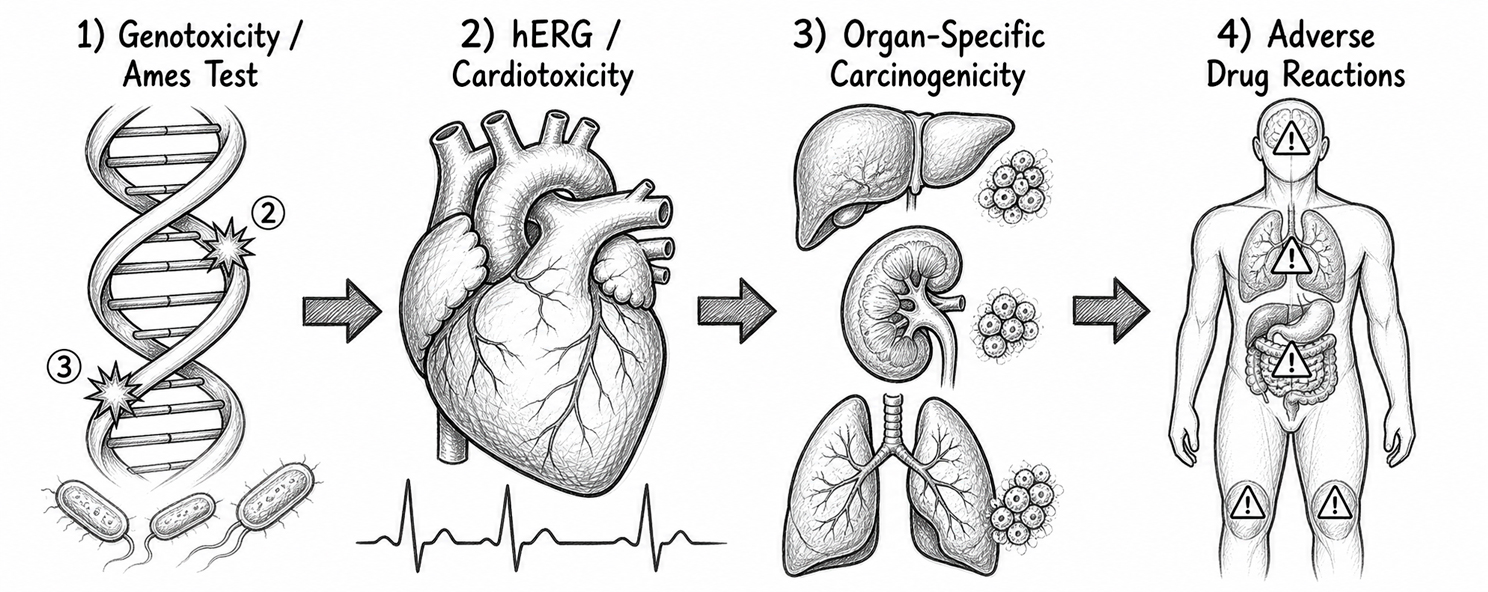
A toxicity evaluation encompasses a broad spectrum of endpoints, each of which represents a distinct mechanistic pathway and regulatory requirement. Genotoxicity is one of the earliest and most strictly regulated concerns. The Ames Mutagenicity Predictor enables rapid in silico screening for mutagenic potential, which is consistent with the Ames bacterial reverse mutation test, a cornerstone of regulatory safety packages. At the cardiac level, blockade of the hERG potassium channel is a leading cause of drug withdrawals from the market. hERG-Pred provides qualitative and quantitative estimates of this risk based on structural input alone. For longer-term systemic concerns, ROSC-Pred addresses rodent, organ-specific carcinogenicity, and ADVERPred delivers broader predictions of serious adverse drug reactions. These web services support comprehensive safety profiling at the candidate selection stage.
The biological effect of a compound in a living organism is rarely the result of the parent molecule alone. Metabolites may be pharmacologically active, toxic, or both — a fact that is often overlooked by conventional activity prediction web services. MetaTox 2.0 directly addresses this issue by predicting xenobiotic metabolites and providing a comprehensive assessment of their biological activity profiles. Building on this, MetaPASS integrates biotransformation pathways into its predictions, offering a systems-level view of how a compound and its metabolic products interact with the body.
A molecule's structural formula encodes more than just its chemical identity; it also contains the blueprint for its biological behavior. Modern in silico approaches can decode this blueprint systematically by translating two-dimensional structural representations into quantitative predictions spanning hundreds of pharmacological and toxicological endpoints. This paradigm shift from empirical trial and error to structure-driven decision-making is changing how early drug discovery is conducted. It enables researchers to explore vast regions of chemical space in a fraction of the time and with a fraction of the resources previously required. At the heart of this approach is the understanding that biological activity, metabolic fate, and toxicological risk are interconnected dimensions of the same chemical reality, not independent properties. These web services enable researchers to generate comprehensive in silico ADMET profiles for any drug-like compound throughout the discovery process, including virtual screening, lead optimization, candidate selection, and regulatory documentation. All services are accessible online and require only a standard chemical structure as input.


© 2011 - 2026 Way2Drug. All rights reserved.


