
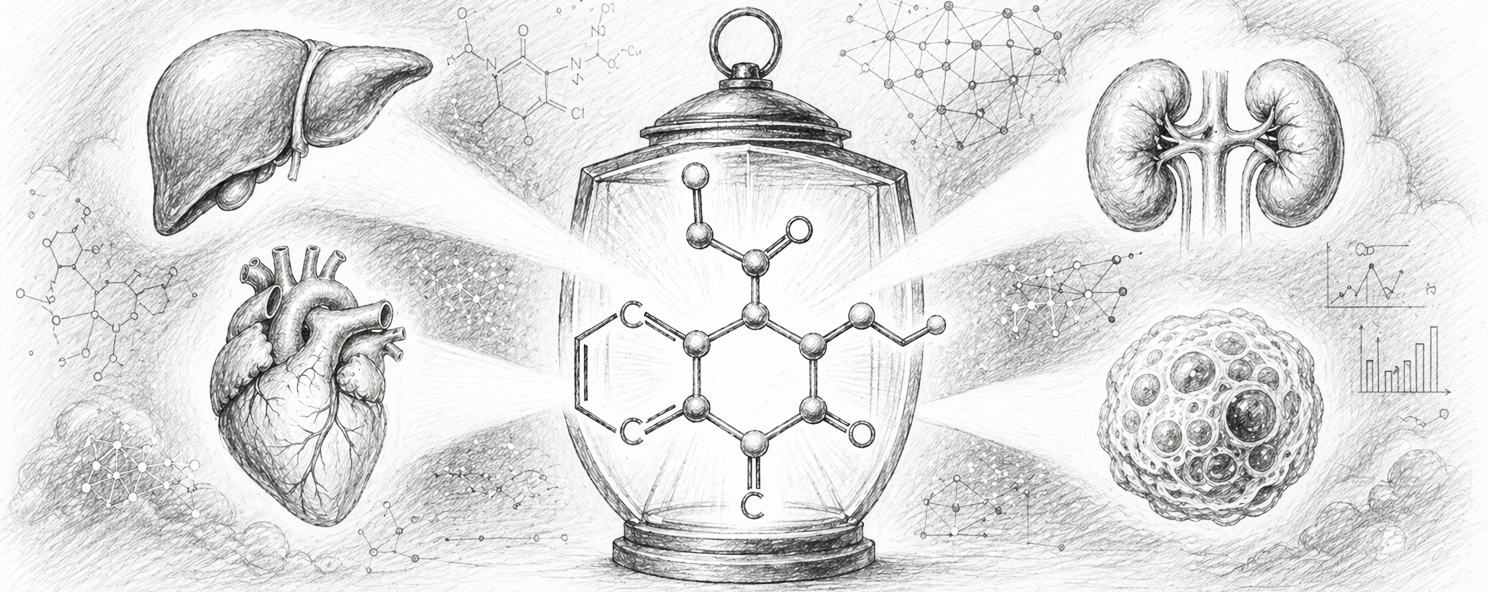
Assessing the safety of chemical compounds is one of the most critical stages of drug development. The Way2Drug platform provides a suite of specialized in silico tools that enable the early identification of potential adverse effects of molecules and help reduce the risks of their manifestation in clinical practice. Using machine learning methods for in silico safety assessments of pharmacologically active substances reduces time and financial costs while covering a broad spectrum of toxicological endpoints, from mutagenicity and cytotoxicity to adverse reactions at the organ and physiological system levels.
Assessing the safety of chemical compounds is one of the most critical stages of drug development, and the quality of in silico predictions here is directly determined by the quality of the training data. This is why the central asset of the Way2Drug platform in the field of safety is the proprietary WWAD (World Wide Approved Drugs) database. This database is a carefully verified, structured repository of information on adverse drug reactions. A systematic comparison of open-access ADR databases showed that WWAD ranks among the most valuable resources simultaneously for building training datasets, generating mechanistic hypotheses about toxicity, and identifying novel drug repurposing opportunities - unlike a number of alternatives constructed through automated text mining without manual curation.
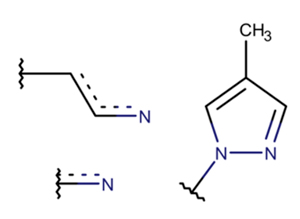
A new direction in the work of the Way2Drug team is the development of highly specific structural fragments for filtering compounds with undesirable biological activities. The method is based on evaluating the contribution of individual atoms to a given type of biological activity, taking into account their local structural environment; the applicability of the approach has been demonstrated on molecular targets associated with a broad spectrum of adverse drug reactions. In practice, highly specific structural fragments were designed for inhibitors of the epidermal growth factor receptor (EGFR) and dipeptidyl peptidase 4 (DPP-4) — two molecular targets whose blockade is associated with a wide range of adverse effects. A search for compounds containing these fragments among 12,070 clinical trial records in the PubChem database identified five Phase I and Phase II candidates with a potentially unfavorable benefit-to-risk ratio.
The flagship PASS Online service simultaneously predicts more than 4,000 types of biological activity, including toxic and adverse effects, as well as interactions with metabolic enzymes and transporters. The mean accuracy of prediction is approximately 95% under leave-one-out cross-validation, making it a reliable tool for early-stage safety screening. The specialized ADVERPred service is focused on predicting adverse reactions of pharmacological substances affecting the cardiovascular and hepatobiliary systems, including severe conditions such as myocardial infarction, arrhythmia, cardiac failure, hepatotoxicity, and nephrotoxicity.
Predicting drug-induced liver injury (DILI), one of the most dangerous adverse effects and a leading cause of acute liver failure, requires special attention. Studies by the Way2Drug team have revealed a clear relationship between the route of administration, daily dose, and the severity of DILI: according to SAR analysis, approximately 40% of compounds with moderate or absent DILI potential can cause severe liver injury when administered orally at high doses. A practical rule emerging from these findings is that compounds recommended for use at low oral doses (<~10 mg/day) or administered parenterally may be considered unlikely to cause severe DILI.
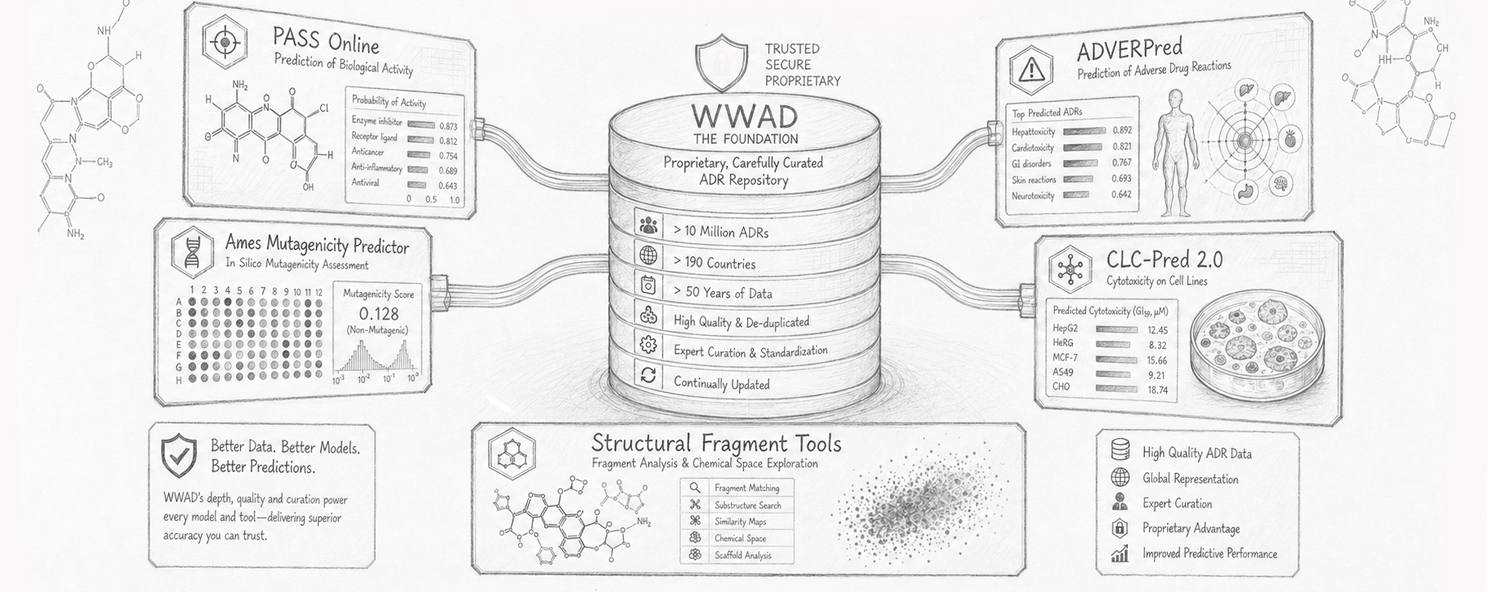
The key safety models of the Way2Drug platform are trained on WWAD data, which provides them with a fundamental advantage over tools relying on lower-quality sources. For the Ames Mutagenicity Predictor, 4,285 non-mutagenic compounds from WWAD were used as negative examples; the resulting SAR models for 69 strains of Salmonella typhimurium achieved a mean prediction accuracy (IAP) of approximately 0.944 under LOO cross-validation. The CLC-Pred 2.0 service uses QSAR models for the quantitative prediction of cytotoxicity (IC50 and GI50) across 10 non-tumor and 8 tumor human cell lines. The high model quality (R2 = 0.691 under 5-fold cross-validation) is largely attributable to the cleanliness and consistency of the underlying training data.
The cumulative impact of this research program is reflected in the platform's adoption across academic, pharmaceutical, and regulatory contexts worldwide. By enabling safety assessment at the earliest stages of the drug discovery pipeline, for example, before synthesis, before animal testing, and before clinical trials, Way2Drug contributes directly to the reduction of late-stage attrition, the prevention of patient harm, and the acceleration of the path from molecule to medicine.


© 2011 - 2026 Way2Drug. All rights reserved.


