
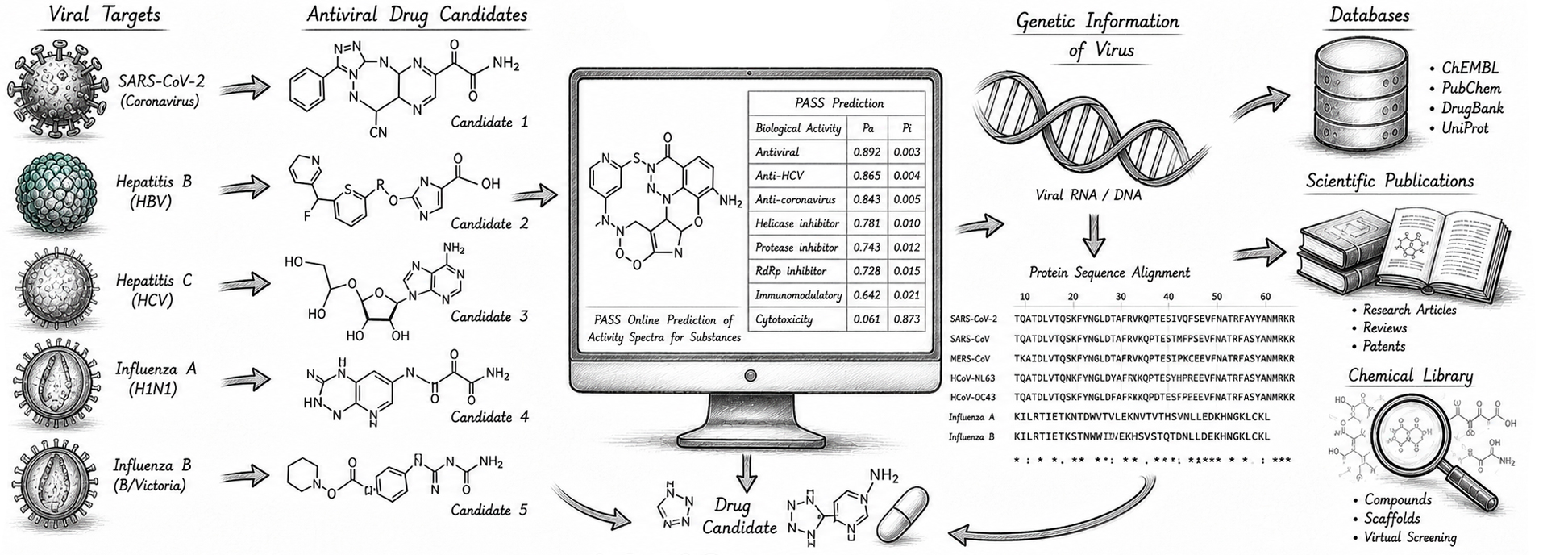
The Way2Drug platform provides a suite of web services for studying viral infections and searching for antiviral agents using in silico methods, covering tasks ranging from biological activity prediction to the consolidation of knowledge from the scientific literature.
The core tool of the platform is the PASS system (Prediction of Activity Spectra for Substances), based on a Bayesian classification method using MNA descriptors. PASS predicts the probability of antiviral activity for any molecule solely from its structural formula, enabling prioritization across virtual libraries before laboratory experiments begin. The method is applied to predict the activity of compounds against HIV-1, Cytomegalovirus, and a number of other viruses, directly guiding synthetic efforts and enabling the selection of the most promising candidates.
The practical applicability of the platform's services was demonstrated during the international "Billion Molecules Against COVID-19" (JEDI) challenge, in which the Way2Drug team participated in screening one billion virtual molecules against SARS-CoV-2 proteins. As a result of the challenge, one of the compounds proposed by the Way2Drug team for the Nsp3 target confirmed inhibitory activity in experiments with IC50 = 24.7 μM and was included among the verified hits. This result clearly demonstrates how the computational capabilities of the platform translate into experimentally confirmed antiviral compounds. We have also predicted anticoronavirus activity for some drugs (Narlaprevir, Boceprevir, Disulfiram, etc.), which activity was confirmed in vitro outside the JEDI project.
For antiretroviral drug discovery tasks, the Way2Drug platform hosts a dedicated web resource, AntiHIV-Pred, combining QSAR models built with the GUSAR software and PASS predictions. The training sets were compiled from over 50,000 experimental records from the ChEMBL database. Approximately 7,000 molecules, which are inhibitors of five HIV-1 proteins (protease, reverse transcriptase, integrase, TAT, and Rev), were used to build regression and classification models with an R2 = 0.95 and Q2 = 0.72, demonstrating high accuracy and predictivity. In addition to direct antiretroviral activity, the resource enables assessment of 81 biological activities associated with the treatment of HIV-associated comorbidities with a mean accuracy of 92%, providing the researcher with a comprehensive picture of a compound's therapeutic potential.
Building upon the PASS algorithm, we implemented an extended proteochemometric approach using combinatorial TLMNA descriptors that combine the MNA descriptors of the ligand with N-grams of protein amino acid sequences. This method was validated on the proteases of 15 socially significant viruses: SARS-CoV-2, SARS-CoV, MERS-CoV, hepatitis C viruses, Zika, Dengue, West Nile, and enteroviruses including rhinoviruses and Coxsackievirus. The particular value of this approach lies in its ability to predict the activity of new ligands against new viral targets, which is critically important in the event of emerging pandemic threats.
The Way2Drug platform hosts a freely available knowledge base on virus–host interactions and antiviral compounds, built by automated information extraction from over 171000 scientific publications. The database covers interactions of hepatitis B and C viruses, SARS-CoV-2, influenza A and B viruses, and herpes simplex virus with host proteins and potential antiviral agents; it contains over 5,400 records of pairwise relationships between chemical compounds, viral and host targets, and diseases. The resource enables researchers to elucidate the molecular mechanisms of known antiviral drugs and identify new candidates for repositioning against specific viral infections.
Knowledge base on HIV-Ligand-Host are applicable across the full spectrum of antiviral pharmaceutical research from early-stage virtual screening of large compound libraries to the rational design of novel drug candidates and the repurposing of existing drugs against emerging viral threats. The platform significantly reduces the time and cost associated with identifying promising antiviral leads by integrating complementary computational approaches, biological activity spectrum prediction, and knowledge mining from the scientific literature. The open-access nature of the platform's resources makes them equally valuable for academic research groups, biotechnology companies, and pharmaceutical organizations engaged in preclinical antiviral drug development.
The web services available on the Way2Drug platform are applicable across the full spectrum of antiviral pharmaceutical research — from early-stage virtual screening of large compound libraries to the rational design of novel drug candidates and the repurposing of existing drugs against emerging viral threats. By integrating complementary computational approaches biological activity spectrum prediction, and knowledge mining from the scientific literature — the platform enables researchers to significantly reduce both the time and cost associated with identifying promising antiviral leads. The open-access nature of the platform's resources makes them equally valuable for academic research groups, biotechnology companies, and pharmaceutical organizations engaged in preclinical antiviral drug development.


© 2011 - 2026 Way2Drug. All rights reserved.


