
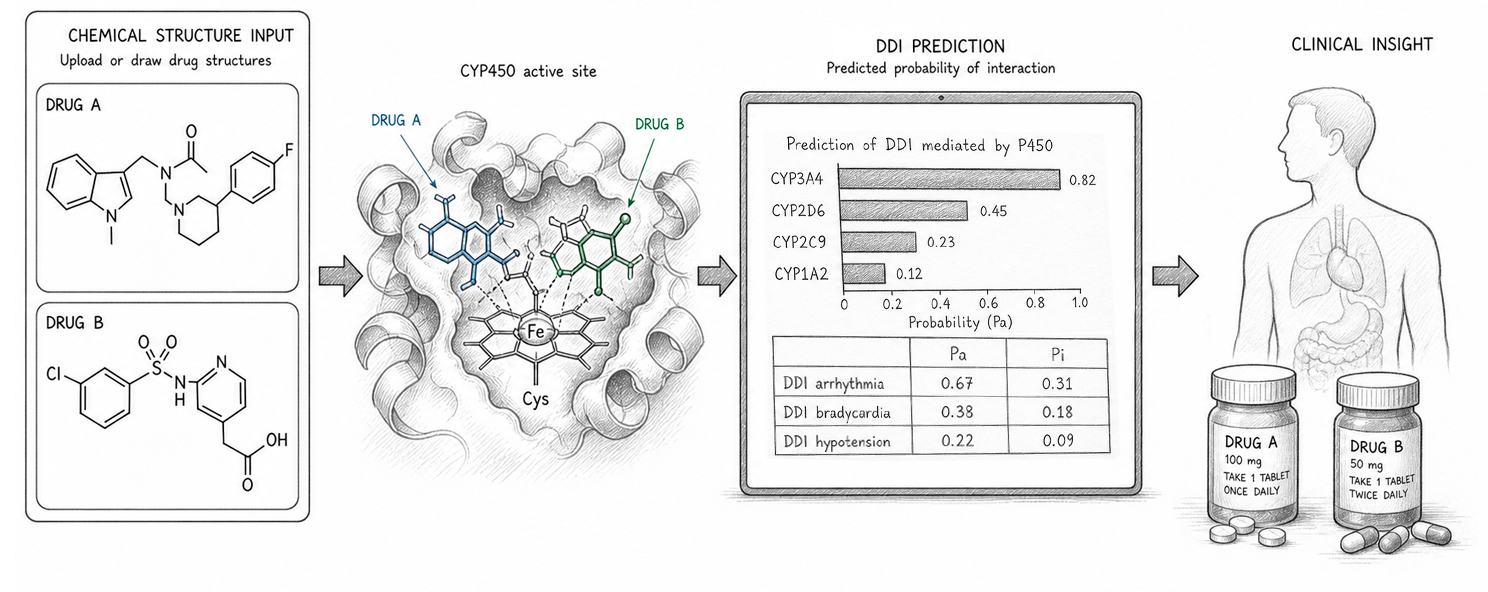
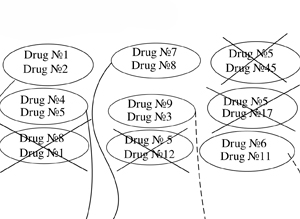
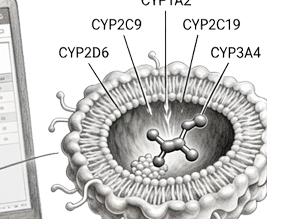
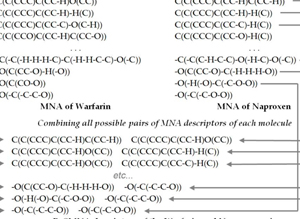
The Way2Drug platform provides researchers and drug developers with a toolkit for in silico prediction of drug–drug interactions, implemented as a web service DDI-Pred. The service delivers probabilistic assessments of possible DDIs directly from the structural formulae of compounds, including substances that have not yet been synthesised or tested in vitro. The service is based on SAR models developed using PASS software and PoSMNA (Pairs of Substances Multilevel Neighbourhoods of Atoms) descriptors. A unique feature of this approach is that a pair of molecules is treated as a single entity: the method directly indicates the possibility of DDI for a specific pair of compounds without requiring prior classification of each substance as a substrate, inhibitor, or inducer of drug-metabolising enzymes. The training set comprises approximately 2,500 DDI records mediated by seven of the most important cytochrome P450 isoforms: CYP1A2, CYP2B6, CYP2C8, CYP2C9, CYP2C19, CYP2D6, and CYP3A4.
The average DDI prediction accuracy, estimated by leave-one-out cross-validation using the IAP (Invariant Accuracy of Prediction) is approximately 0.92, criterion which numerically equivalent to AUC ROC. The highest accuracy was achieved for interactions at the level of CYP2C8 (IAP = 0.98) and CYP1A2 (IAP = 0.95). For the clinically most relevant CYP3A4 the accuracy is 0.93. This makes the method practically applicable to drug discovery and development tasks.
In addition to DDI-Pred, the Way2Drug platform offers the P450-Analyzer web application, which predicts the inhibition and induction of five major cytochrome P450 isoforms (CYP1A2, CYP3A4, CYP2D6, CYP2C9, CYP2C19). Unlike most comparable tools, P450-Analyzer provides not only qualitative classification but also quantitative estimates of pIC50 values for potential inhibitors, enabling the distinction between strong, moderate, and weak inhibitors at the virtual screening stage.
Separate area of application is the prediction of adverse cardiovascular reactions caused by DDI. Using PASS algorithms and PoSMNA descriptors, models have been developed for predicting six of the most serious cardiovascular adverse drug reactions such as arrhythmia, tachycardia, bradycardia, QT interval prolongation, hypertension, and hypotension. The accuracy of the consensus models by AUC criterion exceeds 0.90 for all six conditions, and the applicability of the described approach has been confirmed by retrospective analysis against published literature data.
The Way2Drug platform has already been successfully applied to the analysis of clinically relevant drug combinations. In particular, the DDI-Pred service was used to predict and experimentally confirm the nature of the interaction between omeprazole and erythromycin during H. pylori eradication therapy: the maximum ΔP value was obtained for CYP3A4, which is consistent with the results of electrochemical experiments in vitro. Similarly, DDI prediction was demonstrated for the warfarin/naproxen pair, which has the most probable interaction via CYP2C9 (DP = 0.364)
The Way2Drug DDI prediction tools offer a number of key advantages over traditional approaches. First, the methods are applicable to new, not-yet-synthesised compounds, requiring only a structural formula as input. Second, DDI is predicted directly for pairs of molecules, without intermediate assumptions about the role of each individual substance as a substrate, inhibitor, or inducer. The results are presented as a probabilistic assessment of the likelihood of DDI manifestation, with identification of the specific CYP isoform most likely to be involved. The service is freely accessible via a web browser, and supports structural formulae in SMILES and MOL file formats, as well as input through the built-in structure editor. Regulatory agencies, including the FDA, require preliminary screening of new drug candidates for CYP interactions prior to first-in-human studies, and the Way2Drug tools enable such screening rapidly and with high accuracy at the earliest stages of drug discovery.

© 2011 - 2026 Way2Drug. All rights reserved.


