
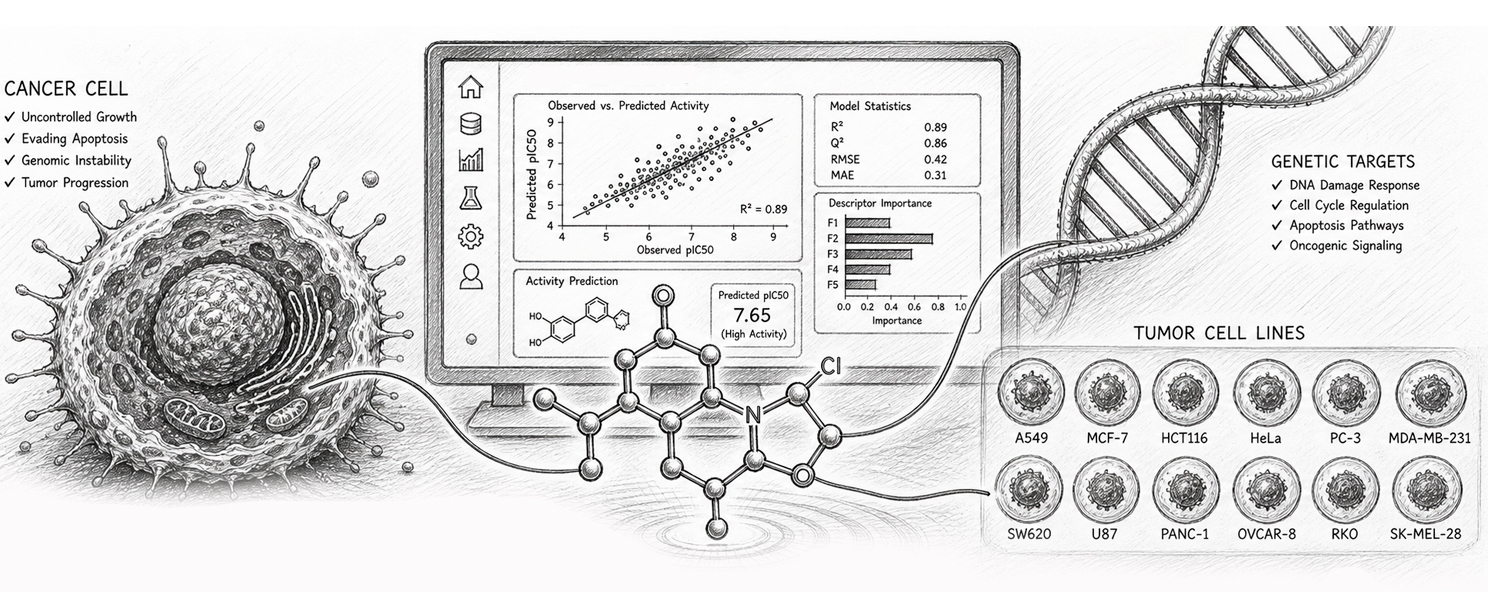
Cancer remains one of the leading causes of mortality worldwide, and the development of new anticancer drugs demands enormous time and financial resources. The Way2Drug platform offers a comprehensive suite of computational tools that significantly accelerate the preclinical stage of oncological research. These tools facilitate everything from virtual compound screening to the prediction of molecular mechanisms of action and cytotoxicity against specific cancer cell lines.
CLC-Pred - the platform's flagship oncology service that covers cell lines spanning 27 different tissue/organ types, including breast, lung, colon, liver, and melanoma, among others. It is particularly valuable for drug repositioning and virtual anticancer screening, allowing researchers to identify candidate compounds with selective cytotoxicity across diverse tumor types before costly experimental testing. Importantly, the inclusion of normal cell line predictions enables early safety assessment of drug candidates, helping to flag compounds likely to be toxic to healthy tissues. Since its launch in 2016, the service has been used by independent research groups worldwide for the assessment of cytotoxicity of natural and synthetic compounds.
To further develop the CLC-Pred web service, we have launched a new version called CLC-Pred 2.0,which represents a substantially expanded version of the service. The training set more than doubled, growing to 128,545 structures (ChEMBL + PubChem), and coverage was expanded to include 391 tumor cell lines and 47 normal cell lines. A key innovation is the addition of two new prediction modes: cytotoxicity against the NCI60 panel at three activity thresholds (GI50: 1, 10, and 100 nM), and prediction of 2,170 molecular mechanisms of action (trained on 656,011 structures, AUC 0.979), enabling users to simultaneously obtain both phenotypic and mechanistic information about a compound.
BC CLC-Pred — a specialized application for breast cancer — provides simultaneous quantitative (IC50 and GI50) and qualitative cytotoxicity predictions against nine breast cancer cell lines (T47D, ZR-75-1, MCF7, BT-20, and others). The service has been validated using paclitaxel as a reference compound. BC CLC-Pred correctly predicted broad-spectrum cytotoxic activity across most supported cell lines, confirming the practical reliability of the models for known antitumor agents.
PASS Online predicts more than 4,000 types of biological activity, including antitumor effects, influence on molecular targets, and mechanisms of carcinogenicity. The PASS technology underpins all oncological predictive services of the platform.
Way2Drug services are actively used by leading research groups worldwide. platform resources were employed for the cheminformatic identification of small molecules targeting acute myeloid leukemia (AML), with subsequent experimental validation in C. elegans models and human cells. Our models were also used to identify novel mitochondria-targeting compounds that selectively kill human leukemia cells. platform services were applied to predict the cytotoxicity of phytoadaptogenic compositions based on Chinese magnolia vine (Schisandra chinensis) against bladder cancer cells, as well as in the development of preventive oncology formulas based on schisandrin and schisantherin A. Proteomic analysis of mucositis mechanisms induced by 5-fluorouracil - one of the key chemotherapeutic agents - was also supported by predictions generated within the Way2Drug platform.
High prediction accuracy - AUC > 0.92 by independent cross-validation for cytotoxicity and > 0.97 for mechanisms of action;
Broad coverage - prediction of activity against hundreds of tumor cell lines from various tissues (leukemia, breast, colon, liver, skin cancer, and others);
Integration with other platform services - CLC-Pred results are complemented by toxicity, metabolism, and ADME predictions within a unified workflow;
Support for natural compounds - CLC-Pred 2.0 works with both synthetic and natural molecules, which is critically important for phytochemical oncology research.
We strive to be useful for medicinal chemists, pharmacologists, oncology researchers, and computational biology specialists interested in accelerating preclinical studies. The platform's capabilities allow users to prioritize compounds for experimental investigation, reduce the costs of screening campaigns, and formulate well-grounded hypotheses about the molecular mechanisms of antitumor action, before the very first laboratory experiment is conducted.

© 2011 - 2026 Way2Drug. All rights reserved.


