
is a freely accessible, web-based database that provides comprehensive, manually curated information on approved low-molecular-weight drug substances collected from national medicine registers and official regulatory documents of 88 countries and regions worldwide. Unlike most existing drug databases that focus exclusively on medicines authorized in the United States and Europe, WWAD aggregates data on drugs approved by regulatory authorities across all major regions, including Asia, Latin America, Africa, and the post-Soviet states, covering substances whose records are often absent from popular resources such as DrugBank.
The database currently contains information on 4,596 unique pharmaceutical substances (Active Pharmaceutical Ingredients, API) interacting with 1,975 molecular targets and covering 1,192 therapeutic indications and 2,669 types of biological activity. Each record includes standardized drug names and synonyms, chemical structure representations (MOL, SMILES, and InChI formats), ATC classification codes, routes of administration, molecular target interactions with source links, therapeutic indications, PDB ligand identifiers, and predicted biological activity spectra generated by PASS software. For registered academic users, WWAD provides access to 3,889 API not classified as narcotic, psychotropic, or toxic compounds under current Russian Federation law.
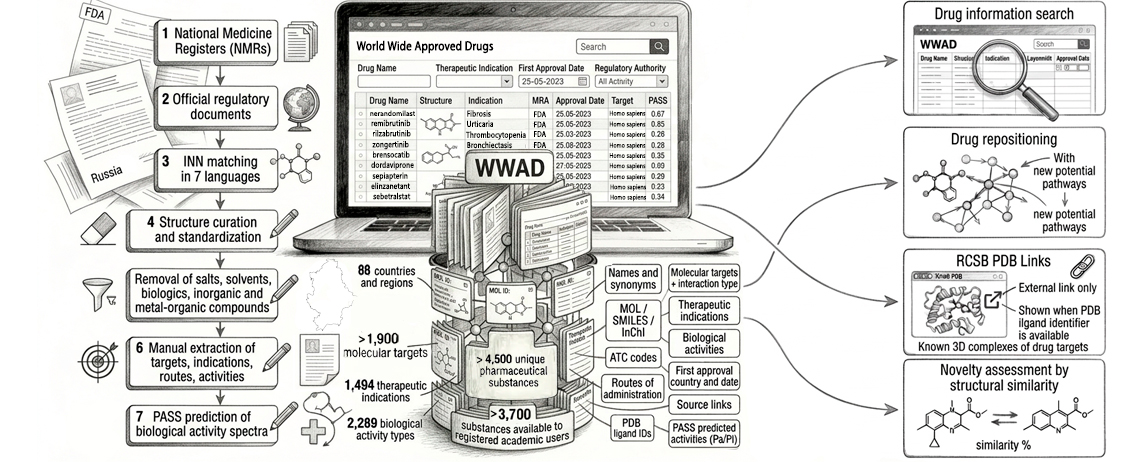
The web interface presents all data in an interactive searchable table with filtering options by drug name, therapeutic indication, regulatory authority, and first-approval date. The standardized chemical structures and unified biological activity terminology make the WWAD data directly applicable in computer-aided drug design (CADD) workflows without additional preprocessing. Key practical applications include knowledge discovery about approved therapeutics, drug repositioning via virtual screening and PASS-based activity prediction, enrichment of structure–activity relationship datasets with globally approved but locally unknown drugs, and novelty assessment of newly synthesized compounds against the global drug chemical space.
WWAD supports a broad range of research and development tasks in the biomedical and pharmaceutical sciences. Researchers can use the database to search for detailed information on approved drugs, including their molecular targets, interaction types, therapeutic indications, and known biological activities, providing a reliable reference grounded in official regulatory documentation. The assembled collection of standardized drug structures enables drug repositioning studies, for example, virtual screening against viral proteases or PASS-based prediction of new therapeutic indications for existing drugs, as demonstrated by the discovery of antineoplastic potential in the antimalarial compound pyronaridine. WWAD also serves as a high-quality training and benchmarking dataset for QSAR and other in silico modeling methods, since all structures are curated, standardized, and free of biologics, inorganic compounds, and metal-organic entities that are typically excluded from such workflows. Finally, the global coverage of the database makes it a unique tool for novelty assessment of newly synthesized compounds, allowing researchers to evaluate structural similarity against the world-wide approved pharmacotherapeutic chemical space rather than just the US/EU-approved fraction.
Access globally approved drugs in one place. WWAD compiles approved drug data from 88 countries and regions into one standardized resource. This gives you access to therapeutics absent from US- or EU-centric databases, including drugs with long clinical histories in Russia, China, Japan, and other countries.
Accelerate drug repurposing and virtual screening. The database provides ready-to-use, preprocessed chemical structures alongside PASS-predicted biological activity spectra, enabling rapid identification of candidate compounds for new indications without time-consuming data cleaning or structure standardization.
Enrich your (Q)SAR and CADD models. By incorporating WWAD data, you can significantly expand the chemical diversity and pharmacological coverage of training sets for structure–activity relationship modeling, improving the quality and generalizability of predictive models.
Evaluate the novelty of your compounds. WWAD allows pairwise structural similarity comparisons against the broadest available set of approved small-molecule drugs, helping you confirm that a newly designed or synthesized compound represents a genuinely novel chemical entity within the global drug space.
Polina Savosina et al. (2024)
WWAD: the most comprehensive small molecule World Wide Approved Drug database of therapeutics.
Frontiers in Pharmacology, 15:1473279.
If you need to use the complete dataset presented in WWAD in your own studies, please contact us to discuss licensing opportunities.
The database does not store user search queries and collects no personal data, handling all queries within the user session.

© 2011 - 2026 Way2Drug. All rights reserved.