
is a web application for the in silico prediction of antibacterial activity of drug-like chemical compounds.
AntiBac-Pred classifies any input chemical structure as a potential growth inhibitor or non-inhibitor against 353 different bacterial strains, covering both antibiotic-resistant and non-resistant forms. This breadth distinguishes it from previously available tools, which were limited to a handful of bacterial targets or specific compound classes such as peptides.
The service is built on the PASS (Prediction of Activity Spectra for Substances) software, which employs a modified Naive Bayes algorithm combined with MNA (Multilevel Neighborhoods of Atoms) descriptors to capture structure–activity relationships. The training set was compiled from ChEMBL ver. 24. In extracting and curating was obtain Minimum Inhibitory Concentration (MIC) data for 41,065 distinct chemical structures across 436 bacterial strains; only strains with a Leave-One-Out Cross-Validation (LOO CV) ROC AUC ≥ 0.75 were retained, resulting in 353 final endpoints. The average ROC AUC across all models is 0.93, indicating high predictive accuracy.
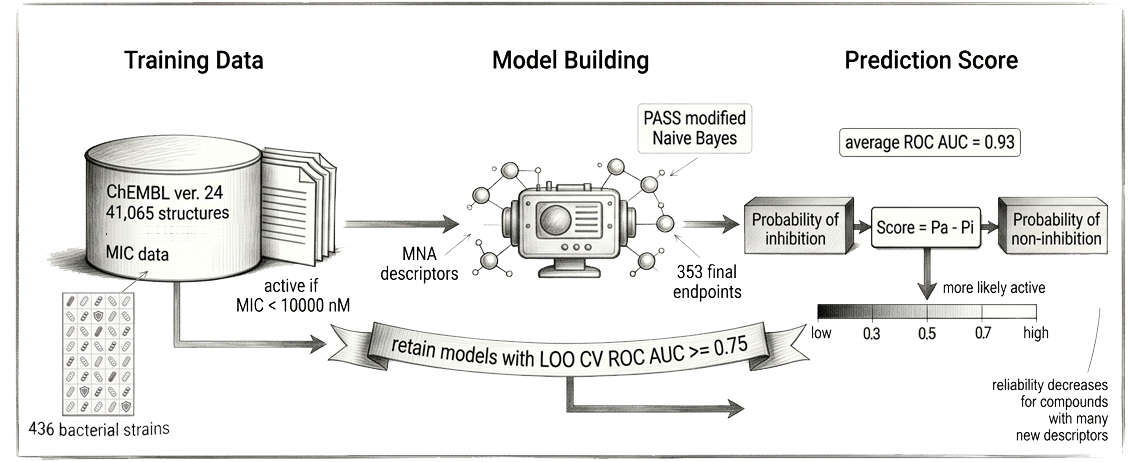
A user submits a chemical structure in one of two ways: entering it as a SMILES string or text of MDL MolFile. After clicking "Predict," the server computes the growth's inhibition of one or more of 353 bacteria in concentration below the 10000 nM. The score for each compound is expressed as a difference between probabilities for chemical compound to inhibit and to do not inhibit the growth of the particular bacteria, which are computed using PASS software based on the existing data. The higher confidence means the higher chance of the positive prediction to be true. Next to the score, you will find a link to Chemble’s entry for that specific bacterium, which will allow you to correlate the prediction results more closely with existing data on the microorganism.
AntiBac-Pred can be directly integrated into the early stages of drug discovery workflows. Researchers can submit novel synthetic compounds, natural products, or drug repurposing candidates to rapidly prioritize structures with the highest predicted antibacterial potential before committing resources to laboratory experiments. For example, a medicinal chemist designing a new series of heterocyclic scaffolds can screen an entire virtual library against all 353 bacterial strains in minutes, filtering out low-confidence candidates and focusing synthesis efforts on the most promising hits. The exported results table can be directly used to plan targeted microbiological assays against specific resistant or non-resistant strains of interest.
Our study with acetyl sulfisoxazole, an FDA-approved antibacterial not included in ChEMBL, demonstrated that AntiBac-Pred correctly identified Escherichia coli (strain K12) as susceptible. It also generated additional experimentally testable hypotheses for other strains. A second case study confirmed that the tool successfully guided selection of thiadiazoline analogs for experimental testing, with moderate confirmed activity against E. coli.

Broad strain coverage in a single query - unlike most freely available tools limited to one or a few bacterial targets, AntiBac-Pred simultaneously evaluates activity against 353 strains, including clinically critical antibiotic-resistant forms such as resistant Stenotrophomonas maltophilia and Staphylococcus species, saving significant time during hit identification.
Reliable, well-validated predictions - with an average LOO CV ROC AUC of 0.93 across all models and a transparent applicability domain cutoff, the service provides statistically grounded confidence scores (Pa − Pi) rather than simple binary outputs, enabling informed decision-making on which compounds deserve experimental follow-up.
Supports resistance-aware prioritization - by explicitly distinguishing resistant from non-resistant bacterial strains in its training data and predictions, AntiBac-Pred helps researchers design compounds with novel modes of action, directly addressing the global challenge of antimicrobial resistance and aligning with current regulatory incentives such as the FDA's LPAD pathway.
Pavel V. Pogodin et al. (2019)
AntiBac-Pred: A Web Application for Predicting Antibacterial Activity of Chemical Compounds.
Journal of Chemical Information and Modeling, 59(11):4513-4518.
If you need to evaluate a large dataset, or if you need to maintain confidentiality of structural formulas transmitted via unsecured data channels, you can contact us to discuss the licensing opportunities.

© 2011 - 2026 Way2Drug. All rights reserved.