
(Reacting Atoms Predictor) is a web service that predicts which atoms in a drug-like molecule are most likely to undergo specific biotransformation reactions. This effectively enables the generation of metabolite structures from 2D molecular formulas.
The tool predicts reacting atoms, defined as the single atoms in a substrate molecule that are chemically modified during a metabolic reaction, for nine major classes of human xenobiotic biotransformations :
Cytochrome P450-mediated: aliphatic hydroxylation, aromatic hydroxylation, N-oxidation, S-oxidation, C-oxidation, N-dealkylation, O-dealkylation;
UGT-mediated: N-glucuronidation, O-glucuronidation.
This goes beyond classical "site of metabolism" (SOM) prediction by identifying a precise atom rather than an ambiguous molecular region, which makes it possible to computationally reconstruct the full structure of the predicted metabolite.
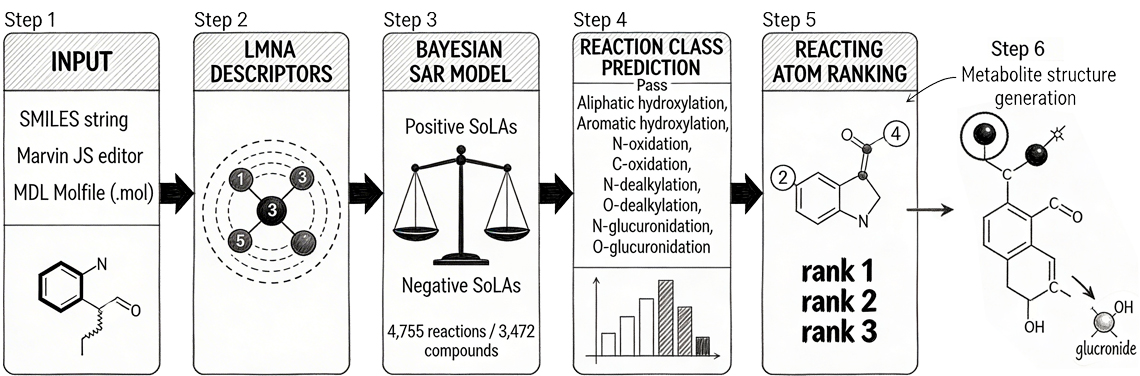
Users can submit a molecular structure in three ways: (1) drawing directly in the embedded Marvin JS editor, (2) pasting a SMILES string, (3) uploading an MDL/Biovia Molfile (.mol)
The web service first predicts the probability spectrum of applicable biotransformation reaction classes for the query molecule using PASS-based SAR analysis. Clicking on any reaction class then displays a ranked list of candidate reacting atoms highlighted on the 2D structure. Results can be exported as .sdf or .pdf files.
Because each supported reaction class has a known structural transformation rule (e.g., addition of –OH for hydroxylation, removal of an alkyl group for dealkylation), predicting the reacting atom is effectively equivalent to predicting the metabolite structure.
By predicting how atoms will react before synthesis, researchers can anticipate which structural fragments of a candidate molecule will be metabolized. This allows medicinal chemists to block vulnerable sites, reduce metabolic clearance, or design prodrug moieties that release an active form upon biotransformation. The service is also valuable for interpreting LC-MS/MS metabolite profiling data: predicted reacting atoms guide the assignment of observed mass shifts (+16 Da for hydroxylation, +176 Da for glucuronidation, etc.) to specific positions in the molecule. Additionally, since reactive metabolites formed via C-oxidation or N-oxidation can bind covalently to proteins and cause idiosyncratic toxicity, early RA prediction supports safety flagging of lead compounds well before in vitro ADMET testing is conducted.

Metabolite structure generation at zero synthetic cost - the precise reacting atom output, combined with known transformation rules, reconstructs full metabolite structures in silico, making it an ideal upstream module to feed into your MetaStab-Analyzer or ADVERPred workflows for assessing metabolite stability and adverse effects.
Toxicity risk profiling of natural products - for phytochemicals with poorly characterized metabolic fates, RA prediction helps identify which atoms undergo N-oxidation or C-oxidation to form potentially mutagenic or reactive intermediates, directly supporting Ames mutagenicity and genotoxicity risk assessment of plant-derived compounds.
High cross-validated predictive performance across diverse reaction classes - the models were rigorously validated using both leave-one-out and 20-fold cross-validation on a dataset of 4,755 reactions covering 3,472 structurally diverse compounds from the Biovia Metabolite Database, achieving an average IAP of 0.96.
Anastasia V. Rudik et al. (2016)
Prediction of reacting atoms for the major biotransformation reactions of organic xenobiotics.
Journal of Cheminformatics, 8:68.
If you need to evaluate a large dataset, or if you need to maintain confidentiality of structural formulas transmitted via unsecured data channels, you can contact us to discuss the licensing opportunities.

© 2011 - 2026 Way2Drug. All rights reserved.