
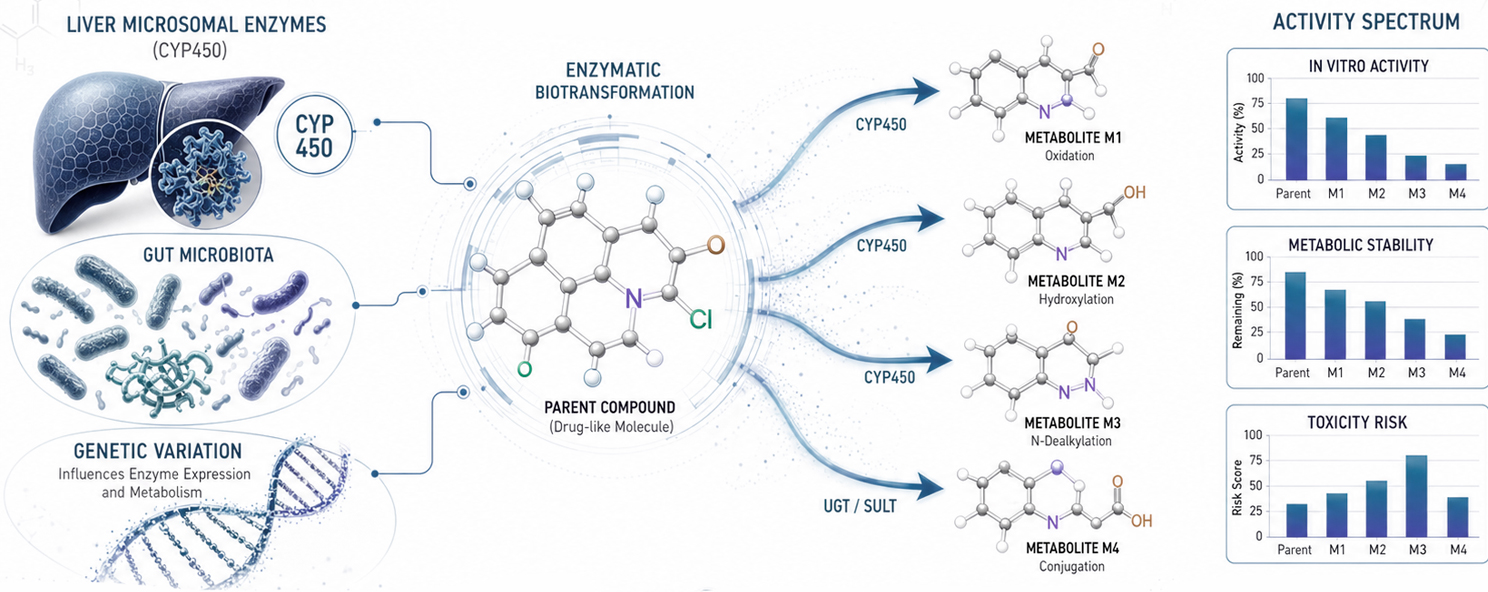
The Way2Drug platform provides a suite of web-based tools for studying the biotransformation and metabolism of drug and drug-like compounds, integrating prediction of metabolic pathways, assessment of the biological activity of metabolites, analysis of metabolic stability, and access to specialized databases on xenobiotic transformations.
In the context of drug biotransformation and metabolism of organic compounds, the platform makes it possible to treat a drug substance not as a static structure, but as a dynamic system whose properties change following enzymatic transformations in the human body and under the influence of the gut microbiota. This approach is important because metabolites may retain pharmacological activity, lose it entirely, or, conversely, acquire new therapeutic and toxicological effects.
One of the platform's key solutions is MetaTox 2.0, designed to predict probable biotransformations of xenobiotics and to subsequently assess the biological activity spectra of the parent compound and its resulting metabolites. In the updated version, the analysis covers 1,957 types of biological activity, enabling a more comprehensive investigation of the potential pharmacological and toxicological consequences of metabolism at the earliest stages of research.
The MetaPASS 2024 service extends this approach by visualizing the probable biological activity spectra of organic compounds taking into account their metabolism. The new version features an expanded set of known metabolic pathways, structural analog searching based on MNA and QNA descriptors, identification of compounds with a high probability of target activity, and treemap visualization of results. These features facilitate interpretation of complex activity profiles for parent compounds and their metabolites.
For the assessment of pharmacokinetic properties, the platform also draws on metabolic stability prediction. In the study dedicated to the use of the PASS and GUSAR programs, metabolic stability is treated as a measure of a compound's susceptibility to biotransformation, linked to parameters such as half-life and clearance; this makes the corresponding models valuable for early-stage selection of compounds with a more favorable ADME profile.
A significant advantage of Way2Drug is the integration of predictive services with experimental data on metabolic transformations. The HGMMX database was developed to accumulate information on the metabolism of drug-like compounds by the human gut microbiota, which is particularly relevant for compounds whose bioavailability, efficacy, or toxicity depends on microbiome-mediated transformations. We also draw attention to gut microorganisms, which can contribute to the transformation of some xenobiotics and drug-like compounds. MDM-Pred supports structure-based research on potential microbiota-mediated metabolism.
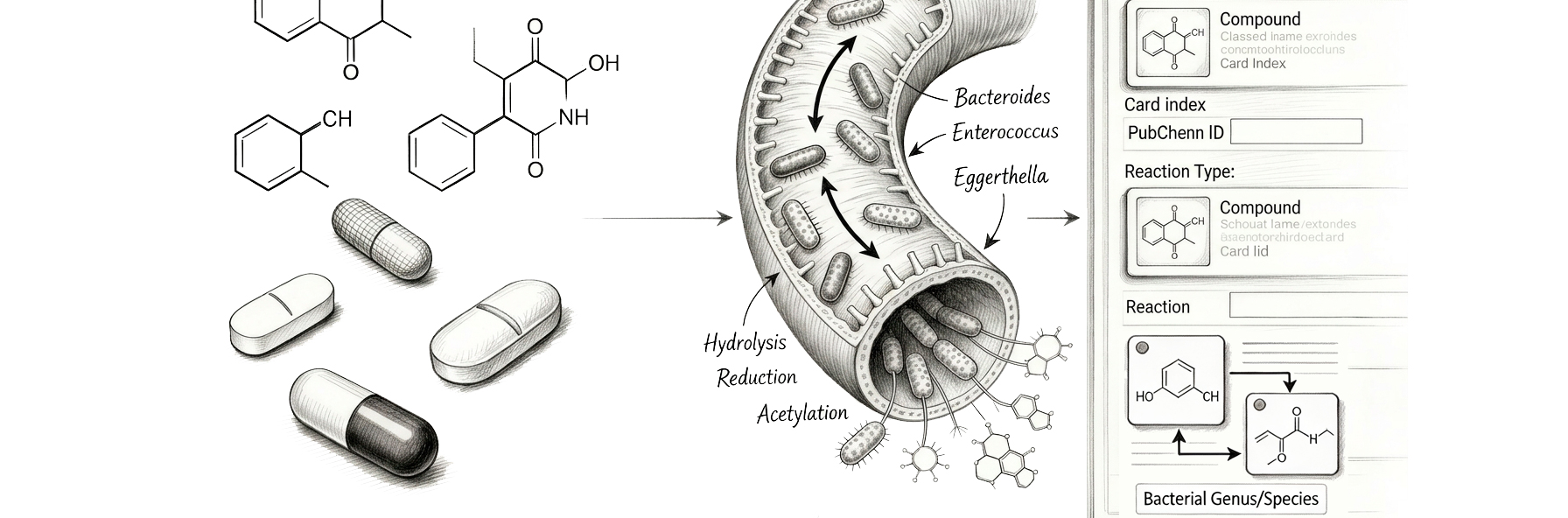
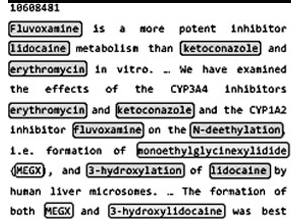
Another important direction involves the automated extraction of knowledge from the scientific literature. We proposed an approach to extracting data on parent compounds and their metabolites from scientific abstracts, while the XenoMet corpus established a specialized text collection for the automated extraction of information on xenobiotic metabolites, which forms the foundation for expanding knowledge bases and improving the completeness of the platform's digital resources.
Thus, the application of the Way2Drug platform encompasses several interrelated tasks: prediction of metabolic pathways, assessment of metabolite activity and toxicity, analysis of metabolic stability, accounting for gut microbiota effects, and extraction of novel biotransformation data from scientific publications. This comprehensive in silico approach helps to accelerate early drug discovery, identify potential risks, and uncover new opportunities for structural optimization and compound repositioning.


© 2011 - 2026 Way2Drug. All rights reserved.


