
(Drug-Drug Interactions Prediction) is web service that uses computer models to predict potential drug-drug interactions from the chemical structures of two input compounds. Importantly, this is not a standard drug interaction checker. Unlike clinical databases, which retrieve known DDI records, this service uses in silico predictive models that can assess interactions for virtual compounds that have not yet been synthesized.
The prediction models are based on the PASS (Prediction of Activity Spectra for Substances) approach combined with PoSMNA (Pairs of Substances Multilevel Neighborhoods of Atoms) descriptors, which encode the structural features of compound pairs as a unified representation suitable for machine learning. The training sets were built from literature data, and model performance is evaluated using a "Leave all pairs out" cross-validation procedure that yields IAP (Invariant Accuracy of Prediction) values, ensuring robust and unbiased performance estimates.
You can submit a pair of compounds in three ways: by drawing structures in a JSME applet, entering SMILES strings, or typing drug names. After clicking the "Predict DDI" button, results appear immediately across several tabs, each corresponding to a distinct predictive model.
The service currently covers four major DDI prediction tasks:
DDI severity / risk level - estimates the overall clinical risk of combining two compounds.
Cytochrome P450-mediated interactions - predicts DDI at the level of various CYP isoforms involved in drug metabolism
Mechanisms of drug interaction - identifies possible mechanistic pathways through which interactions may occur.
Adverse cardiovascular effects - assesses potential cardiotoxic consequences of a drug combination.
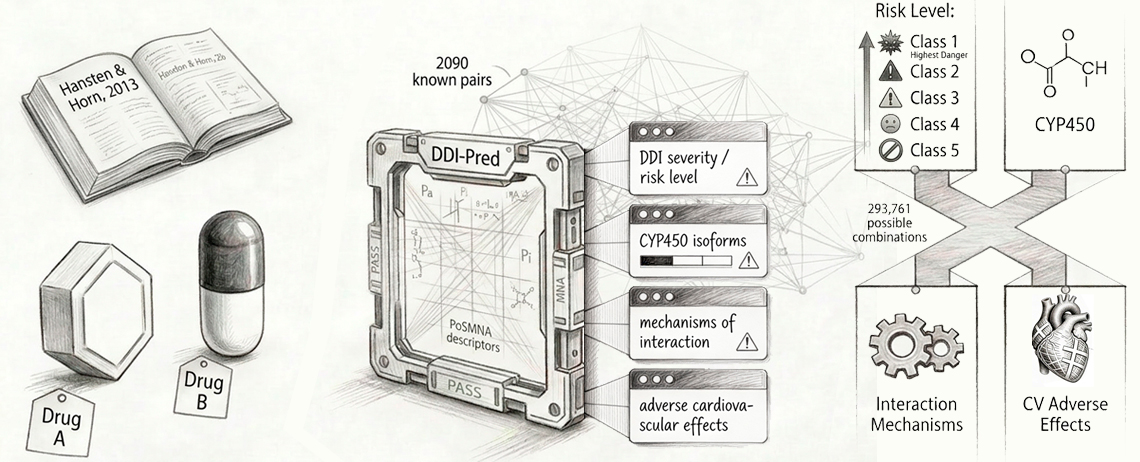
The DDI-Pred service predicts the severity of drug-drug interactions using the OpeRational ClassificAtion (ORCA) system, which divides all possible interactions into five risk classes. These classes range from the most clinically dangerous to the absence of any interaction:
Class 1 - Contraindicated: the combination must be avoided; co-administration poses an unacceptable risk.
Class 2 - Provisionally contraindicated: the combination is generally not recommended and should only be considered under exceptional circumstances.
Class 3 - Conditional: the interaction is clinically significant, but co-administration may be acceptable with careful monitoring and dose adjustments.
Class 4 - Minimal risk: the combination produces only minor effects that are unlikely to require clinical intervention.
Class 5 - No interaction: no pharmacokinetic or pharmacodynamic interaction is expected between the two compounds.
In addition to ORCA severity classes, the service also estimates the probability of five major adverse drug effects that may result from a DDI: myocardial infarction, arrhythmia, cardiac failure, hepatotoxicity, and nephrotoxicity.
The training set used to build the prediction models comprised 2,090 drug pairs sourced from the handbook "Drug Interaction Analysis and Management" (Horn & Hansten, 2013), distributed across all five ORCA classes. The PASS-based algorithm was applied to predict classes 1–3, representing the most clinically relevant and dangerous interactions, while the overall average prediction accuracy across all five classes is approximately 0.75, and reaches 0.84 when the model is restricted to the three most severe classes.
DDI-Pred is particularly well-suited for early-stage drug discovery and preclinical safety assessment, where experimental interaction data are unavailable. Researchers can submit pairs of novel or virtual compounds to rapidly screen for potentially hazardous combinations before committing to costly in vitro or in vivo studies. The service is equally applicable in pharmacology and clinical pharmacy, allowing practitioners to evaluate combinations of approved drugs in contexts not yet covered by existing interaction handbooks. Because the tool accepts SMILES strings and drawn structures, it integrates naturally into standard cheminformatics workflows alongside other computational ADMET profiling tools.
Screen novel drug candidates early. The service can assess interaction risk for compounds that have never been synthesized or tested, enabling proactive safety decisions at the design stage rather than after extensive investment in synthesis and testing.
Go beyond existing interaction databases. Unlike conventional DDI checkers limited to already documented drug pairs, DDI-Pred generates structure-based predictions for any combination of molecules, including those absent from clinical handbooks.
Cover multiple risk dimensions in one run. A single submission provides severity class predictions, CYP-mediated interaction estimates, mechanistic pathway assessments, and adverse cardiovascular effect probabilities, offering a complete safety profile without the need for multiple tools.
Alexander Dmitriev et al. (2019)
Prediction of Severity of Drug-Drug Interactions Caused by Enzyme Inhibition and Activation.
Molecules, 24(21), 3955.
If you need to evaluate a large dataset, or if you need to maintain confidentiality of structural formulas transmitted via unsecured data channels, you can contact us to discuss the licensing opportunities.

© 2011 - 2026 Way2Drug. All rights reserved.