
is a bioinformatics tool designed for the in silico prediction of the mutagenicity of chemical compounds in the Ames test. Unlike classical binary models, this service evaluates mutagenic potential individually for 69 different strains of Salmonella typhimurium and also provides a prediction of overall nonspecific mutagenicity.
The web application is based on structure-activity relationship (SAR) models developed using the algorithms of the PASS 2024 program. The system uses MNA (Multilevel Neighborhoods of Atoms) descriptors to analyze structural formulas and calculates two key indicators: the probability of the presence of mutagenic activity (Pa) and the probability of its absence (Pi). The models were trained on a representative dataset of 7,535 chemical compounds and demonstrated high average invariant accuracy of prediction (IAP), reaching 0.944 for specific strains and 0.962 for nonspecific mutagenicity.
Users can input the chemical structure of a compound in three ways: by drawing it in the built-in Marvin JS editor, by using SMILES notation, or through text-based compound name search. The final predictions are displayed as an interactive table that supports filtering by strain name and sorting by probability values. For further processing or inclusion in scientific documentation, the results can be exported in convenient formats such as CSV, PDF, or XLSX.
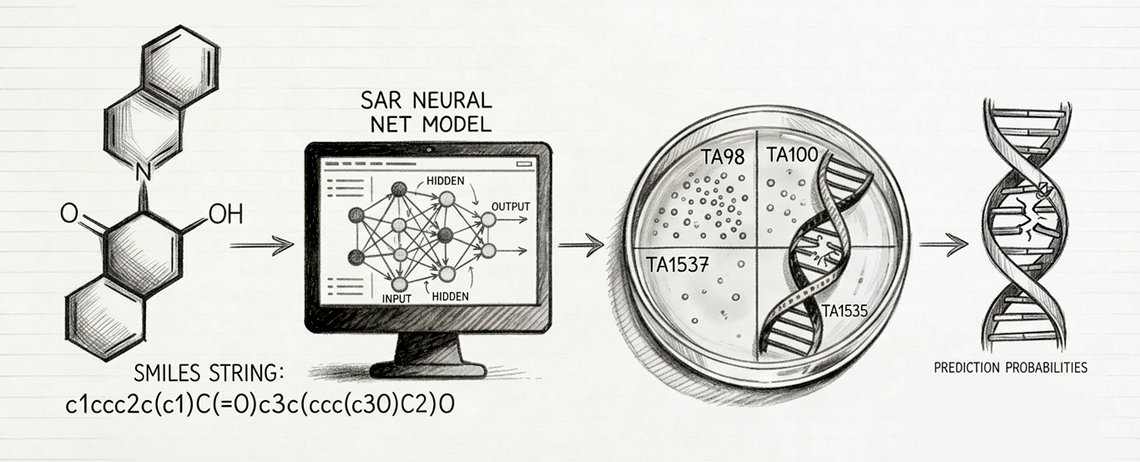
The detailed strain-specific profile allows toxicologists and medicinal chemists to more accurately identify the molecular mechanisms of potential DNA damage at the earliest stages of drug design. This approach makes it possible to prioritize candidate compounds for subsequent experimental testing more effectively, saving significant laboratory time and resources. Importantly, the use of such validated in silico models is fully consistent with current international regulatory requirements in toxicology, including the ICH M7 and OECD guidelines.

It helps you screen chemical compounds for potential mutagenicity at an early stage, so you can prioritize the most relevant molecules before moving to experimental testing.
It provides strain-specific predictions for 69 Salmonella typhimurium strains, together with an overall nonspecific mutagenicity estimate, which gives a more detailed profile than a simple binary prediction.
It supports several input formats, including structure drawing, SMILES notation, and compound name search, making it convenient for everyday use in toxicology and medicinal chemistry workflows.
Alexander V. Dmitriev et al. (2025)
SAR Modeling to Predict Ames Mutagenicity Across Different Salmonella typhimurium Strains.
Pharmaceuticals (Basel), 18(12):1853.
doi: 10.3390/ph18121853
If you need to evaluate a large dataset, or if you need to maintain confidentiality of structural formulas transmitted via unsecured data channels, you can contact us to discuss the licensing opportunities.

© 2011 - 2026 Way2Drug. All rights reserved.