
compiles and presents key genes, biological pathways, and master regulators associated with the development of major depressive disorder, derived from a comprehensive multi-omics analysis integrating genomic and transcriptomic data.
The database contains structured information on genes identified through a transcriptome-wide association study (TWAS) conducted across 15 brain regions, yielding 371 high-confidence major depressive disorder-associated genes, 269 of which were novel compared to prior TWAS studies. The genomic foundation rests on GWAS summary statistics from the large-scale meta-analysis by Howard et al. (807,553 individuals), from which 4,625 significant SNPs were mapped to genes using FUMA and Ensembl VEP. Gene annotations are enriched with functional data from KEGG, Reactome, and UniProt databases.
Genes in the database are organized into biologically meaningful categories, including:
Metabolic enzymes - involved in glutamate, glycine, fatty acid, glycan, phospholipid, and kynurenine metabolism;
Gene expression regulators - chromatin remodelers (INO80 complex, Polycomb group proteins), RNA splicing factors, translation regulators, and ribosomal proteins;
Cellular process proteins - cytoskeletal motors (kinesins, dyneins), vesicular transport components (SNARE complex), cell adhesion molecules (integrins, protocadherins);
Receptors and ligands - neurotransmitter receptors (serotonin, dopamine, glutamate, GABA), immune proteins (butyrophilins, complement factors, interleukins), and hormones/growth factors;
Master regulators - transcription factors and their upstream regulators (kinases, receptors, ligands) that orchestrate the transcriptional landscape altered in major depressive disorder, including sex-specific regulators such as AMH, GDF9, FZD4, and FZD7.
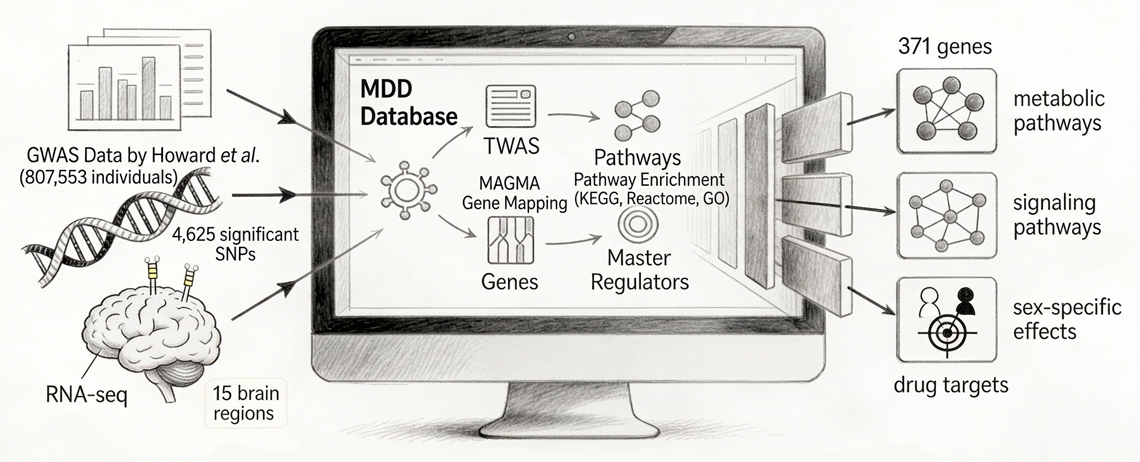
A notable feature of the database is its incorporation of sex-specific transcriptional data. We carried out differential expression analyses separately for males and females using postmortem brain RNA sequencing datasets (GEO: GSE80655, GSE101521, and GSE102556). These analyses revealed that many genes and pathways are altered in opposite directions between the sexes, which is a critical consideration for major depressive disorder diagnosis and pharmacotherapy.
The MDD database serves as a curated reference resource for researchers working on the molecular basis of depression, facilitating target identification for antidepressant drug discovery. By linking SNP-driven gene expression changes to downstream biological processes and master regulators, the database supports hypothesis generation for sex-stratified treatment strategies and the identification of novel drug targets beyond the classical monoamine system.
The MDD database can be directly applied in computational drug discovery workflows targeting major depressive disorder. Researchers can query the database to retrieve MDD-associated genes organized by functional categories - metabolic, signaling, transcriptional, or immune and use them as candidate targets for virtual screening or PASS-based activity prediction available elsewhere on the Way2Drug platform. Clinicians and pharmacologists may cross-reference identified master regulators and sex-specific gene expression profiles with existing antidepressant mechanisms to rationalize polypharmacology or repurposing strategies. The database also supports pathway enrichment analysis, as its gene sets are directly compatible with KEGG, Reactome, and Gene Ontology frameworks, enabling seamless integration into standard bioinformatics workflows.

For drug discovery researchers: MDD provides a curated, evidence-graded list of 371 genomically and transcriptomically validated target genes, drastically reducing the search space for novel antidepressant target identification compared to unfiltered genome-wide datasets.
For translational scientists and pharmacologists: The database contains sex-stratified gene expression data that can be used to develop sex-specific pharmacological hypotheses. This is an underexplored dimension of antidepressant therapy that may explain why drugs affect male and female patients differently.
For systems biologists and bioinformaticians: The master regulator layer of the database links upstream transcription factors, kinases, and receptors to downstream MDD-associated gene sets. This provides a network-level entry point for identifying high-impact intervention nodes and designing combination therapy strategies.
Sergey M. Ivanov et al. (2025)
Analysis of Genomic and Transcriptomic Data Revealed Key Genes and Processes in the Development of Major Depressive Disorder.
International Journal of Molecular Sciences, 26(19), 9557.
doi: 10.3390/ijms26199557
If you need to use the complete dataset presented in MDD in your own studies, please contact us to discuss licensing opportunities.
The database does not store user search queries and collects no personal data, handling all queries within the user session.

© 2011 - 2026 Way2Drug. All rights reserved.