
is a web applicationfor the computational prediction of protein secondary structures (SSPs).
The tool is built upon a novel sequence–structure–property relationship (SSPR) modeling approach implemented in MultiPASS software. Protein or peptide sequences are first converted into structural formulae (MOL V3000 format), after which atom-centric MNA (Multilevel Neighborhoods of Atoms) descriptors at the 9th level are generated to describe molecular fragments. A Bayesian classifier then establishes relationships between these descriptors and eight SSP types: α-helix (H), 31010-helix (G), π-helix (I), polyproline II-helix (P), β-strand (E), unstructured coil (C), turn (T), and bend (S). The models were trained on a dataset of over 335,000 annotated SSP sequences from 37,000 proteins extracted from the Protein Data Bank.
The SSPR models achieved a mean AUC of 0.902 via leave-one-out cross-validation. On independent, external test sets (ASTRAL and CB513), the best models achieved an area under the curve (AUC) value of 0.860 and 0.889, a Q8 accuracy of 70.92% and 74.74%, and a Q3 accuracy of 77.32% and 78.78%, respectively. These results are competitive with those of many state-of-the-art deep learning methods.
The web application supports two input modes:
Protein mode - accepts a UniProt ID or a protein sequence in FASTA format; the tool automatically generates all possible subsequences (4–30 amino acids) via a sliding window, predicts SSPs for each, and annotates each residue position with the highest Pa–Pi confidence score;
Peptide mode - accepts up to 100 peptide sequences at once, converting each directly to its structural formula for prediction; useful for analyzing the effect of amino acid substitutions on secondary structure.
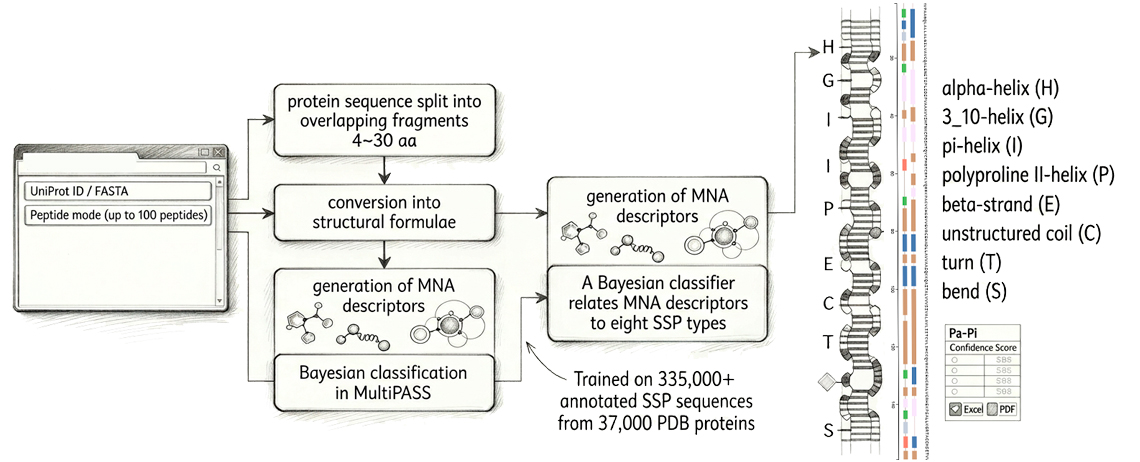
Results are displayed in a color-coded format clearly distinguishing all eight SSP types (or a simplified three-class view: helices, strands, coil). By default, only structures with Pa–Pi > 0.7 are shown, though this threshold can be adjusted. Detailed tabular output includes sequence positions, specific subsequences, predicted SSP types, and Pa–Pi probability scores reflecting prediction confidence. Results can be exported in Excel or PDF format, and the search field within the table allows filtering by sequence or SSP type.
MNA-PSS-Pred can be applied across a broad range of research and clinical tasks where knowledge of protein secondary structure is essential. In drug discovery and pharmacology, the tool helps characterize the structural features of therapeutic peptides and protein targets, supporting the rational design of antibodies, enzyme inhibitors, and biologics where α-helix or β-sheet content is functionally critical. In the fields of medical genetics and clinical bioinformatics, this service allows for a quick evaluation of how specific amino acid substitutions, such as those caused by single nucleotide polymorphisms, affect local secondary structure. This is an important step in identifying pathogenic or drug-resistant genetic variants. For antimicrobial peptide research, Peptide mode allows users to confirm or predict the structural class (α-helical, β-sheet, or mixed) of candidate sequences, since secondary structure type is directly linked to the antimicrobial mechanism of action. In vaccine development, the tool can assist in selecting peptide epitopes with favorable secondary structural properties, helping to ensure immunogenic stability and appropriate conformation for antigen presentation.

No deep learning infrastructure required - unlike computationally demanding state-of-the-art models (WGACSTCN, AttSec, DeepACLSTM), MNA-PSS-Pred runs entirely via a lightweight web interface with no local installation, making it instantly accessible to researchers without specialized hardware or programming skills.
Peptide-level resolution with substitution analysis - the dedicated Peptide mode allows you to submit short sequences or sequence variants and directly compare predicted secondary structure types, making it a practical tool for studying how point mutations or post-translational modifications affect local protein conformation.
Transparent, interpretable confidence scores - each prediction is accompanied by a Pa–Pi probability score, giving you a quantitative measure of confidence for every residue position rather than a simple binary classification, which aids in prioritizing results for experimental follow-up.
Oleg S. Zakharov et al. (2024)
Prediction of Protein Secondary Structures Based on Substructural Descriptors of Molecular Fragments.
International Journal of Molecular Sciences, 25(23), 12525.
If you need to evaluate a large dataset, or if you need to maintain confidentiality of structural formulas transmitted via unsecured data channels, you can contact us to discuss the licensing opportunities.

© 2011 - 2026 Way2Drug. All rights reserved.