
is a web service for predicting T-cell receptor specificity to antigenic epitopes and major histocompatibility complex molecules based on the amino acid sequences of CDR3 regions. Identifying relationships between CDR3 TCR sequences and specific epitopes or major histocompatibility complex types is one of the key challenges in modern immunology. TCR-Pred is based on an original approach. It encodes CDR3 amino acid sequences using MNA (multilevel neighborhoods of atoms) descriptors, which are the same type of descriptors used in the PASS system to predict the biological activity of small molecules. A Naive Bayes classifier algorithm is used to build the structure–activity relationship (SAR) classification models. The service's models were trained on more than 250,000 unique CDR3 TCR sequences drawn from three specialized immunological databases: VDJdb, McPAS-TCR, and IEDB. This extensive dataset ensures broad coverage of receptor–epitope interactions.
The service processes CDR3 sequences from both the α- and β-chains of TCR:
α-chain: prediction of CDR3 interactions with 116 epitopes and 25 major histocompatibility complex types.
β-chain: prediction of CDR3 interactions with 202 epitopes and 28 major histocompatibility complex types.
For each submitted sequence, the service returns the probabilities of its interaction with each of the covered epitopes and major histocompatibility complex types. Model quality was assessed using 20-fold cross-validation: mean AUC values range from 0.857 to 0.884, indicating high predictive performance. TCR-Pred is recommend for T-cell repertoire profiling, immune response studies, and immunotherapy research.
TCR-Pred only requires a raw CDR3 amino acid sequence as input; no structural data or 3D coordinates are necessary. The sequence is automatically converted into MNA molecular fragment descriptors, which capture the local chemical neighbourhood of each atom at multiple levels of depth. These descriptors are then fed into pre-trained Naive Bayes classification models, which compute an individual probability score for each epitope and MHC type in the database, ranking the most likely binding targets for the submitted sequence.
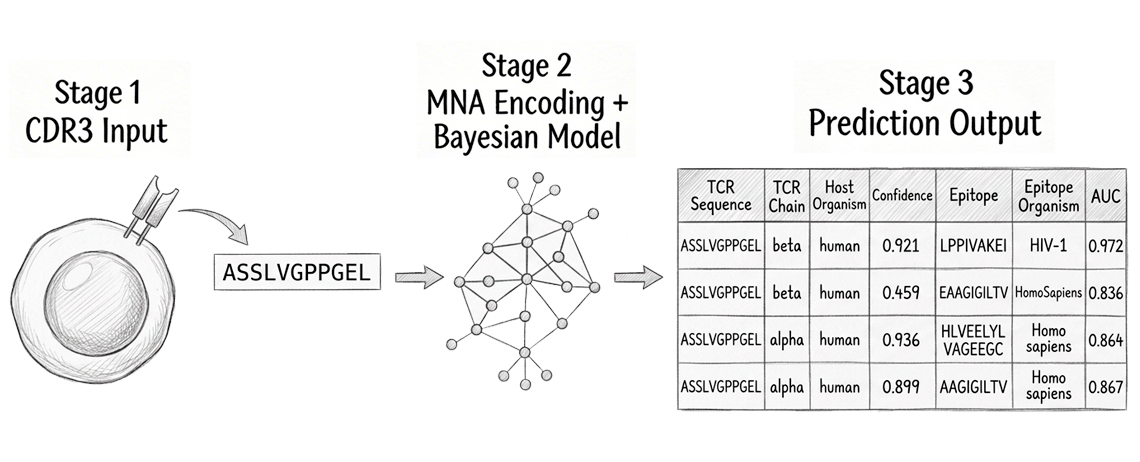
TCR-Pred can be applied across a wide range of research and clinical contexts:
Immune repertoire profiling - characterizing the antigen specificity landscape of TCR sequences obtained from next-generation sequencing (TCR-seq) experiments;
Vaccine and epitope research - identifying which immune cell populations recognize specific pathogen-derived or tumor-associated epitopes;
Autoimmune disease studies - mapping potentially self-reactive TCR clonotypes by screening CDR3 sequences against MHC-presented self-peptides;
Cancer immunotherapy - supporting the selection and engineering of tumor-infiltrating lymphocytes or CAR-T cells by predicting their target specificity prior to experimental validation.

Broad coverage - a single query screens CDR3 sequences against hundreds of epitopes and dozens of MHC types simultaneously, providing a comprehensive specificity profile in one run.
High predictive reliability - independently validated AUC scores of 0.857–0.884 across 20-fold cross-validation confirm that the models perform well above random chance on unseen data.
Applicable to both TCR chains - the service handles α- and β-chain CDR3 sequences independently, allowing researchers to analyze single-chain sequencing data or cross-validate specificity predictions across both chains of the same receptor, which is particularly valuable when full paired-chain sequencing is unavailable.
Anton S. Smirnov et al. (2016)
TCR-Pred: A new web-application for prediction of epitope and MHC specificity for CDR3 TCR sequences using molecular fragment descriptors.
Immunology, 169(4):447-453.
doi: 10.1111/imm.13641
If you need to evaluate a large dataset, or if you need to maintain confidentiality of structural formulas transmitted via unsecured data channels, you can contact us to discuss the licensing opportunities.

© 2011 - 2026 Way2Drug. All rights reserved.