
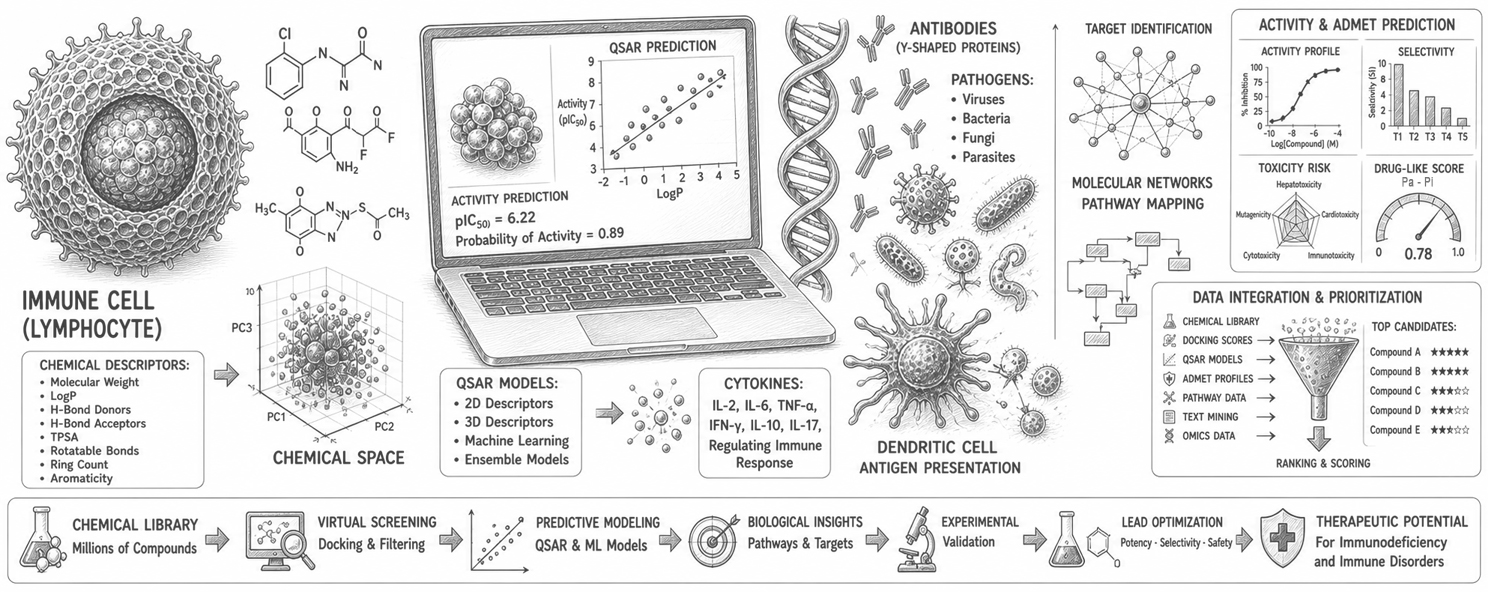
The Way2Drug platform offers specialized tools for studying the molecular mechanisms of immune response, predicting the pathogenicity of genetic variants in primary immunodeficiencies, and analyzing T-cell receptor interactions with antigens. This combination of resources opens new opportunities for researchers in immunology, virology, and personalized medicine.
The web application SAV-Pred enables the prediction of pathogenicity of amino acid substitutions in proteins associated with primary immunodeficiencies. The service covers 25 clinically significant proteins encoded by the genes IL2RG, JAK3, RAG1, RAG2, BTK, FOXP3, ATM, STAT3, NLRP3, MEFV, SERPING1, and others. SAV-Pred models are built on data from 4,825 pathogenic and benign substitutions derived from the ClinVar and gnomAD databases, using the MultiPASS algorithm and MNA descriptors of peptide structural formulas. The average prediction accuracy (AUC by 5-fold cross-validation) is 0.831 ± 0.037.
The practical value of SAV-Pred has been confirmed in real clinical cases: the tool correctly identified the pathogenicity of variants of uncertain significance in the FAS, ELANE, CD40LG, and NLRP3 genes in patients with ALPS, cyclic neutropenia, hyper-IgM syndrome, and Behçet's disease, respectively. The use of SAV-Pred enables clinicians and geneticists to make informed decisions regarding the management of patients with rare hereditary diseases of the immune system.
The web service TCR-Pred is designed for the prediction of interactions between CDR3 sequences of T-cell receptors and antigenic epitopes and MHC alleles. The system is trained on more than 250,000 unique CDR3 sequences from the VDJdb, McPAS-TCR, and IEDB databases; models for α-chains predict interactions with 202 epitopes and 28 MHC types. Models for β-chains predict interactions with 116 epitopes and 25 MHC types. Average AUC values range from 0.857 to 0.884.
TCR-Pred is based on an original approach in which CDR3 sequences are represented as structural chemical formulas using MNA descriptors and the MultiPASS algorithm, enabling their processing by the same methods applied to small molecules within the QSAR modeling framework. The application can be used for T-cell profiling, peptide vaccine development, and adoptive T-cell therapy.
We have demonstrated the applicability of transcriptomic analysis for identifying common molecular mechanisms of immune response disruption across nine different viral infections (CMV, EBV, HTLV-1, HBV, HCV, HIV-1, DENV, SARS-CoV, and SARS-CoV-2). Using an original computational pipeline, master regulators of immune response were identified, receptors on the surface of PBMCs whose modulation may be considered as a strategy for pathogenesis-directed antiviral therapy.
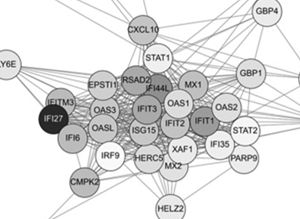
In a separate study relying on the same computational approaches, a transcriptomic analysis of CD8 T-lymphocytes from HIV elite controllers was performed; 22 master regulator receptors were identified, including receptors for interferon-gamma, interleukin-2, and androgen, which may serve as therapeutic targets for slowing HIV disease progression. Results of paired RNA sequencing of PBMCs from HIV-infected patients before and after 24 weeks of antiretroviral therapy demonstrated early suppression of chronic interferon-driven activation and reduced immune exhaustion, evidenced by downregulation of IFI44L, ISG15, STAT1, CD38, and a trend toward decreased PDCD1/PD-1 expression.
The PASS (Prediction of Activity Spectra for Substances) algorithm, which underlies all of the tools listed above, enables the prediction of a broad spectrum of biological activities, including immunomodulatory, antiviral, and anti-inflammatory activities, as well as effects on specific components of both innate and adaptive immune response. This makes PASS applicable for virtual screening of potential immunotropic agents at the preclinical research stage, as well as for the analysis of undesirable immunological effects of compounds under investigation.
Taken together, the computational tools available on the Way2Drug platform (SAV-Pred, TCR-Pred, and PASS) represent a comprehensive suite of in silico approaches covering three complementary directions in immunological research: genomic variant interpretation, immune receptor profiling, and small-molecule activity prediction. These resources are relevant across a broad range of biomedical disciplines, including clinical immunology and medical genetics (pathogenicity assessment of variants in primary immunodeficiencies), vaccinology and adoptive immunotherapy (T-cell receptor — epitope interaction prediction), virology and antiviral drug discovery (identification of host immune regulators and virtual screening of immunotropic compounds), and computational pharmacology (prediction of immunomodulatory and anti-inflammatory activities as part of multi-target drug profiling). The platform is equally suited for fundamental research into immune evasion mechanisms and for applied tasks such as drug repurposing, adverse effect prediction, and the early-stage prioritization of therapeutic candidates targeting the immune system.

© 2011 - 2026 Way2Drug. All rights reserved.


