
is a specialized database of secondary metabolites from medicinal plants included in the State Pharmacopoeia of the Russian Federation and is intended to support research aimed at discovering new natural-product-based pharmaceutical agents. The database contains information on 3,128 phytocomponents identified in 268 medicinal plants from the 14th edition of the Russian Pharmacopoeia. For each compound, the service provides:
physicochemical properties, including molecular weight (MW), AlogP, number of hydrogen bond acceptors and donors (HBA, HBD), number of rotatable bonds (RTB), and polar surface area (PSA);
structural annotations, including Canonical SMILES, InChI, and InChI Key;
experimental data on interactions with 802 human molecular targets (IC50, Ki, EC50), with a total of 13,688 records;
cross-references to PubChem, ChEMBL, and ChEBI.
Each plant is described in terms of taxonomy, species synonyms (533 synonyms were collected), and the phytochemical composition of individual plant parts, which distinguishes Phyto4Health from many analogous resources where compounds are listed for the whole plant without specifying the exact organ or tissue.
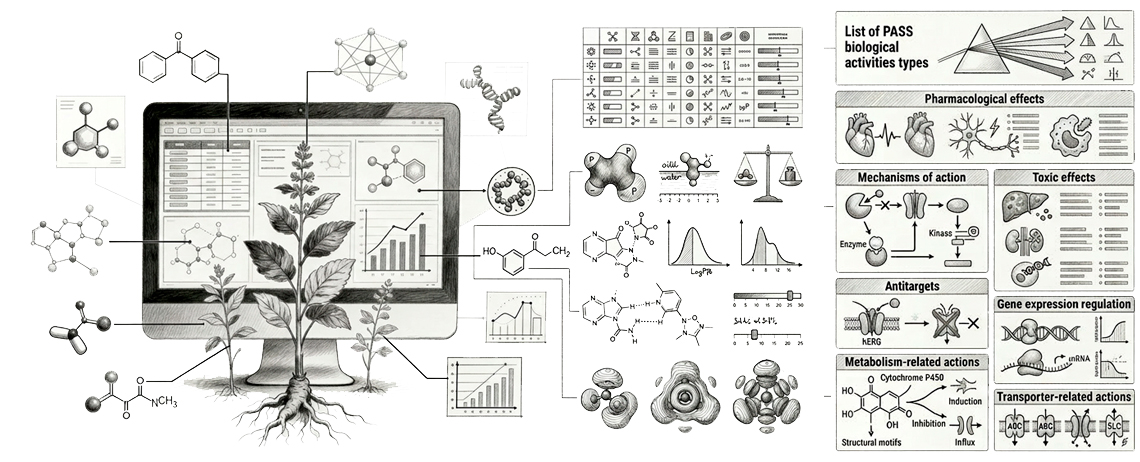
For all 3,128 compounds, in silico prediction of biological activity was performed using PASS Refined 2022, which predicts 1,957 types of biological activity with an average accuracy of 97%. The PASS algorithm is based on a Naive Bayes classifier and MNA descriptors (Multilevel Neighborhoods of Atoms), and its output includes two estimates: Pa, the probability “to be active,” and Pi, the probability “to be inactive”. In total, the database contains more than 135,000 predicted records of pharmacological effects and mechanisms of action at the threshold Pa > 0.5.
Search - text-based search across four categories: compound, plant, molecular target, and PASS-predicted activity; the system supports trivial names, systematic names, IUPAC names, InChI, and SMILES;
Advanced Search - extended search with filtering by physicochemical property ranges (MW, PSA, RTB, HBA, HBD, AlogP), as well as by a specific plant, target, or PASS-predicted activity.
Comparison with three other natural product databases representing medicinal plants from different regions, SistematX (Brazil, 8,940 compounds), Ayurveda (India, 2,102 compounds), and NANPDB (North Africa, 6,328 compounds), showed that more than 57% of the structures in Phyto4Health are unique and differ substantially from phytocomponents found in those regional resources, with an average structural similarity of about 0.17 ± 0.09. This finding highlights the significant untapped potential of the Russian flora as a source of novel pharmaceutical agents. Thus, Phyto4Health is the first specialized tool for systematic in silico analysis of secondary metabolites from medicinal plants listed in the Russian Pharmacopoeia, integrating structural data, experimental activity data, and PASS predictions within a single user-friendly interface.
Phyto4Health can be used for virtual screening of plant-derived compounds, selection of candidate molecules with desired pharmacological profiles, and prioritization of compounds for experimental validation. The resource is also valuable for identifying phytocomponents linked to specific molecular targets, assessing possible mechanisms of action, and exploring the medicinal potential of individual plants or their specific parts. Because the database combines literature-derived phytochemical data with experimental target information and PASS predictions, it can support early-stage drug discovery, pharmacological profiling, and academic research on medicinal plants.

Precise data localization: Quickly find phytocomponents explicitly linked to specific parts of medicinal plants, rather than just the whole organism.
Hypothesis generation: Access over 135,000 in silico PASS predictions to uncover novel or non-obvious pharmacological properties of natural substances.
Unique chemical space: Explore promising structures from Russian flora, over 57% of which are absent from major international natural compound databases.
Nikita Ionov et al. (2023)
Phyto4Health: Database of Phytocomponents from Russian Pharmacopoeia Plants.
Journal of Chemical Information and Modeling, 63(7):1847-1851.
If you need to use the complete dataset presented in Phyto4Health in your own studies, please contact us to discuss licensing opportunities.
The database does not store user search queries and collects no personal data, handling all queries within the user session.

© 2011 - 2026 Way2Drug. All rights reserved.