
is a web application that analyzes the probable biological activity spectrum of drug-like organic compounds while explicitly accounting for their biotransformation and the activities of their metabolites. It is designed for situations where the parent molecule alone is not enough, because metabolism can create new compounds with different pharmacological or toxicological effects.
You can submit a compound by drawing its chemical structure in the built-in Marvin JS editor or by importing it in standard formats such as SMILES, SDF, MOL, or InChI. The service then searches for structurally similar compounds among 2,377 parent compounds and their metabolites, collected from three databases: ChEMBL v.33 (173 compounds), DrugBank v.5.1.12 (959 compounds), and MetXbioDB (1,245 compounds). Structural similarity is assessed using MNA and QNA descriptors, and results are separately shown for parent compounds and metabolites.
Biological activity prediction is performed using PASS Refined 2022, a specialized version of the PASS (Prediction of Activity Spectra for Substances) software. The system calculates three values per predicted activity for each compound in the metabolic network, including the parent compound and all of its metabolites: Pa (probability of being active), Pi (probability of being inactive), and Pamax (the highest Pa value across the entire metabolic network for a given activity). The predicted activities are grouped into seven categories: pharmacological effects (E), molecular mechanisms of action (M), toxicity and adverse effects (T), adverse targets (A), effects on xenobiotic metabolism (Z), effects on gene expression (G), and effects on transporter proteins (C).
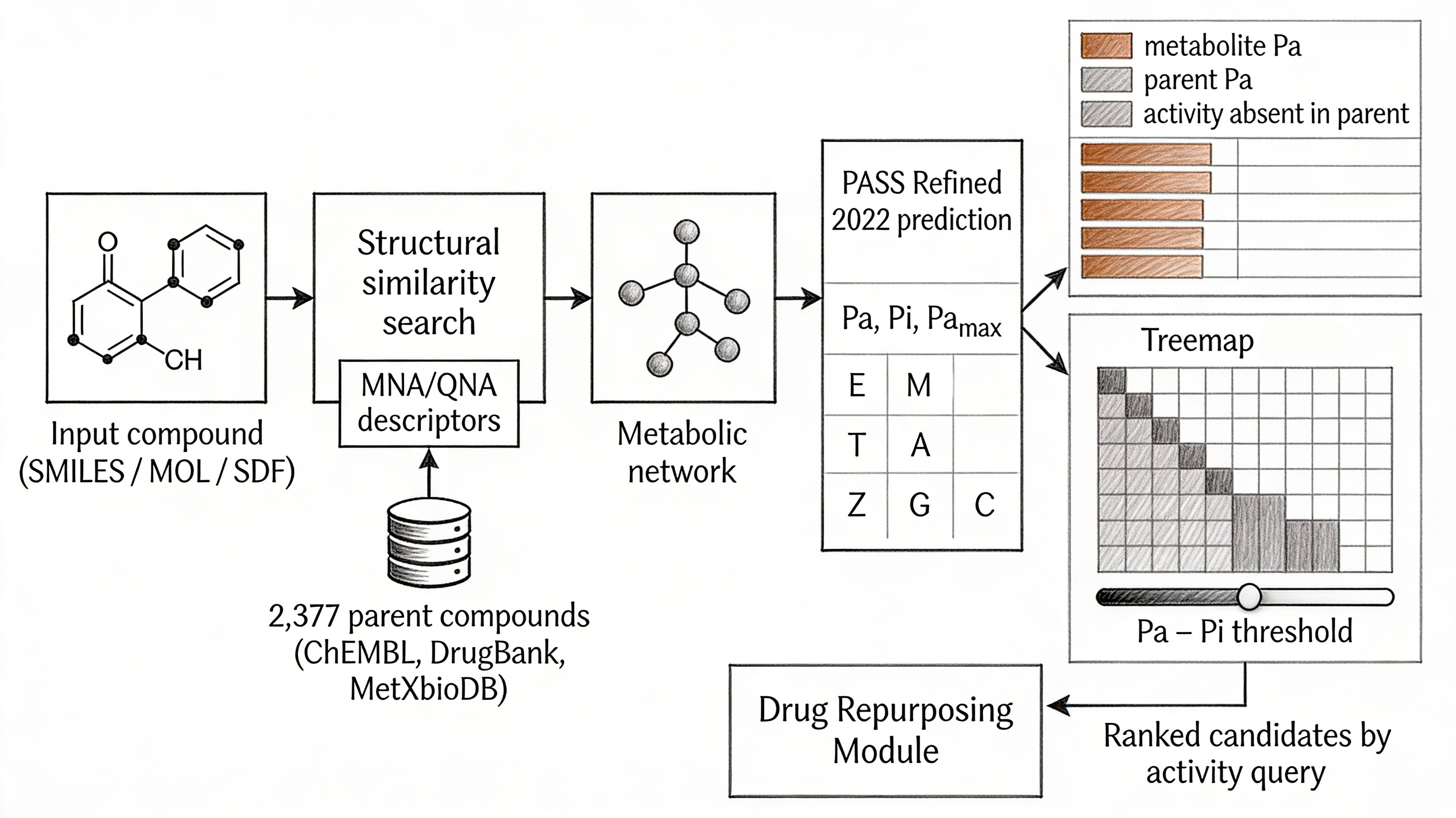
The main interface displays the metabolic network on the left and the aggregated BAS prediction on the right. Color coding highlights biologically relevant shifts: activities shown in brown are those where a metabolite has a higher Pa than the parent compound (Pamax > Paparent); activities shown in gray are those not predicted for the parent (Pa < Pi) but predicted for at least one metabolite.
An interactive treemap (color map), built with the D3.js JavaScript library, provides a visual overview of the entire BAS across all activity categories. The area of each rectangle in the treemap is proportional to the number of compounds in the metabolic network for which at least one activity from that category was predicted, while color intensity reflects the average Pa − Pi value within the category. A slider allows users to dynamically adjust the Pa − Pi threshold and instantly update the map.
MetaPASS includes a dedicated module for drug repurposing, accessible via the "Activity" button. It returns ranked lists of approved drugs and their metabolites with the highest predicted probabilities for any user-specified biological activity, supporting systematic identification of candidates for new therapeutic indications. For example, searching for "SARS" returns compounds with the highest predicted anti-SARS-CoV-2 activities among both parent drugs and their metabolites, which can then be cross-validated against published literature.
MetaPASS is practically applied in early-stage drug discovery and preclinical research to obtain a comprehensive pharmacological and toxicological profile of a compound that accounts for its entire metabolic profile. A researcher can submit a candidate molecule and instantly retrieve predicted activities not only for the parent structure but also for all known or structurally inferred metabolites, identifying cases where bioactivation may generate more potent, toxic, or off-target species. The treemap visualization makes it straightforward to compare activity category distributions between parent compounds and metabolites side by side. The drug repurposing module allows medicinal chemists and pharmacologists to rapidly screen approved drugs for new therapeutic indications by querying any biological activity of interest and obtaining ranked candidate lists with supporting Pa values. MetaPASS is equally applicable to natural product research, where complex biotransformation pathways often determine the true bioactive form of a phytochemical.

Metabolite activity profiling. Unlike conventional QSAR or PASS tools that analyze only the submitted structure, MetaPASS evaluates the full metabolic network, revealing hidden activities that emerge exclusively in biotransformation products and would otherwise be missed in standard in silico screening.
Toxicity and adverse effect detection. The service explicitly flags metabolites with predicted toxicological or adverse effects (category T and A), enabling early identification of potentially dangerous transformation products before costly in vitro or in vivo experiments are performed.
Drug repurposing support. The built-in activity-targeted search across 2,377 approved drugs and their metabolites makes MetaPASS a practical tool for repurposing studies, allowing users to query any target activity and retrieve the most promising candidates ranked by predicted probability.
Anastasia V. Rudik et al. (2025)
MetaPASS 2024: Visualization of Biological Activity Spectra of Organic Compounds Taking into Account Their Biotransformation.
Biomedical Chemistry: Research and Methods, 8(2), e00240.
doi: 10.18097/BMCRM00243
Anastasia Rudik et al. (2020)
MetaPASS: A Web Application for Analyzing the Biological Activity Spectrum of Organic Compounds Taking into Account their Biotransformation.
Molecular Informatics, 40(4), e2000231.
If you need to evaluate a large dataset, or if you need to maintain confidentiality of structural formulas transmitted via unsecured data channels, you can contact us to discuss the licensing opportunities.

© 2011 - 2026 Way2Drug. All rights reserved.