
(Host Gut Microbiota Metabolites of Xenobiotics) is a freely accessible web database that catalogues the biotransformation of drug-like compounds by the human gut microbiota. The human intestinal microbiome encodes a gene set nearly 150 times larger than the human genome, including enzymes capable of extensively metabolizing xenobiotics. These microbially-produced metabolites can differ markedly from parent compounds in terms of pharmacological activity and toxicity, for example, gut bacteria inactivate levodopa in Parkinson's disease patients and activate pro-drugs such as sulfasalazine and olsalazine. Despite growing research interest, no curated database of such metabolites had previously existed, creating a bottleneck for the development of computational prediction tools.
HGMMX serves as a foundational resource for developing QSAR and machine learning models predicting gut microbiota-mediated biotransformation, supporting drug candidate screening, drug repurposing, and personalized medicine research by illuminating how gut microbiota composition affects drug efficacy and safety.
Through manual curation of 86 peer-reviewed publications, we assembled HGMMX DB with data on 678 unique chemical compounds, 368 substrates metabolized by gut microbiota (producing 247 distinct metabolites) and 310 compounds confirmed as non-metabolized. Each entry is annotated with the compound name, chemical structure (in MOL, SMILES, InChI, and InChIKey formats), the biotransformation reaction type, the bacterial genus and species responsible, and the biological/pharmacological effects of the resulting metabolism. Compounds are classified according to DrugBank into three categories: Approved drugs, Dietary supplements, and Others.
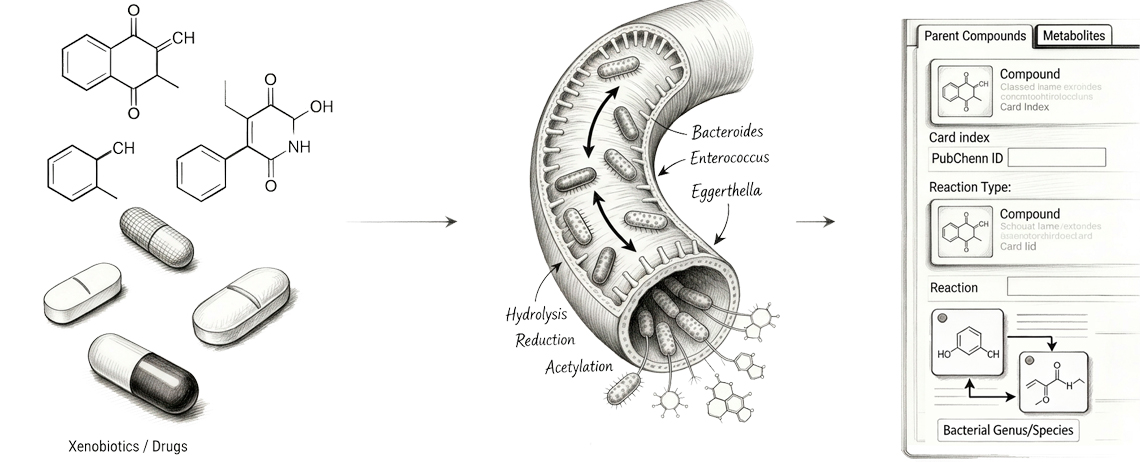
The web application offers three complementary search modes:
Text search by compound name or synonym;
Filter-based search by compound type, bacterial genus, and biotransformation reaction class;
Structural similarity search is implemented via the JS molecular editor, supporting SMILES, MOL, and SDF formats; similarity is calculated using MNA (Multilevel Neighborhoods of Atoms) and QNA (Quantitative Neighborhoods of Atoms) descriptors, with Tanimoto and Todeschini coefficients respectively.
Search results are divided into "Parent compounds" and "Metabolites" tabs, and each molecule's detail page provides full structural identifiers, PubChem/DrugBank cross-references, and literature citations. The full dataset can be downloaded as CSV or SDF files, split into two sets - MDM+ (metabolized) and MDM− (not metabolized). The database does not store user search queries and collects no personal data, handling all queries within the user session.
HGMMX can be directly applied across several stages of drug discovery and biomedical research:
Researchers can query the database to assess whether a candidate compound is likely to be biotransformed by intestinal bacteria before it reaches systemic circulation, enabling early-stage filtering of drug candidates with unfavorable gut-mediated metabolic profiles;
Medicinal chemists can use the structural similarity search to find analogs of their compounds of interest and retrieve known metabolic outcomes, reaction types, and responsible bacterial taxa;
The downloadable MDM+/MDM− datasets (in CSV and SDF formats) can be used directly as training and validation sets for building QSAR or machine learning models aimed at predicting gut microbiota-mediated biotransformation;
Pharmacologists and clinicians can consult the database when evaluating drug–drug interactions or pro-drug activation potential in the context of patients' gut microbiome composition.
Drug discovery and candidate optimization - HGMMX helps identify whether a new drug-like molecule may be activated, inactivated, or converted to a toxic metabolite by gut bacteria, allowing early structural modifications to improve metabolic stability or leverage beneficial bioactivation.
Drug safety and toxicity assessment - cross-referencing compounds with HGMMX entries reveals known cases where gut microbiota-mediated metabolism leads to toxic metabolite formation or dangerous drug–drug interactions, supporting in silico safety screening prior to costly in vitro or in vivo studies..
Personalized medicine and microbiome research - by linking specific bacterial genera and species to individual biotransformation reactions, HGMMX enables researchers to investigate how inter-individual differences in gut microbiome composition may affect pharmacotherapy outcomes, contributing to the development of microbiome-aware dosing strategies.
Anton S. Kolodnitsky et al. (2023)
HGMMX: Host Gut Microbiota Metabolism Xenobiotics Database.
Journal of Chemical Information and Modeling, 63, 6463−6468.
If you need to use the complete dataset presented in HGMMX in your own studies, please contact us to discuss licensing opportunities.
The database does not store user search queries and collects no personal data, handling all queries within the user session.

© 2011 - 2026 Way2Drug. All rights reserved.