
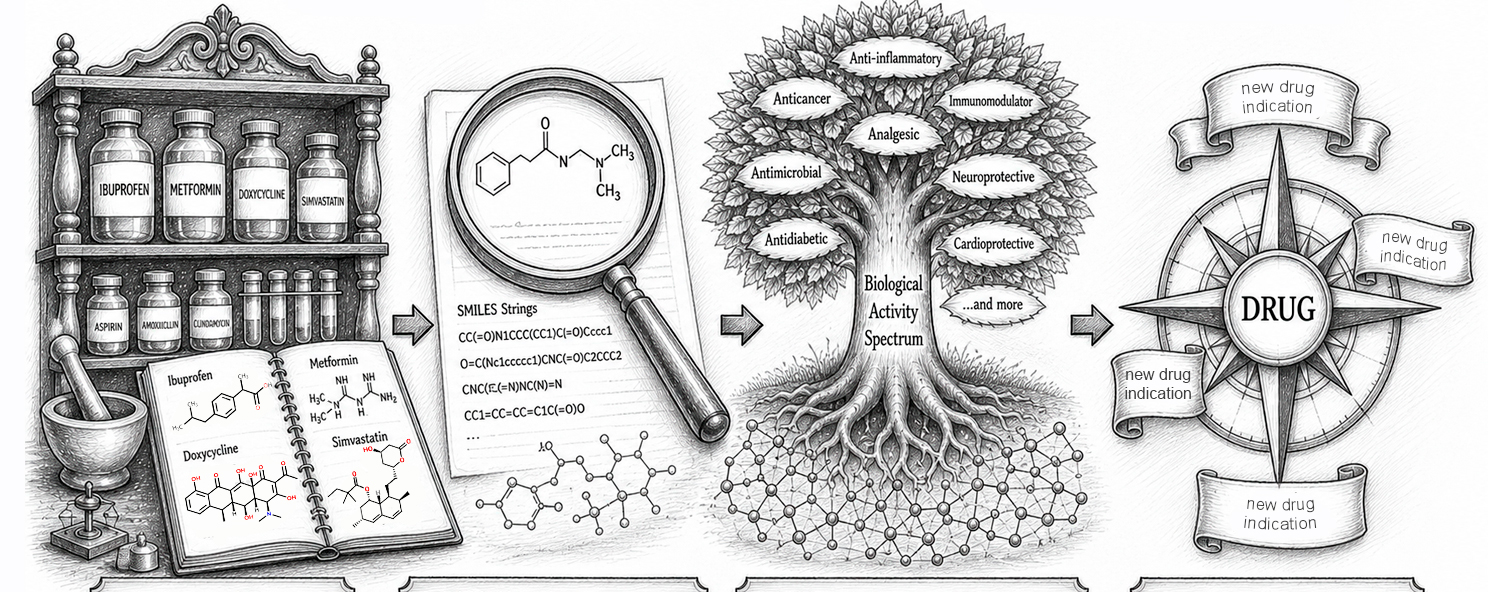
The Drug Repositioning platform is a freely available, integrative, computational web resource designed to streamline and systematize the process of drug repositioning, which is the identification of new therapeutic uses for drugs that have already been approved.
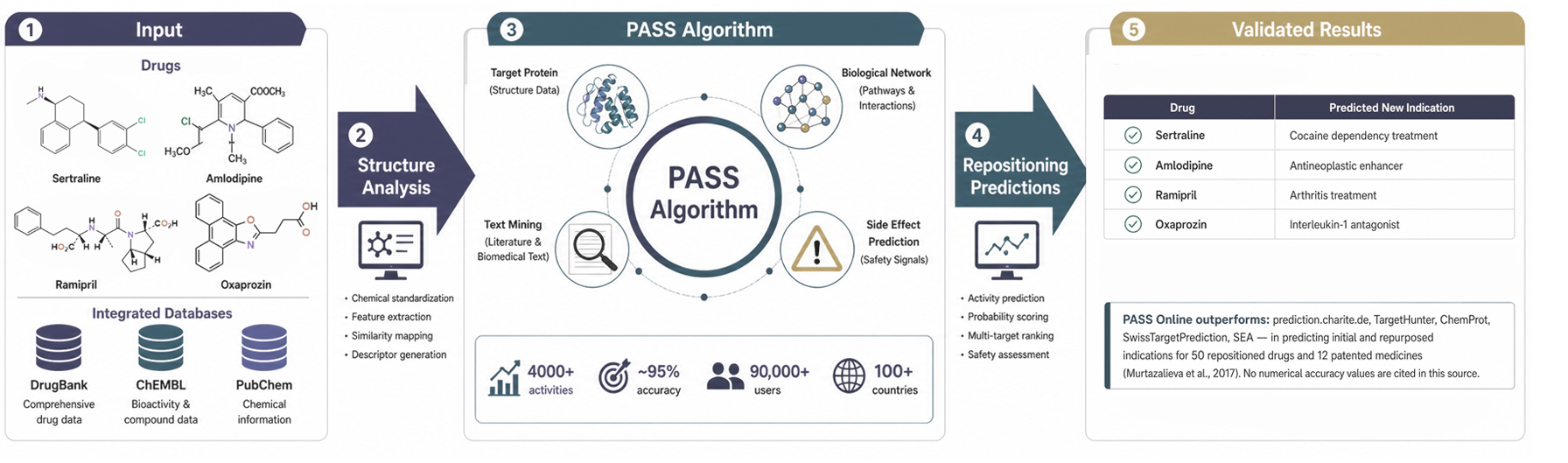
The platform is built around the PASS (Prediction of Activity Spectra for Substances) algorithm, the first freely available web service capable of predicting many types of biological activity from a compound's structural formula alone. PASS currently predicts over 4,000 kinds of biological activity with an average accuracy of approximately 95%, and is used by more than 19,000 researchers from over 100 countries. The method is ligand-based and relies on the multilevel neighborhoods of atoms (MNA) structural descriptors, comparing a query compound against a training database of over 260,000 drug-like, biologically active compounds.
The Drug Repositioning platform integrates data on existing approved drugs with PASS-based predictive services in a unified interface. The workflow adheres to the network pharmacology paradigm, replacing the traditional "magic bullet" concept (one drug–one target) with a more sophisticated model of disease, pathway, target, and ligand. This accounts for the multi-target nature of most pharmacological agents and the complexity of signal transduction regulatory networks. Key integrated data dimensions include:
Known drug structures and pharmacological profiles;
Predicted biological activity spectra for each drug;
Target interaction data drawn from public databases (PubChem, ChEMBL, DrugBank);
Side effect and adverse drug reaction associations (SIDER, Offside);
Gene-expression profiling linkages for mechanism-of-action inference.
The platform supports multiple computational strategies for repositioning:
Ligand-based methods: identify novel indications based on structural similarity to known bioactive compounds;
New drug-target interaction detection: using inverse virtual screening and molecular docking as validation, complementary to ligand-based PASS predictions;
Structure Preparation. Enter the structural formula of an approved drug in SMILES format or as a mol-file on the PASS Online service;
Obtaining the Activity Spectrum. PASS predicts the full spectrum of biological activities with Pa/Pi values, including those that are not part of the drug's official indications;
Analysis of "Unexpected" Activities. Identify activities with high Pa (>0.5–0.7) in areas different from the registered application, these are the repositioning candidates;
Comparison with the World Wide Approved Drugs database. DR platform provides access to a WWAD database of > 4,000 approved drugs from the world for matching against predicted activity profiles;
Verification via PharmaExpert. The PharmaExpert tool analyzes the relationships between predicted activities, drug-drug interactions, and multi-target effects, enabling the elimination of artifacts;
Accounting for Metabolites. The MetaPASS service additionally calculates the maximum Pa (Pamax) value among the parent compound and its metabolites. This makes it possible to detect activities that only manifest after biotransformation.
The platform and underlying PASS algorithm have a documented track record of successful prospective predictions. In 2001, PASS predictions for eight drugs from the Top-200 list proposed the following repositionings:
| Drug | Predicted New Indication |
|---|---|
| Sertraline | Cocaine dependency treatment |
| Amlodipine | Antineoplastic enhancer |
| Ramipril | Arthritis treatment |
| Oxaprozin | Interleukin-1 antagonist |
A retrospective analysis published in 2017 confirmed these predictions based on subsequently published experimental literature. In addition, a comparative computational study demonstrated that PASS Online outperforms several other freely available biological activity prediction services in predicting both initial and repositioned indications for 50 well-known repositioned drugs and 12 recently patented medicines.
Drug repositioning via the platform requires significantly less time and financial investment than de novo drug discovery. This makes drug repositioning accessible to academic research settings, unlike industrial pipelines which require over a decade and billions of dollars per drug. The platform was supported by RSF-DST Grant (Indo-Russian collaboration) and is actively cited in international research on computational repositioning methodology. It exemplifies how publicly available, annotation-driven computational frameworks can be used to systematically annotate drug–disease–target relationships and extract actionable repositioning hypotheses from the existing biomedical knowledge base.



© 2011 - 2026 Way2Drug. All rights reserved.


