
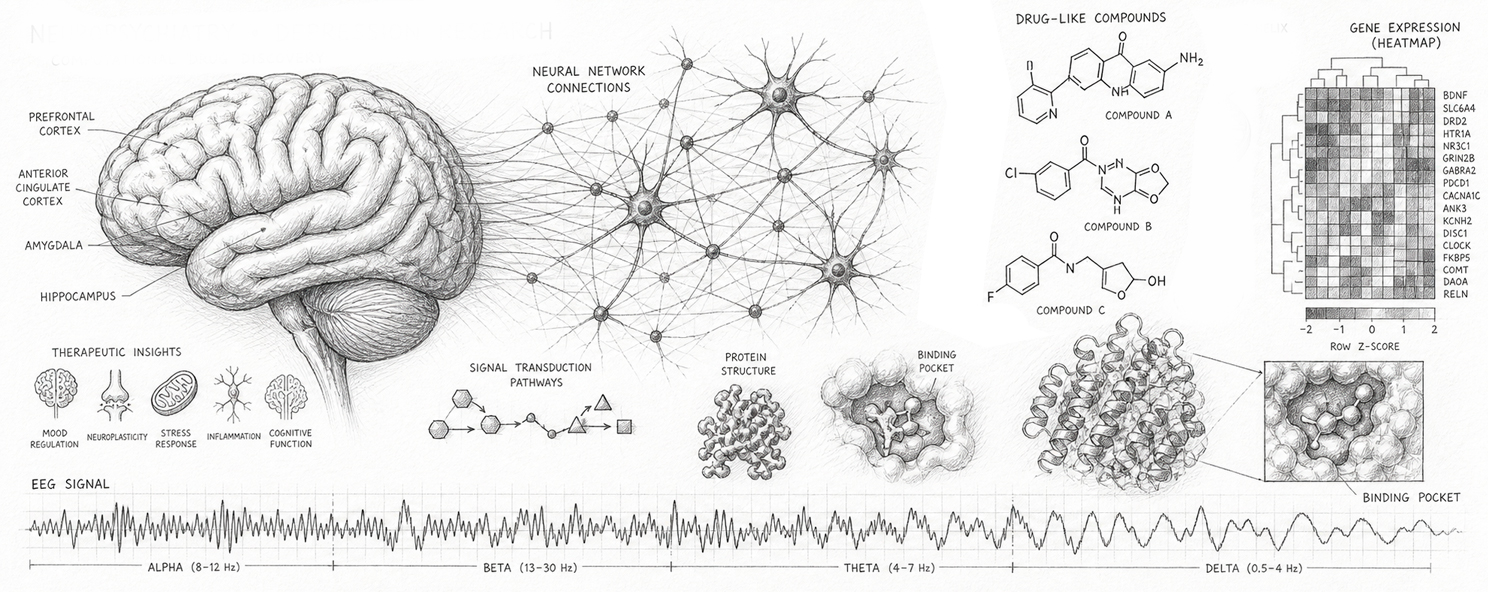
Neuropsychiatric disorders, including major depressive disorder (MDD), schizophrenia, and bipolar disorder, are among the greatest unmet medical needs of our time. Despite decades of research, existing pharmacotherapies remain effective in only a fraction of patients, and the molecular mechanisms underlying these conditions are still poorly understood. Way2Drug provides an integrated computational platform that enables researchers to systematically investigate these diseases at multiple levels: from gene expression and molecular targets to drug repositioning and bioactivity prediction.
The platform's tools have been applied to decode the molecular basis of MDD through combined analysis of genomic and transcriptomic datasets. We identified key genes and biological processes driving the development of major depressive disorder using computational approaches developed and validated within the Way2Drug. Complementing this, transcriptomic profiling of iPSC-derived neural cultures enables mechanistic dissection of disease-relevant neuronal phenotypes at the cellular level, bridging genomic findings with functional biology.
One of the platform's most notable applications in neuropsychiatry is drug repositioning, which involves identifying existing, approved compounds as potential treatments for MDD. Using DIGEP-Pred, service for predicting drug-induced gene expression changes, researchers can match the transcriptomic signatures of candidate drugs against disease-associated gene expression profiles.We demonstrated this approach, repositioning known drugs for MDD treatment by predicting their effects on disease-relevant gene networks.
PASS Online predicts over 4,000 biological activity types, including antidepressant, antipsychotic, anxiolytic, and nootropic effects, with mean prediction accuracy of ~95%. This makes it uniquely for identifying novel molecular targets for neuropsychiatric pharmacotherapy. We applied in silico approaches to propose novel potential targets for the development of antidepressant and antipsychotic drugs. This demonstrates how in silico activity spectrum prediction can direct experimental programs towards areas that traditional screening methods cannot easily access.
Neuropsychiatric disorders rarely exist in isolation. Depression, anxiety, psychosis, and epilepsy often occur together in the same patient and share common molecular mechanisms and pharmacological targets. Way2Drug platform provides web services that allow researchers to investigate these overlapping pathologies within a single computational environment, leveraging biological activity prediction, transcriptomic analysis, and systems pharmacology.
A compelling example is the bioinformatics approaches from the platform were applied to develop a novel animal model of drug-resistant epilepsy. We used rotenone-adjuvant kindling in mice and justified our choice of experimental protocol through a computational analysis of the molecular targets and biological activities of the compounds. Computational prediction was crucial in establishing the model's relevance in advance and minimizing the number of animals required for validation, aligning with modern 3R principles in biomedical research.
Drug-resistant epilepsy is of particular interest because many antiepileptic drugs also have mood-stabilizing and antidepressant properties, and vice versa. Predicting the spectrum of biological activity with PASS Online allows these pharmacological overlaps to be explored systematically: a single candidate can be simultaneously evaluated for anticonvulsant, antidepressant, anxiolytic, and neuroprotective activities. This multiparameter screening is especially valuable when searching for treatments targeting comorbid conditions, where a classical single-target strategy is inherently insufficient. When combined with DIGEP-Pred, a tool for predicting drug-induced gene expression changes, Way2Drug becomes a universal platform for investigating the full spectrum of CNS pathologies, from monotarget disorders to complex comorbid syndromes.
Way2Drug compresses years of experimental hypothesis-generation into hours of computational analysis. For neuropsychiatry and depression specifically, the platform offers:
Multi-omic integration - connect genomic, transcriptomic, and pharmacological data within a single workflow;
Insight driven repositioning - identify approved drugs with profiles matching MDD gene expression signatures via DIGEP-Pred;
Broad bioactivity profiling - screen any compound for antidepressant, antipsychotic, anxiolytic, and neuromodulatory activities with PASS Online;
Novel target discovery - use PASS Targets prediction to prioritize new molecular targets and avoid off-target CNS liabilities.
Way2Drug empowers neuropsychiatry researchers to move from molecule to mechanism faster, smarter, and with greater confidence in translational relevance by combining structure-based activity prediction with gene expression analysis and systems pharmacology.

© 2011 - 2026 Way2Drug. All rights reserved.


