
developed for the computational prediction of inhibitors and inducers of the five major human cytochrome P450 isoforms: CYP1A2, CYP2C9, CYP2C19, CYP2D6, and CYP3A4. These five isoforms collectively account for approximately 80% of all drug metabolism in humans, making them critical targets for early assessment of drug–drug interactions (DDIs). Cytochrome P450 inhibition can slow the biotransformation of co-administered drugs, causing toxic accumulation. Conversely, CYP induction accelerates their clearance and reduces bioavailability. Both of these phenomena can produce severe or fatal adverse drug reactions.
The predictive models in P450-Analyzer were built from over 70,000 curated records extracted from the freely available ChEMBL and PubChem databases. Two complementary computational approaches were applied: GUSAR software, which uses Quantitative Neighborhoods of Atoms (QNA) and Multilevel Neighborhoods of Atoms (MNA) molecular descriptors combined with a Radial-Basis Function and Self-Consistent Regression (RBF–SCR) algorithm to generate QSAR regression models predicting pIC50 values; and PASS software, which employs an advanced Naive Bayes classifier with MNA descriptors to generate SAR classification models for both inhibition and induction.
In total, 320 QSAR models were built for inhibition, with consensus models selected where R2 > 0.6 and Q2 > 0.5. Prediction accuracy was validated via 5-fold cross-validation; RMSE values for all five isoforms remained below 0.7, and over 95% of test compounds fell within the applicability domain. For classification models, the Invariant Accuracy of Prediction (IAP, analogous to ROC AUC) reached values of up to 0.937 for CYP1A2, validated by both leave-one-out and 20-fold cross-validation.
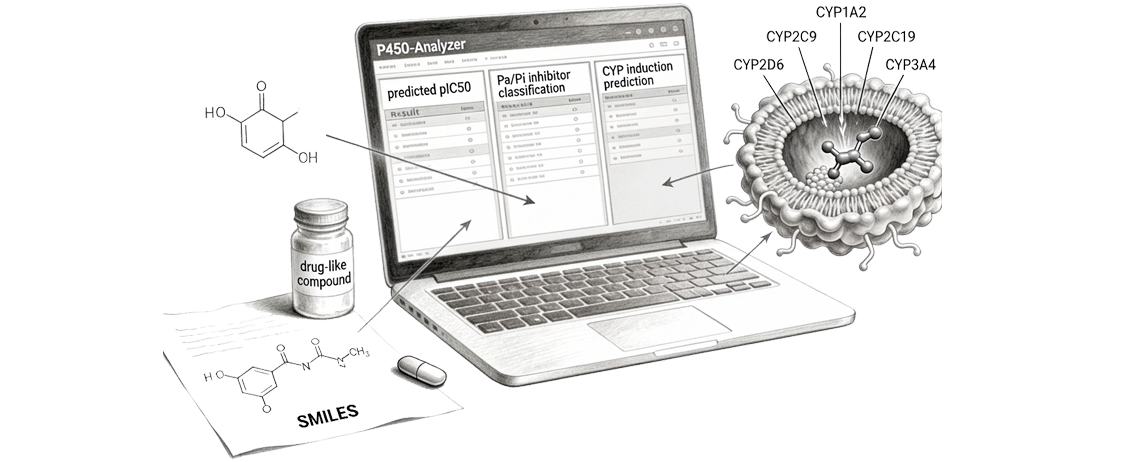
The service offers flexible compound submission through multiple input formats:
SMILES - direct text input of molecular structures;
Drug name - look up by INN or common name;
JSME Applet - interactive chemical structure drawing in the browser;
MOL file upload - for pre-prepared structure files.
For each submitted compound, P450-Analyzer generates three structured result tables:
QSAR table (Table A) - provides predicted pIC50 values for each of the five CYP isoforms. Compounds with pIC50 > 6 are considered potential inhibitors and are flagged for experimental follow-up;
SAR classification table (Table B) - provides Pa (probability to be an inhibitor) and Pi (probability to be a non-inhibitor) for each isoform. By default, activities with Pa > Pi are displayed as possible inhibitors.;
CYP induction table (Table C) - presents selected activities from PASSOnline corresponding to CYP induction. The PASS training set comprises over 1.5 million compounds and predicts more than 8,000 biological activities with an average accuracy of ~0.93.
All three tables can be exported in PDF, CSV, and Excel formats for further analysis.
Unlike other freely available CYP prediction tools such as SwissADME, WhichCyp, pkCSM, or SuperCYPsPred, P450-Analyzer uniquely combines quantitative inhibition potency estimation (pIC50) with direct induction prediction for all five major CYP isoforms in a single interface. This allows compounds to be classified not only as inhibitors or non-inhibitors, but also as strong, moderate, or weak inhibitors. This enables a more nuanced assessment of potential drug-drug interaction risk during early drug discovery.
P450-Analyzer is particularly well-suited for use at the hit-to-lead and lead optimization stages of drug discovery, where early identification of undesirable metabolic properties can save considerable time and resources. By submitting a candidate compound or a focused library of structures, researchers can rapidly screen for potential CYP inhibition and induction liabilities before committing to costly in vitro or in vivo experiments. The service is equally applicable in the context of drug repurposing, natural product research, and safety pharmacology studies, where understanding CYP-mediated interactions is critical for predicting pharmacokinetic behavior and anticipating adverse drug reactions in polypharmacy settings.
Rapid multi-isoform DDI screening - in a single query, the service simultaneously evaluates all five clinically critical CYP isoforms (CYP1A2, CYP2C9, CYP2C19, CYP2D6, CYP3A4), delivering both quantitative potency estimates (pIC₅₀) and classification probabilities (Pa/Pi) without requiring any specialized software or computational expertise.
Induction prediction beyond classical inhibition tools - Unlike the majority of freely available CYP prediction servers, P450-Analyzer explicitly models CYP induction - a frequently overlooked but clinically important mechanism responsible for decreased plasma drug levels and therapeutic failure.
Dual-algorithm consensus increases predictive reliability - The service combines two structurally distinct computational approaches — QSAR regression models built with GUSAR (using QNA/MNA descriptors and RBF–SCR algorithm) and SAR classification models built with PASS (Bayesian classifier with MNA descriptors) — allowing cross-validation of results across methodologies.
Anastassia Rudik et al. (2023)
Computational Prediction of Inhibitors and Inducers of the Major Isoforms of Cytochrome P450.
Molecules, 27(18):5875.
If you need to evaluate a large dataset, or if you need to maintain confidentiality of structural formulas transmitted via unsecured data channels, you can contact us to discuss the licensing opportunities.

© 2011 - 2026 Way2Drug. All rights reserved.