
predicts the probability of pairwise drug combinations exhibiting synergistic anticancer cytotoxicity against 45 cancer cell lines from the NCI-60 panel, requiring only the structural formulas of the two compounds as input. Cancer pharmacotherapy increasingly relies on drug combinations to overcome resistance and reduce adverse effects compared to monotherapy. However, the vast combinatorial space of possible drug pairs makes experimental screening prohibitively expensive and time-consuming. CLC-Pred Synergy addresses this by applying structure–activity relationship (SAR) modeling to predict synergy in silico, building on the predecessor tool CLC-Pred, which predicted cytotoxicity of individual compounds against hundreds of cell lines.
The models were trained on data from the NCI-ALMANAC database, which contains over 300,000 cytotoxicity experiments covering ~ 5 000 pairwise drug combinations tested against the NCI-60 panel of 60 human cancer cell lines. Chemical structures of compound pairs are encoded using PoSMNA (Pairs of Substances Multilevel Neighborhoods of Atoms) descriptors, which are a a pairwise extension of the MNA descriptor system developed specifically for drug–drug interaction modeling. A modified Naive Bayes classifier implemented in the PASS DDI software then learns structure–synergy patterns from these descriptors.
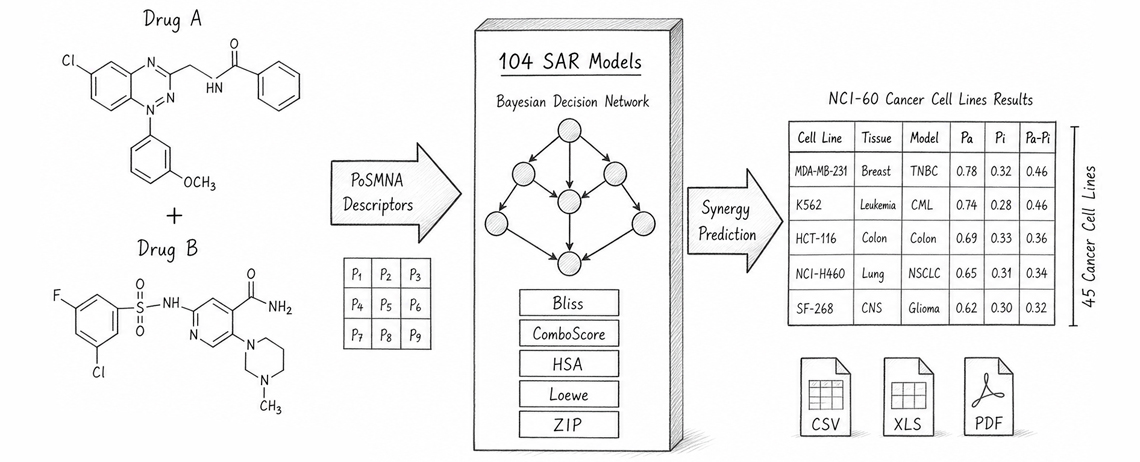
From 1,500 generated SAR models (covering 60 cell lines × 5 synergy metrics × 5 thresholds), 104 high-quality models with AUC > 0.70 were selected, corresponding to 45 cancer cell lines and achieving a mean AUC of 0.749. We used a rigorous leave-one-out compounds-out cross-validation scheme to validate the models. This scheme ensured that no compound from a test pair appeared in any training pair, thus genuinely simulating prediction for novel molecules.
The structural formulas of two compounds, entered either as SMILES, retrieved by drug name search or draw using chemical editor.
A ranked table of predictions across 45 cancer cell lines, with the following columns for each cell line / synergy model combination:
Pa - probability of being synergistic;
Pi - probability of being non-synergistic;
AUC (LOOCOCV) - model accuracy reference;
Cell line name, tissue of origin, and histology.
Five synergy scoring frameworks are covered simultaneously: Bliss, ComboScore, HSA, Loewe, and ZIP. Combinations where both Pa and Pi are low indicate the pair falls outside the applicability domain of the model.
The service was validated on 23 clinically approved synergistic drug pairs (for melanoma, breast, colon, kidney, lung, and ovarian cancers) not present in the training sets. CLC-Pred Synergy correctly predicted synergistic activity for 17 of 23 pairs (73.9%), including notably predicting the encorafenib–binimetinib combination against melanoma cell lines harboring the BRAF V600E/V600K mutation, consistent with its FDA approval in 2018.
Within seconds, the application returns a ranked prediction table covering up to 45 NCI-60 cancer cell lines across five synergy models (Bliss, ComboScore, HSA, Loewe, and ZIP). A typical workflow would involve screening several candidate combination partners for a lead compound, ranking them by Pa–Pi across relevant cancer cell lines, and prioritizing the top-scoring pairs for subsequent in vitro cytotoxicity assays. This significantly narrows the experimental search space before any laboratory work begins.
For researchers working in computational drug discovery, medicinal chemistry, or oncology pharmacology, CLC-Pred Synergy fills a practical gap that most existing tools leave open. Unlike deep learning approaches such as DeepSynergy and H-RACS, which require gene expression profiles, proteomic data, or known drug target annotations as input, CLC-Pred Synergy only needs chemical structure information. This makes it immediately applicable to novel scaffolds or make-on-demand compounds that have not yet been biologically profiled.
If you are developing or evaluating potential anticancer agents within the Way2Drug platform, CLC-Pred Synergy integrates naturally with other platform services. A compound flagged as cytotoxically active by CLC-Pred can be immediately tested as part of a drug pair in CLC-Pred Synergy, creating a seamless in silico pipeline from single-agent activity to combination synergy assessment..
Beyond internal use, the service is well-suited for academic collaborators and pharmaceutical partners who need a quick, no-barrier tool to prioritize combination experiments. The availability of five independent synergy models in a single output gives users a more nuanced picture: when multiple models agree on a synergistic prediction, the confidence in pursuing that combination experimentally is considerably higher.
Vladislav S. Sukhachev et al. (2026)
CLC-Pred Synergy: Web Application for Predicting Pairwise Drug Combinations with Synergistic Activity Against NCI60 Cancer Cell Lines.
International Journal of Molecular Sciences, 27, 5208.
doi: 10.3390/ijms27125208
If you need to evaluate a large dataset, or if you need to maintain confidentiality of structural formulas transmitted via unsecured data channels, you can contact us to discuss the licensing opportunities.

© 2011 - 2026 Way2Drug. All rights reserved.