
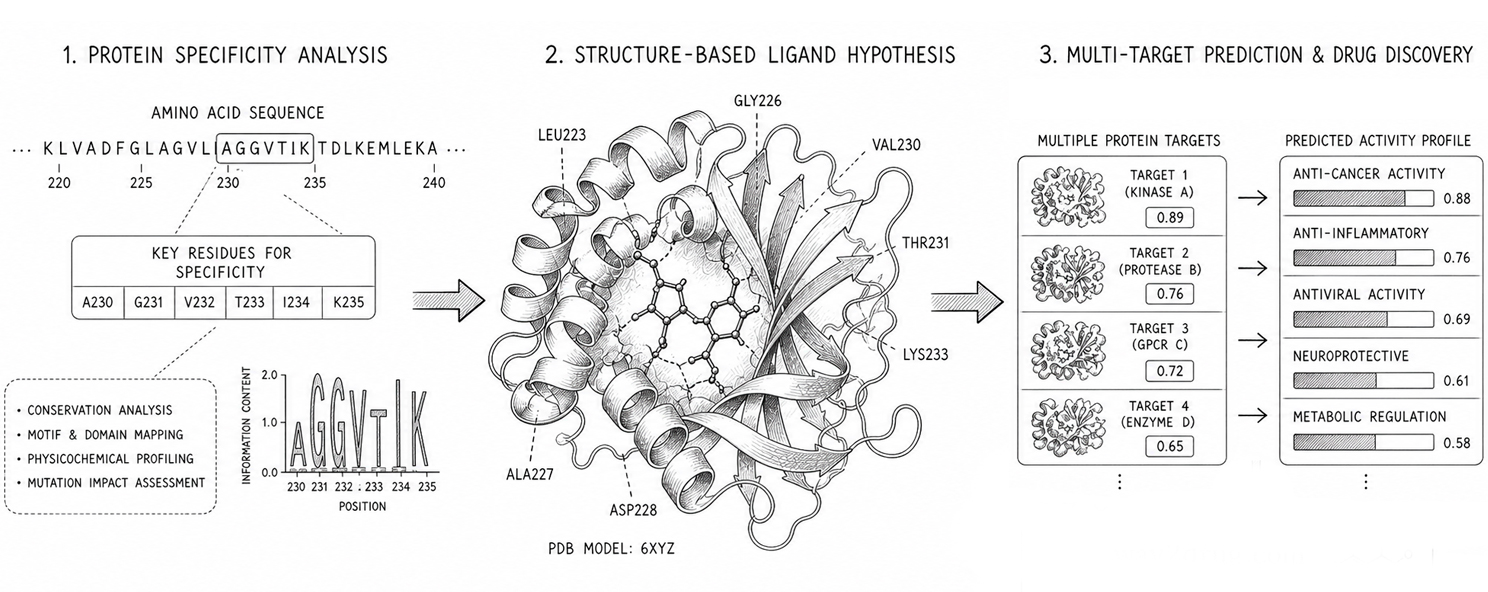
The Way2Drug platform integrates proteomic data and protein structure analysis methods directly into computational workflows for drug discovery and lead optimization. This enables researchers to combine molecular-structural analysis of proteins with biological activity prediction within a single computational environment.
The PASS Targets tool predicts interactions between chemical compounds and human protein targets based on ChEMBL data, providing researchers with a comprehensive map of potential molecular targets for the compound of interest. Even broader capabilities are offered by the Proteochemometrics service, which implements the proteochemometric approach consisting of predicting ligand–protein interactions simultaneously based on both ligand structure and the amino acid sequence of the target. The method features a wide applicability domain and can generate predictions even for poorly characterized proteins, which is critically important when working with large target families.
The SprOS service implements an algorithm for predicting amino acid positions that determine the functional specificity of proteins within a given family, based on local sequence similarity analysis. This approach enables identification of key residues responsible for ligand binding or substrate specificity, thereby guiding compound optimization on a structurally informed basis.
Neuroproteomics of the brain generates an extensive dataset on proteins of synapses, postsynaptic densities, and cerebrospinal fluid that undergo changes in Alzheimer's disease, Parkinson's disease, and other neurodegenerative pathologies. Through neuroproteomic analysis, candidate biomarker proteins were identified, such as VAMP2, syntaxin-1, neurogranin, PSD95, and other synaptic proteins. These proteins represent potential therapeutic targets for directed drug discovery. The tools available on the Way2Drug platform enable researchers to bridge the gap between these experimentally established targets and computational prediction: using PASS Targets and Proteochemometrics, one can assess which known or designed compounds are likely to interact with specific neuroproteomic targets, while the platform's side effect and toxicity prediction services allow the safety profile of such candidates to be evaluated immediately.
The integrative nature of the Way2Drug platform allows proteomic data to be combined with predictions of side effects, drug–drug interactions, and gene expression. This is clearly demonstrated by studies employing proteomic analysis: for example, mass spectrometry-based identification of protein composition changes in the intestinal mucosa during 5-fluorouracil-induced mucositis revealed multiple mechanisms of toxicity, which can subsequently be reproduced within the platform's in silico tools. As a result, proteomic findings from experimental studies enrich the Way2Drug databases and improve the predictive accuracy of all associated services.
Unified environment: from protein primary structure analysis to pharmacological profile prediction — all within a single platform;
Wide applicability domain: proteochemometric methods cover both well-characterized and poorly annotated protein targets;
Structure–function relationships: identifies functionally significant amino acid positions, facilitating rational ligand design;
Integration with experimental data: proteomic results from partner laboratory publications are systematically incorporated into the platform's knowledge bases.


© 2011 - 2026 Way2Drug. All rights reserved.


