
is a web server for in silico prediction of sites of metabolism (SOM) in drug-like compounds based only on their structural formula. The method was developed from analysis of structure–SOM relationships using a Bayesian approach together with labelled multilevel neighbourhoods of atoms as molecular descriptors, and it was trained on data from over 1,000 metabolized xenobiotics sourced from the BIOVIA Metabolite database, demonstrating that accurate SOM predictions can be achieved without resorting to computationally expensive quantum-mechanical or 3D structure-based descriptors.
SOMP predicts metabolic sites catalyzed by five major human cytochrome P450 (CYP) isoforms: CYP1A2, CYP2C9, CYP2C19, CYP2D6, and CYP3A4. It also predicts sites catalyzed by enzymes of the UDP-glucuronosyltransferase (UGT) family. The user submits a compound using its structural formula (e.g., as a SMILES string or drawn structure), and the server highlights the predicted reactive atoms within the molecule for each relevant enzyme.
he predictive performance of SOMP is notable: the average invariant accuracy reached 0.90 on training sets (via leave-one-out cross-validation) and 0.95 on independent evaluation sets, placing it among the high-accuracy ligand-based SOM predictors.
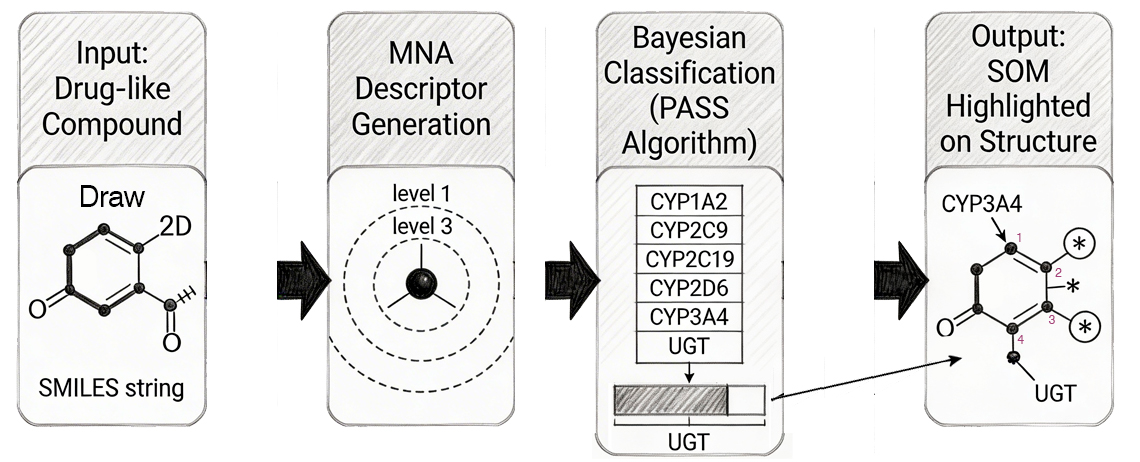
SOMP is designed to integrate seamlessly into early-stage drug discovery and medicinal chemistry workflows. The tool allows researchers to rapidly prioritize structural modifications that can improve metabolic stability by identifying metabolically labile atoms directly from a 2D structural formula, without requiring experimental data or 3D conformation. For example, if SOMP predicts that a specific aromatic carbon is a primary CYP3A4 oxidation site, the medicinal chemist can introduce a fluorine substituent or a methyl group at that position to block the metabolic attack. The web service also supports the prediction of likely phase II glucuronidation sites via UGT enzymes, making it applicable not only to oxidative metabolism but also to conjugation reactions critical for drug clearance assessment. Furthermore, SOMP results can complement other in silico ADMET tools, such as those on the Way2Drug platform, to create a full picture of a compound's biotransformation profile before any laboratory experiments are conducted.

Zero experimental data required - predictions are generated from a 2D structural formula alone, making SOMP immediately applicable at the earliest stages of compound design, even before synthesis.
Multi-enzyme coverage in a single run - the service simultaneously evaluates five major CYP isoforms and UGT enzymes, providing a holistic metabolic landscape.
High predictive accuracy - with invariant accuracy up to 0.95 on external evaluation sets, SOMP delivers reliable atom-level SOM predictions that can confidently guide structural optimization decisions.
Anastasia Rudik et al. (2015)
SOMP: web server for in silico prediction of sites of metabolism for drug-like compounds.
Bioinformatics, 31(12), 2046–2048.
If you need to evaluate a large dataset, or if you need to maintain confidentiality of structural formulas transmitted via unsecured data channels, you can contact us to discuss the licensing opportunities.

© 2011 - 2026 Way2Drug. All rights reserved.