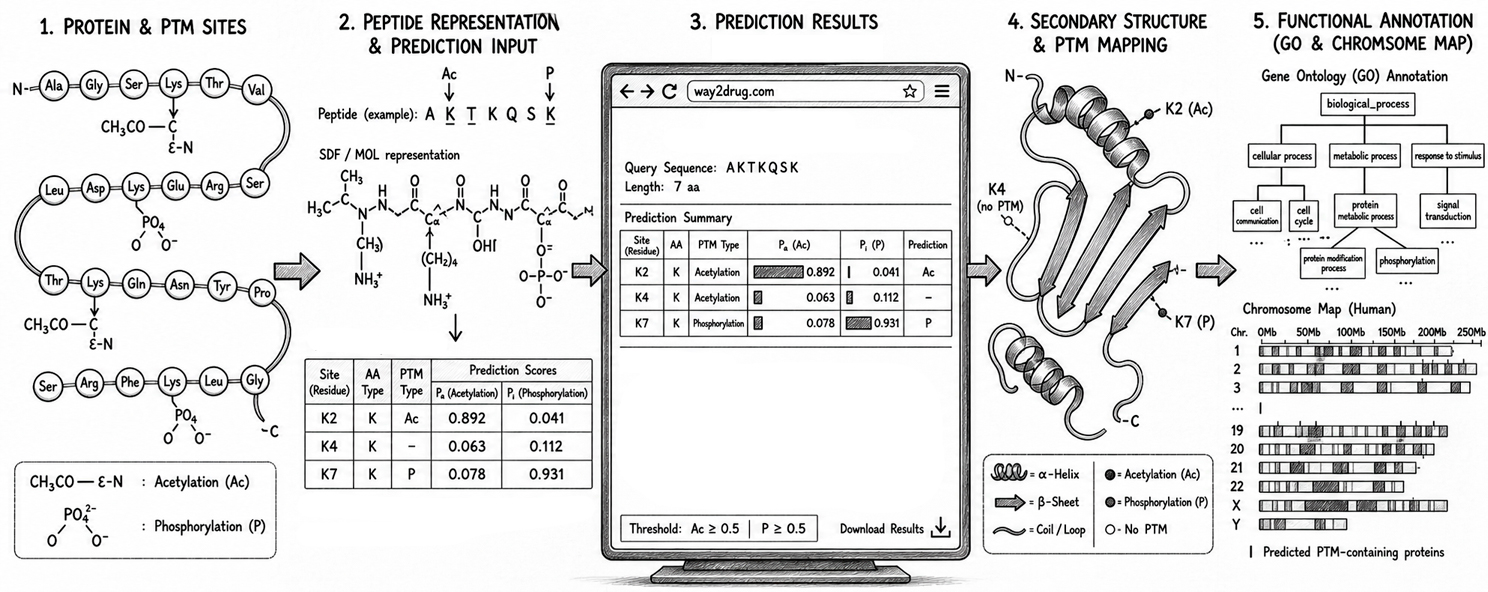
The Way2Drug platform provides services for the computational prediction of protein post-translational modifications based on the original MNA descriptor technology (Multilevel Neighborhoods of Atoms) and the algorithm implemented in the MultiPASS software. This approach enables encoding of peptide amino acid sequences as structural formulae and building sequence–structure–property relationship classification models.
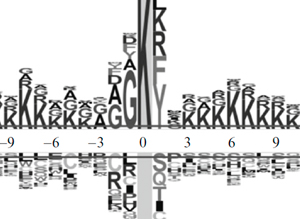
One of the key research directions is the prediction of specific post-translational modifications sites in human proteins. Using MultiPASS, models have been successfully developed for predicting phosphorylation sites specific to various protein kinase families, as well as N-acetylation sites of lysine residues (N-ε-acetylation of Lys) in the human proteome. Applying the best model (MNA descriptor level 9, peptide length 35 amino acids) to the human reference proteome revealed more than 1,136 previously unknown potential N-acetylation sites of lysine (Lys) in 418 proteins, with an expected positive predictive value of approximately 69%.
PTM site prediction on Way2Drug directly supports drug discovery tasks: PTM sites are known to directly overlap with ligand-binding sites or reside in their immediate vicinity, influencing drug–target interactions. Furthermore, PTM prediction results are used to optimize costly mass spectrometry experiments, particularly the selection of proteotypic peptides, thereby reducing costs and improving the scientific rationale of studies.
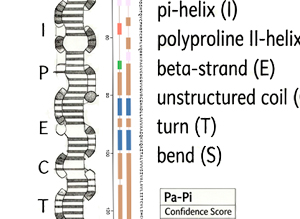
Knowledge of PTM sites is inseparable from understanding the structural context of a protein. The Way2Drug platform includes the freely available MNA-PSS-Pred web application, which predicts the secondary structures of proteins and peptides using the same MNA descriptors and MultiPASS models. The mean AUC for eight secondary structure types is 0.902 under leave-one-out cross-validation, and on the independent ASTRAL and CB513 test sets, Q3 accuracy values of 77.32% and 78.78% were achieved, respectively. This tool allows users to assess how PTM sites are positioned relative to α-helices, β-sheets, and other structural elements, which is critical for interpreting their functional consequences.
Unified (Q)SAR model framework - PTM prediction services use MNA descriptors and the Naive Bayes classifier , successfully applied to predicting pathogenicity of amino acid substitutions, drug resistance, TCR specificity, and phosphorylation sites.s;
Sequence-only input - no three-dimensional protein structure is required; data are accepted in FASTA format or as UniProt IDs;
Scalability - batch mode supports the analysis of up to 100 peptides simultaneously, making it suitable for high-throughput screening;
Integration with public databases - automatic annotation of results using UniProt, Gene Ontology, Pfam, and BRENDA provides biologically meaningful interpretation of predicted PTMs.

© 2011 - 2026 Way2Drug. All rights reserved.