
is an advanced in silico web service designed to predict the cytotoxicity of synthetic and natural compounds from their structural formula across a wide range of human tumor and non-transformed cell lines, while also providing insights into their potential molecular mechanisms of action.
CLC-Pred 2.0 uses the PASS approach to analyze structure-activity relationships based on a molecule’s structural formula, which can be provided as SMILES, the name of a known drug, a Molfile, or a structure drawn in the Marvin JS editor. The method is based on MNA descriptors and a Bayesian algorithm, and the output is presented as probabilities Pa and Pi, where Pa reflects the probability that the activity is present and Pi reflects the probability that it is absent.
The service performs three main types of qualitative prediction:
cytotoxicity for 391 tumor and 47 normal human cell lines;
activity against the NCI60 panel at GI50 thresholds of 100, 10, and 1 nM;
prediction of 2170 molecular mechanisms of action associated with human proteins.
For the cell line modeling, a dataset comprising 128,545 unique chemical structures and 379,767 experimental records from ChEMBL and PubChem was utilized, enabling the selection of 438 human cell lines with predictive performance exceeding an AUC of 0.8. A separate NCI-60 modeling block incorporated 22,726 compounds and over 1.26 million experimental measurements. For mechanism-of-action prediction, an extensive dataset of 656,011 structures and 957,545 activity records was employed, resulting in the identification of 2,170 mechanisms with high predictive accuracy.
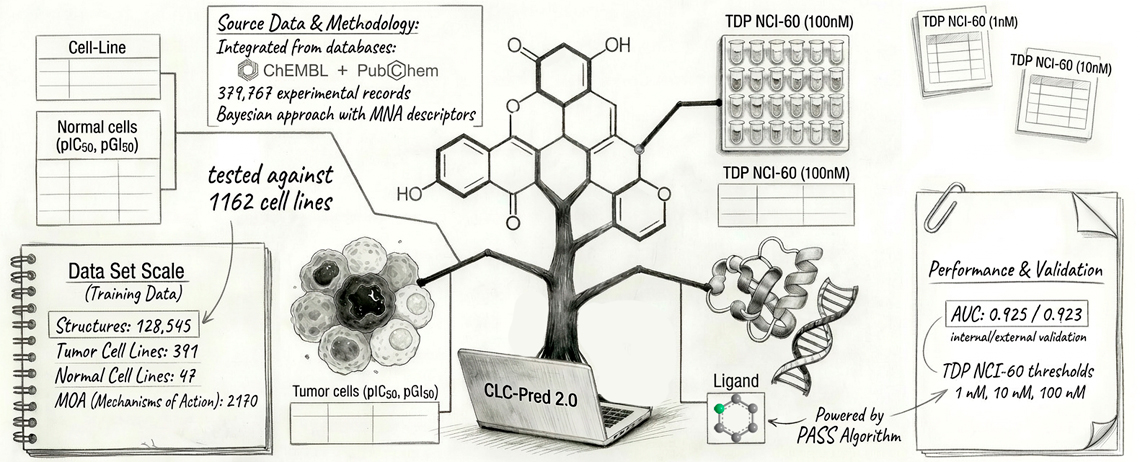
The average predictive accuracy for the block covering 391 tumor and 47 normal cell lines was AUC 0.925 in leave-one-out cross-validation and 0.923 in 20-fold cross-validation. For the NCI60 panel, the average accuracy ranged from 0.870 to 0.945, and for mechanisms of action it reached 0.979, which makes the service a useful tool for preliminary screening, prioritizing compounds, and planning subsequent biological experiments.
CLC-Pred 2.0 can be applied across a wide range of drug discovery and research scenarios. Medicinal chemists can use the service to screen virtual compound libraries and select the most cytotoxically promising candidates before synthesis. Pharmacologists can evaluate synthetic or natural compounds for potential anticancer activity against specific tumor cell lines, avoiding unnecessary experimental costs. Researchers working on drug repurposing can assess known drugs or investigational compounds against the full NCI60 panel to identify new therapeutic indications. In toxicological studies, the prediction of activity against non-transformed cell lines helps estimate the selectivity of a compound and its potential safety profile at the early stages of development.
Save time and resources - obtain rapid in silico cytotoxicity estimates for any compound of interest without prior experimental screening, significantly reducing the cost and duration of early-stage drug discovery campaigns.
Broad coverage - assess activity simultaneously against 391 tumor and 47 normal human cell lines, the NCI60 panel at multiple activity thresholds, and 2,170 molecular mechanisms of action in a single query.
Mechanistic insight - go beyond simple cytotoxicity readouts and gain hypothesis-driven insight into how a compound may exert its biological effects at the molecular and target level, supporting rational drug design.
Alexey A. Lagunin et al. (2023)
CLC-Pred 2.0: A Freely Available Web Application for In Silico Prediction of Human Cell Line Cytotoxicity and Molecular Mechanisms of Action for Druglike Compounds.
International Journal of Molecular Sciences, 24(2), 1689.
doi: 10.3390/ijms24021689
If you need to evaluate a large dataset, or if you need to maintain confidentiality of structural formulas transmitted via unsecured data channels, you can contact us to discuss the licensing opportunities.

© 2011 - 2026 Way2Drug. All rights reserved.