
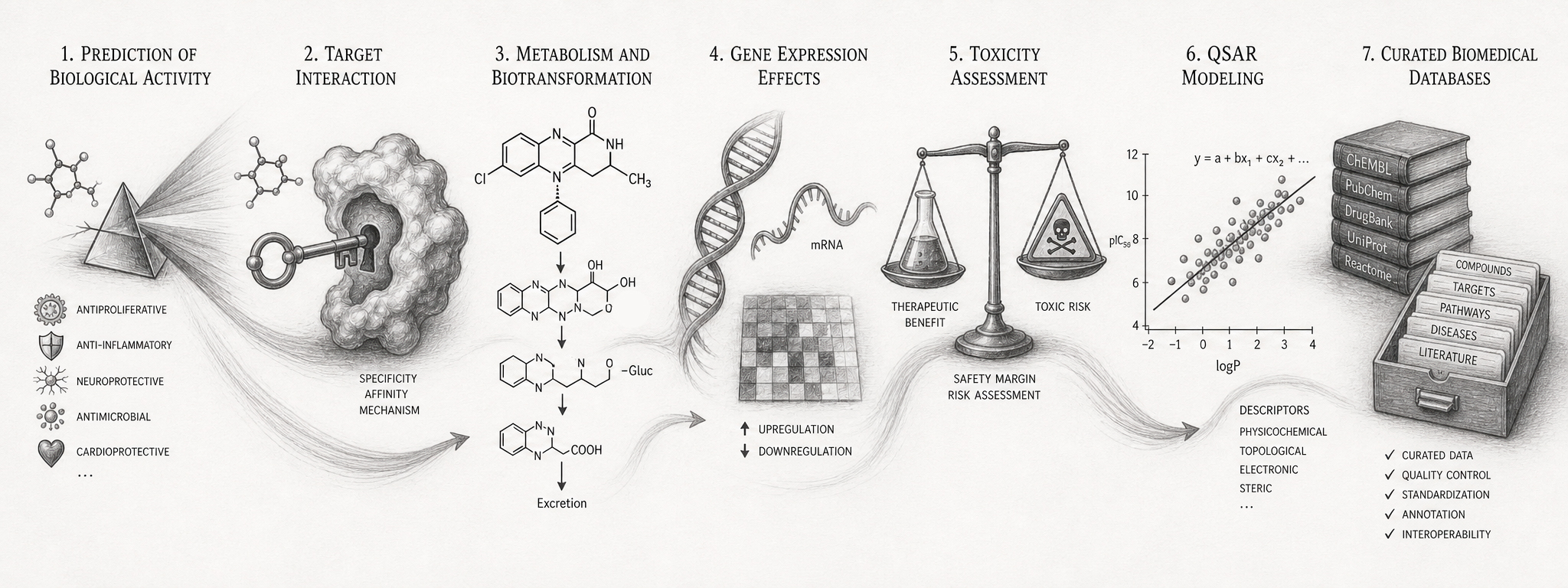
The Way2Drug platform is founded on the premise that the biological properties of chemical compounds are encoded in their molecular structure and can be computationally assessed prior to experimental investigation. The platform integrates a suite of software services and web services covering the complete cycle of in silico pharmacological evaluation: from broad biological activity prediction to quantitative structure–activity/property relationship modeling, metabolism and toxicity prediction, gene expression profiling, and multi-target pharmacological analysis.
The core technology of the Way2Drug platform is the PASS (Prediction of Activity Spectra for Substances), which estimates the probable biological activity spectrum of a small molecule compound based on its two-dimensional structural formula provided in MOLfile or SDfile format. PASS generates probabilistic estimates for more than 10 000 types of biological activity (4,000 are presented on the platform), covering pharmacotherapeutic effects, biochemical mechanisms of enzyme inhibition and receptor interactions, toxic and adverse properties, CYP-mediated metabolic effects, gene expression regulation, and transporter-related activities including P-glycoprotein substrate and inhibitor status.
The PASS algorithm base includes experimentally confirmed structure–activity relationships for more than one million compounds. The predictive accuracy of PASS, evaluated by leave-one-out cross-validation applied to the entire training set, averages approximately 96%.
PASS algrorithm serves as the methodological foundation for a family of specialized web services available on the Way2Drug platform:
PASS Online - prediction of more than 4,000 types of biological activity based on structural formula; freely available to registered users;
PASS Targets - prediction of interactions with human protein targets using a Naive Bayes approach trained on ChEMBL data;
MetaPASS - analysis of biological activity spectra of organic compounds accounting for their biotransformation and predicted metabolic pathways;
DIGEP-Pred - in silico prediction of drug-induced changes in gene expression profiles based on PASS algorithm and training sets derived from the Comparative Toxicogenomics Database;
CLC-Pred (Cell Line Cytotoxicity Predictor) - prediction of cytotoxicity against tumor and non-tumor cell lines based on structural formula;
ROSC-Pred - prediction of organ-specific carcinogenic effects in rodents using training sets from the Carcinogenic Potency Database;
AntiBac-Pred - prediction of antibacterial activity;
SAV-Pred (Single Amino acid Variants Predictor) - for predicting the clinical effect of single amino acid substitutions in proteins associated with monogenic hereditary diseases included in newborn screening panels;
And many others.
PharmaExpert is an expert system designed for systematic analysis of predicted biological activity spectra generated by PASS. The system operates on a formalized knowledge base encoding relationships between predicted types of biological activity, known drug interactions, protein targets, signaling and regulatory pathways, biological processes, and therapeutic and adverse pharmacological effects. This approach enables the identification of chemical compounds satisfying a specified combination of desired pharmacotherapeutic and biochemical activities, while excluding compounds with defined toxic or undesirable properties. PharmaExpert supports the automated generation of structured electronic reports on the pharmacological evaluation of compound libraries, providing a systematic basis for hit selection and compound prioritization in drug discovery projects. A practical example of PharmaExpert application in the context of polypharmacological assessment is demonstrated in the analysis of natural compounds.
PTM site prediction on Way2Drug directly supports drug discovery tasks: PTM sites are known to directly overlap with ligand-binding sites or reside in their immediate vicinity, influencing drug–target interactions. Additionally, PTM prediction results optimize the planning of costly mass spectrometry experiments, particularly the selection of proteotypic peptides, reducing costs and improving the scientific rationale of studies.
GUSAR (General Unrestricted Structure–Activity Relationships) is a software tool for building quantitative SAR and SPR models based on user-provided experimental datasets. The program accepts a custom training set of chemical structures with associated numerical values of biological activity or physicochemical properties, and generates statistically validated predictive models applicable to external compound libraries via batch processing of SD files. The GUSAR Online web service extends this functionality through publicly available models, including prediction of acute toxicity in rats across four routes of administration and interactions with anti-targets.
An important feature of the Way2Drug approach is the combination of predictive resources with curated information systems. The platform includes a number of specialized databases that provide chemical, pharmacological, metabolic, and biomedical context for computational analysis. WWAD (World Wide Approved Drugs) is described on the platform as a database of approved small-molecule drugs and includes chemical structures, names, pharmacotherapeutic fields, mechanisms of action, therapeutic indications, approval-related data, and PASS-based biological activity profiles. Phyto4Health is represented as a resource associated with compounds from the Pharmacopoeia of the Russian Federation and provides compound-centered chemical records on the platform. HGMMX is devoted to human microbiota metabolism and contains information linking parent compounds, metabolites, metabolic transformations, and literature evidence. RHIVDB is identified on the platform as a resource related to HIV sequences, and MDD as a resource related to major depressive disorder.
Taken together, the Way2Drug platform represents an integrated computational environment in which structural formulae serve as the primary input for prediction, interpretation, and modeling of compound properties and effects. Its architecture combines broad biological activity profiling, target-oriented and mechanism-oriented prediction, metabolism and toxicity assessment, gene expression response estimation, quantitative SAR/SPR modeling, and database-supported contextualization of compounds and diseases. The availability of both web-accessible services and locally deployable software products indicates that the platform is intended to support research tasks ranging from exploratory screening and hypothesis generation to the analysis of proprietary datasets in computational environments.

© 2011 - 2026 Way2Drug. All rights reserved.


