
was created to support early-stage discovery of novel antiretroviral drugs. Despite the existence of highly active antiretroviral therapy (HAART), currently available drugs do not provide a complete cure, carry serious side effects, and contribute to the emergence of drug-resistant viral strains. The use of computational prediction methods at early research stages reduces the number of compounds requiring synthesis and biological testing, thereby lowering both time and financial costs.
More than 50,000 experimental records of antiretroviral activity were extracted from the ChEMBL database (version 24) to build the predictive models. After thorough data curation, training sets were assembled for five HIV-1 targets: protease (PR), reverse transcriptase (RT), integrase (IN), TAT protein, and Rev protein. Regression models were built using the GUSAR software and demonstrate high accuracy: mean R2 = 0.95 and Q2 = 0.72. Additionally, using the PASS program, prediction of 81 types of biological activity relevant to the treatment of HIV-associated comorbidities is implemented, with a mean accuracy of 92%. The service accepts single-component, uncharged structures with molecular weight below 1250 Da and at least three carbon atoms.
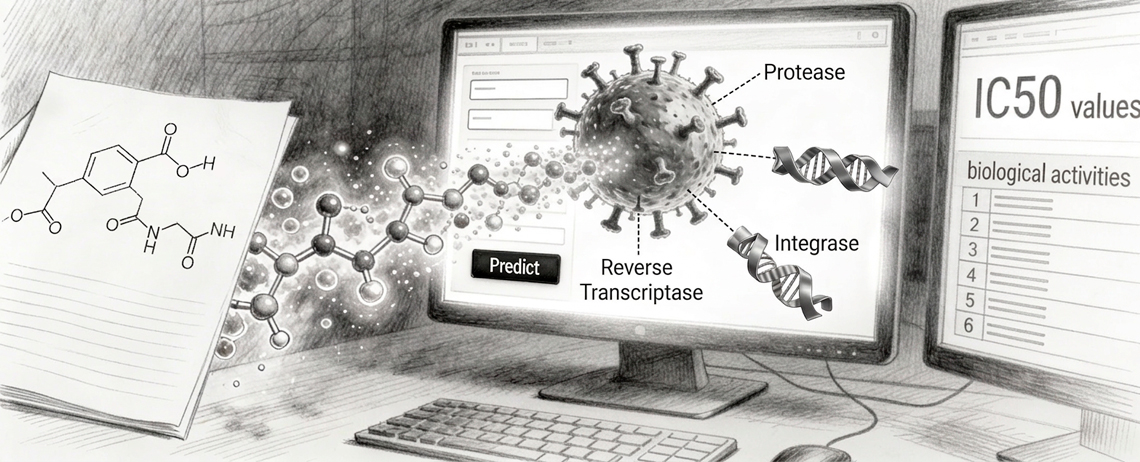
Working with the service is straightforward:
The user draws a molecular structure in the built-in Marvin JS editor (runs in any HTML5-compatible browser without plugins);
Selects the HIV-1 target of interest and the experimental data source for the model;
Clicks the "Predict" button and receives the result.
The service provides the following outputs:
Predicted IC50 values for the molecule's interaction with HIV-1 protease, reverse transcriptase, and integrase;
A list of probable biological activities relevant to the treatment of HIV-associated comorbidities, with probabilities Pa (probability of belonging to the "active" class) and Pi (probability of belonging to the "inactive" class);
The service provides direct access to predictions for compounds from the Open NCI database (NCI Developmental Therapeutics Program), whose samples researchers can request for experimental testing.
AntiHIV-Pred can be applied at different stages of a drug discovery pipeline. At the hit identification stage, researchers can screen virtual libraries of newly synthesized or commercially available compounds to quickly rank candidates by predicted potency against specific HIV-1 targets. At the lead optimization stage, medicinal chemists can compare structural analogs side by side, using the predicted IC50 values as a guide for rational modification of the scaffold. Additionally, because the service covers HIV-associated comorbidities through PASS-based predictions, it is well suited for identifying multi-target compounds that may simultaneously address the virus and conditions such as neurocognitive disorders or opportunistic infections commonly seen in HIV-positive patients.
A useful feature of the service is direct access to compounds from the Open NCI database, some of which can be requested for experimental testing through the NCI Developmental Therapeutics Program. In practice, this makes AntiHIV-Pred not just a prediction interface, but a convenient screening tool for prioritizing molecules with potential anti-HIV activity and multi-target therapeutic relevance before laboratory validation.

For medicinal chemists and synthetic chemists - instantly assess the likely anti-HIV potency of your newly designed structures before committing to laboratory synthesis, saving both reagents and time.
For pharmacologists and drug repurposing researchers - screen approved drugs or natural product libraries against all five HIV-1 targets simultaneously, and identify unexpected candidates with multi-target profiles.
For computational and ADMET researchers - integrate AntiHIV-Pred predictions into broader in silico workflows alongside toxicity and ADMET tools available on the Way2Drug platform, building a comprehensive early safety and efficacy profile for each candidate.
Leonid Stolbov et al. (2019)
AntiHIV-Pred: web-resource for in silico prediction of anti-HIV/AIDS activity.
Bioinformatics, 36(3):978–979.
If you need to evaluate a large dataset, or if you need to maintain confidentiality of structural formulas transmitted via unsecured data channels, you can contact us to discuss the licensing opportunities.

© 2011 - 2026 Way2Drug. All rights reserved.