
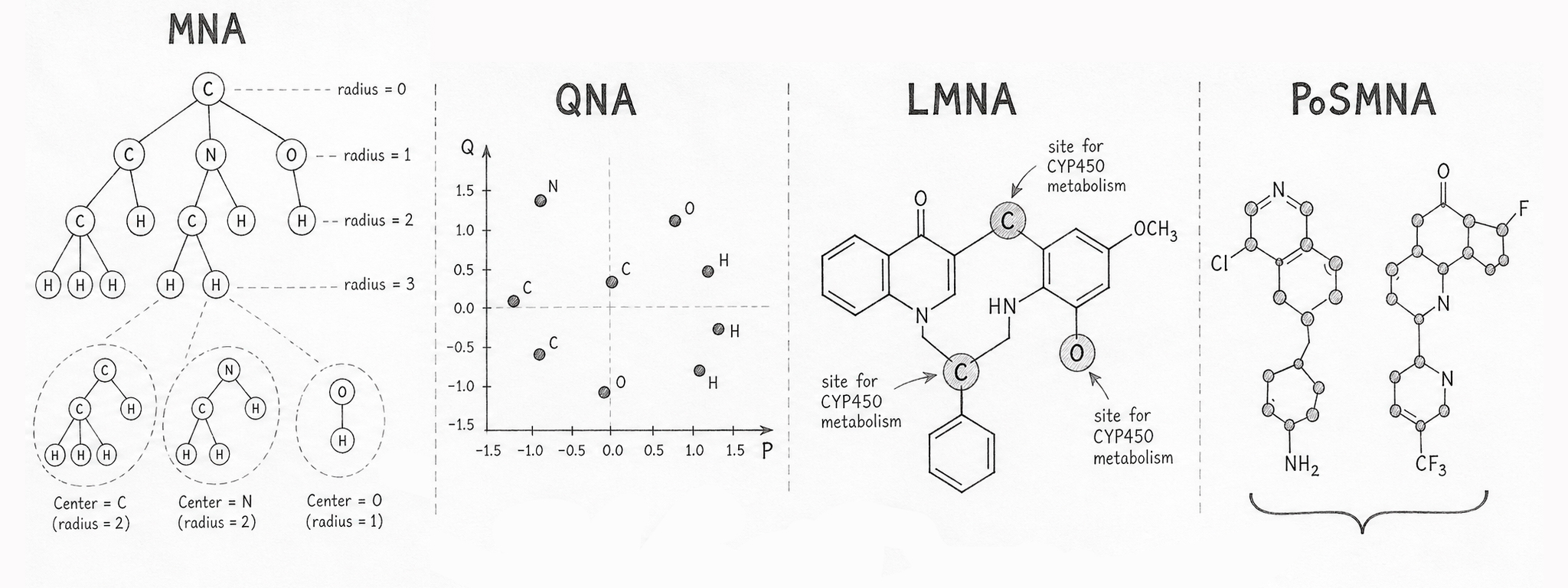
The Multilevel Neighborhoods of Atoms (MNA) structure descriptors are 2D atom-centered structural fingerprints introduced by us in 1999, generated recursively from a molecule's connection table and atom type table. The generation follows a strict recursive scheme: the zero-level descriptor of each atom is simply its element type label A; each subsequent level N+1 descriptor is formed as A(D1D2…Di), where D1…Di are the level-N MNA descriptors of all immediate neighbors of the given atom, arranged in lexicographic order. A key feature of MNA is that hydrogen atoms are included implicitly according to atomic valences and partial charges, while bond types are not explicitly specified and hybridization and charge information is therefore encoded indirectly through atom labels rather than bond annotations.
The resulting descriptor set for a molecule is a collection of unique string-based substructure notations, one per heavy atom, representing nested local chemical environments at growing radii from each atom center. Two molecules are considered structurally equivalent in MNA-based models if and only if their complete sets of MNA descriptors are identical, meaning stereoisomers that differ only in spatial arrangement are formally treated as equivalent. MNA descriptors have been the structural representation backbone of the PASS (Prediction of Activity Spectra for Substances) software for more than 25 years and underpin numerous Way2Drug services.
QNA descriptors, introduced by us in 2009, extend the atom-neighborhood concept by replacing symbolic atom labels with quantum-chemical atomic parameters, specifically, the standard ionization potential (IP) and electron affinity (EA) of each atom, derived from the molecular connectivity matrix. From these values, two composite atomic parameters are computed for each atom i: Ai = ½ (IPi+EAi) and Bi =(IPi−EAi)½, which serve as coordinates in a two-dimensional descriptor space; the full QNA descriptors P and Q are then obtained by propagating these values across the molecular graph via an exponential decay of the connectivity matrix, so that every atom's descriptor reflects contributions from all other atoms in the molecule weighted by topological distance.
This design leads to the hallmark of the QNA-based "Star Track" QSAR methodology: rather than representing a molecule as a single point in a high-dimensional descriptor space, each molecule is represented as a set of points in 2D QNA space like one point per atom and the predicted quantitative property is computed as an average function over all atomic contributions. This approach requires only two descriptors (P and Q per atom) instead of the thousands used in conventional QSAR, dramatically reducing dimensionality while retaining chemically meaningful, physics-grounded information about electronic structure. QNA descriptors are the core of the GUSAR (General Unrestricted Structure–Activity Relationships) service on Way2Drug, which is used for building QSAR/QSPR models of quantitative endpoints such as acute toxicity, human liver microsomal stability, and antitarget interaction potency.
Pairs of Substances Multilevel Neighbourhoods of Atoms (PoSMNA) descriptors were developed and introduced as part of the DDI (Drug-Drug Interaction) prediction framework within the PASS software, specifically to address the challenge of encoding pairs of molecules rather than individual compounds as input to SAR models. A single PoSMNA descriptor for a molecular pair is formed as the direct Cartesian product of the two individual MNA descriptor sets: given molecule A with MNA descriptor set {a, b, c, …} and molecule B with set {d, e, f, …}, the PoSMNA descriptor set is {ad, ae, af, …, bd, be, bf, …, cd, ce, cf, …}, capturing all pairwise combinations of local atomic environments from both compounds simultaneously.
This combinatorial construction enables the classification algorithm in PASS to learn structure–activity relationships not for individual molecules, but for interacting molecular pairs, which is the natural representation for phenomena such as drug-drug interactions mediated by shared metabolic pathways. The descriptor uses 2nd-level MNA descriptors computed for heavy atoms only, balancing descriptor granularity with computational tractability. PoSMNA-based models have demonstrated an average prediction accuracy of approximately 0.84 for DDI class prediction and are implemented in the DDI prediction web service; the approach is also generalizable to any task where pairs of molecules act jointly, such as synergy or antagonism prediction.
Labeled MNA (LMNA) descriptors extend the original MNA framework by introducing explicit atomic labels that encode additional chemical information beyond simple element type. In standard MNA, each atom is identified solely by its element symbol and implicit hydrogen count; in LMNA, each atom is additionally characterized by a label derived from its local chemical environment, such as functional group membership, charge state, or specific bonding context providing a richer and more discriminative representation of the molecular structure.
The generation principle mirrors that of MNA: descriptors are built recursively from a molecule's connection table, with each atom's LMNA descriptor at level N+1 being formed by combining its own typed label with the sorted level-N LMNA descriptors of its neighboring atoms. The additional labeling allows the method to distinguish chemically distinct atomic environments that would appear identical under standard MNA atom typing, thereby improving the resolution of structure–activity models for tasks where subtle local chemical differences are decisive.
We introduced LMNA descriptors in 2014, which are used in Way2Drug services that focus on biotransformation and metabolism prediction. These services require a higher level of atom-specificity than MNA alone provides to identify the precise reactive atomic site, or the site of metabolism (SOM). A further extension, described in a 2024 proteochemometric study, combines LMNA-type atomic descriptors of ligands with protein sequence N-grams into a composite representation termed TLMNA (Target-Ligand MNA), enabling simultaneous encoding of both the small molecule and its macromolecular target for predicting ligand–protein interaction selectivity.
| Descriptor | Key Innovation | Primary Application on Way2Drug |
|---|---|---|
| MNA | Recursive, bond-type-free 2D atom neighborhoods | PASS Online, CLC-Pred, PASS Targets, HVR, MetaPASS and etc. |
| QNA | Quantum-chemical IP/EA atomic properties in 2D space | GUSAR (toxicity, antitargets), Metabolic Stability, AntiHIV-Pred |
| PoSMNA | Pharmacophore-typed atom labels in MNA framework | CLC-Pred Synergy, DDI-Pred, AdverDDIpred |
| LMNA | Labeled atoms for biotransformation context | SOMP, RA, P450-Analyzer |
The four descriptors are unified by the principle of local confirmity, which posits that global molecular properties arise from the aggregation of local atomic environments. This principle renders the descriptors computationally efficient, interpretable, and ideal for large-scale SAR modeling across diverse chemical spaces.

© 2011 - 2026 Way2Drug. All rights reserved.


