
was designed to predict the metabolism of drug-like compounds by the human gut microbiota using in silico SAR modeling.
The human gut microbiota contains microbial enzymes that can biotransform a variety of xenobiotics, including orally administered pharmaceuticals, through processes such as reduction, hydrolysis, deacetylation, deglucuronidation, ring fission, and dealkylation. These transformations can activate, inactivate, or toxify drugs (e.g., sulfasalazine activation, digoxin inactivation, irinotecan toxification), making early-stage prediction of microbiota-mediated drug metabolism (MDM) critical for pharmacological research.
The service is underpinned by three SAR classification models built using PASS (Prediction of Activity Spectra for Substances) software, trained on a curated dataset of over 600 compounds drawn from more than 80 publications. The training set includes 329 MDM-positive and 292 MDM-negative compounds, with the Multilevel Neighbourhoods of Atoms descriptors used as molecular representations.
Predictive Performance
| Model | Function | Accuracy (IAP/AUC) |
|---|---|---|
| MDM | Predicts whether a compound will be metabolized by HGM | 0.85 |
| Genus | Predicts bacterial genera responsible for metabolism | avg. 0.92–0.95 |
| Reaction | Predicts biotransformation reaction types | avg. 0.92–0.93 |
Users can submit a query compound via three input methods: drawing a structure in the JSME Applet, entering a SMILES string, or uploading a MOL file. Drug names can also be entered, with structures retrieved from DrugBank v5.10.
The prediction output consists of four result tables covering:
overall MDM susceptibility;
responsible bacterial genus;
predicted biotransformation reactions - all presented as Pa (probability active) and Pi (probability inactive) scores, with only results where Pa > Pi displayed;
a table of structurally similar compounds from the training set, with similarity calculated using both MNA/Tanimoto and QNA/modified-Tanimoto methods and providing experimental context for the predictions.
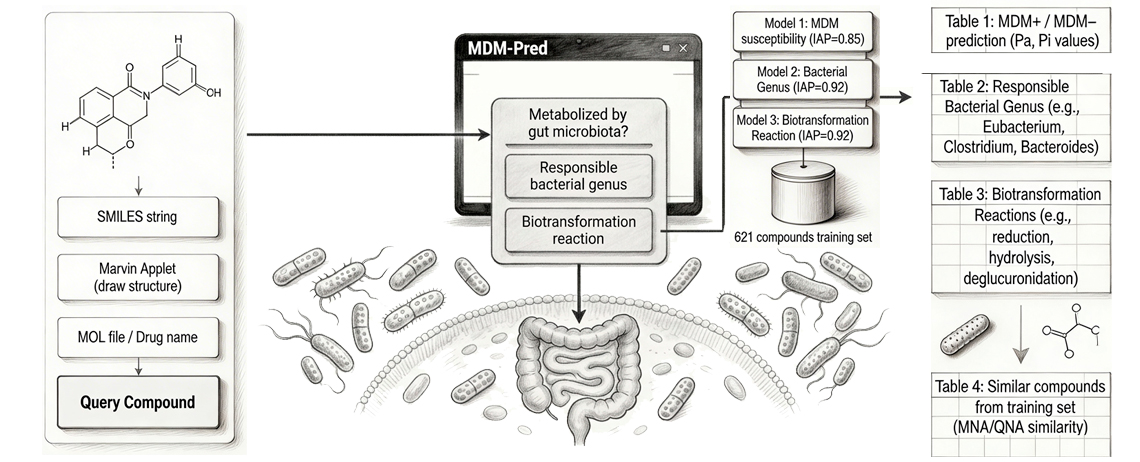
MDM-Pred is designed to support early-stage evaluation of orally administered drug candidates by predicting their susceptibility to biotransformation by the human gut microbiota. The service helps researchers predict which reactions, such as reduction, hydrolysis, deglucuronidation, dealkylation, or ring fission, are most likely to occur and identify the bacterial genera responsible for these transformations. Examples of these genera include Eubacterium, Clostridium, Bacteroides, and Blautia. This information is directly relevant to microbiome-aware pharmacokinetic and pharmacodynamic modelling, enabling a more complete picture of a compound's metabolic fate in the gastrointestinal tract. MDM-Pred can help researchers identify cases of prodrug activation, drug inactivation, and metabolic toxification by gut bacteria. These phenomena are well documented for compounds such as sulfasalazine, digoxin, and irinotecan. Thus, MDM-Pred can contribute to the safer and more rational design of new pharmaceutical agents.
Early-stage risk flagging: quickly identify microbiota-mediated metabolic liabilities of new drug candidates at the earliest stages of drug discovery, long before costly in vitro or in vivo experiments.
Mechanistic depth: unlike simple yes/no classifiers, MDM-Pred simultaneously predicts the responsible bacterial genus and the type of biotransformation reaction, offering actionable mechanistic insight in a single query.
Experimental context: the built-in similar compounds table (ranked by MNA/Tanimoto and QNA similarity) lets you directly compare your prediction with structurally related compounds that have published experimental MDM data.
Anton S. Kolodnitsky et al. (2023)
MDM-Pred: a freely available web application for predicting the metabolism of drug-like compounds by the gut microbiota.
SAR and QSAR in Environmental Research, 34(5):383-393.
If you need to evaluate a large dataset, or if you need to maintain confidentiality of structural formulas transmitted via unsecured data channels, you can contact us to discuss the licensing opportunities.

© 2011 - 2026 Way2Drug. All rights reserved.