HOME / Software

Affiliate software

Software for sensitive data

Modern pharmacology faces a fundamental paradox: the chemical space of potential drug molecules is virtually boundless. By various estimates, it comprises more than 10⁶⁰ synthetically accessible organic compounds. However, the experimental evaluation of each candidate demands substantial time and financial resources. The cost of bringing a single new drug to market exceeds one billion dollars, and the majority of compounds that enter clinical trials never reach registration due to insufficient efficacy, toxicity, or undesirable pharmacokinetic properties that were not identified in earlier stages. In this context, cheminformatics and computer-aided drug design play an indispensable filtering role. (Q)SAR modeling methods and biological activity spectrum prediction make it possible to assess the pharmacological potential and safety profile of a molecule in advance, before synthesis, concentrating experimental resources on the most promising structures. It is precisely to address these challenges that the software packages PASS, PharmaExpert, and GUSAR were developed, which many years ago laid the foundation for the Way2Drug platform as a publicly accessible suite of services for evaluating the biological insight of organic compounds.

Taken together, PASS, PharmaExpert, and GUSAR form an integrated computational environment for the prediction, interpretation, and quantitative modeling of structure–activity relationships. PASS provides broad biological profiling, PharmaExpert translates predicted activity spectra into pharmacologically meaningful conclusions, and GUSAR enables the construction of custom quantitative models tailored to specific experimental datasets. In a local deployment format, these software products provide organizations with full control over confidential data, flexible integration into internal workflows, and efficient support for computer-aided drug discovery and chemical safety assessment.

PASS local software for structure-based activity profiling

PASS (Prediction of Activity Spectra for Substances)

Qualitative prediction
  • Role: PASS (Prediction of Activity Spectra for Substances) is a software for estimating probable biological activity profiles of chemical compounds based solely on their structural formulae provided in MOLfile or SDfile format. The program predicts the spectrum of potential biological effects that a compound may exhibit, allowing researchers to assess its pharmacological potential at the early stages of drug discovery. The list of predictable activities includes more than 10 000 biologically meaningful terms and covers a broad range of endpoints, such as pharmacotherapeutic effects (for example, antiarrhythmic or anti-inflammatory activity), biochemical mechanisms of action (such as cyclooxygenase 1 inhibition), toxic and adverse effects (including carcinogenicity and teratogenicity), metabolism-related properties (for example, inhibition of CYP isoforms such as CYP3A4), regulation of gene expression (such as VEGF expression inhibition), and transporter-related activities (including P-glycoprotein substrate or inhibitor properties).
  • Background:The prediction generated by PASS is based on a large knowledge base of structure–activity relationships derived from more than 1 500 000 chemical compounds with experimentally determined biological activities. This extensive training set enables the software to identify hidden regularities between molecular structure and biological response, even for structurally diverse compounds. PASS is especially valuable for virtual screening, hit discovery, drug repurposing, mechanism-of-action hypothesis generation, and prioritization of compounds for experimental testing. According to leave-one-out cross-validation performed on the entire training set, the average prediction accuracy is about 96%, which makes PASS a reliable tool for preliminary biological profiling in large-scale and focused research projects alike. The PASS software served as the foundation for the PASS Online web service, which for more than 20 years has enabled users to evaluate the spectrum of 4,000 types of biological activities of low-molecular-weight chemical compounds based solely on their chemical structure.

PharmaExpert

Analytical system
  • Role:PharmaExpert is a knowledge-based analytical system developed to interpret and refine the predicted activity spectra generated by PASS. While PASS provides probabilities of individual biological activities, PharmaExpert analyzes the logical and pharmacological relationships between these activities, as well as their associations with drug–drug interactions, therapeutic effects, adverse reactions, and polypharmacological behavior. This makes PharmaExpert particularly useful for selecting compounds with a desired combination of activities and for excluding those with potentially unfavorable properties. The system supports the design and identification of compounds possessing predefined biological activity profiles, including required pharmacotherapeutic effects and relevant biochemical mechanisms, while simultaneously filtering out compounds associated with undesirable toxicities or side effects.
  • Background:In practical applications, PharmaExpert may be used for lead optimization, compound library triage, safety-oriented prioritization, and polypharmacology analysis. By combining predicted activities into meaningful expert rules and pharmacological patterns, it helps researchers move from a raw activity spectrum to a more interpretable biological and therapeutic assessment. Another important feature of PharmaExpert is the generation of electronic reports summarizing the analysis of chemical compound libraries, which can support decision-making in medicinal chemistry programs, screening campaigns, and internal R&D workflows.
PharmaExpert software for interpretation of predicted activity profiles
GUSAR software for QSAR and QSPR model development

GUSAR

Quantitative prediction
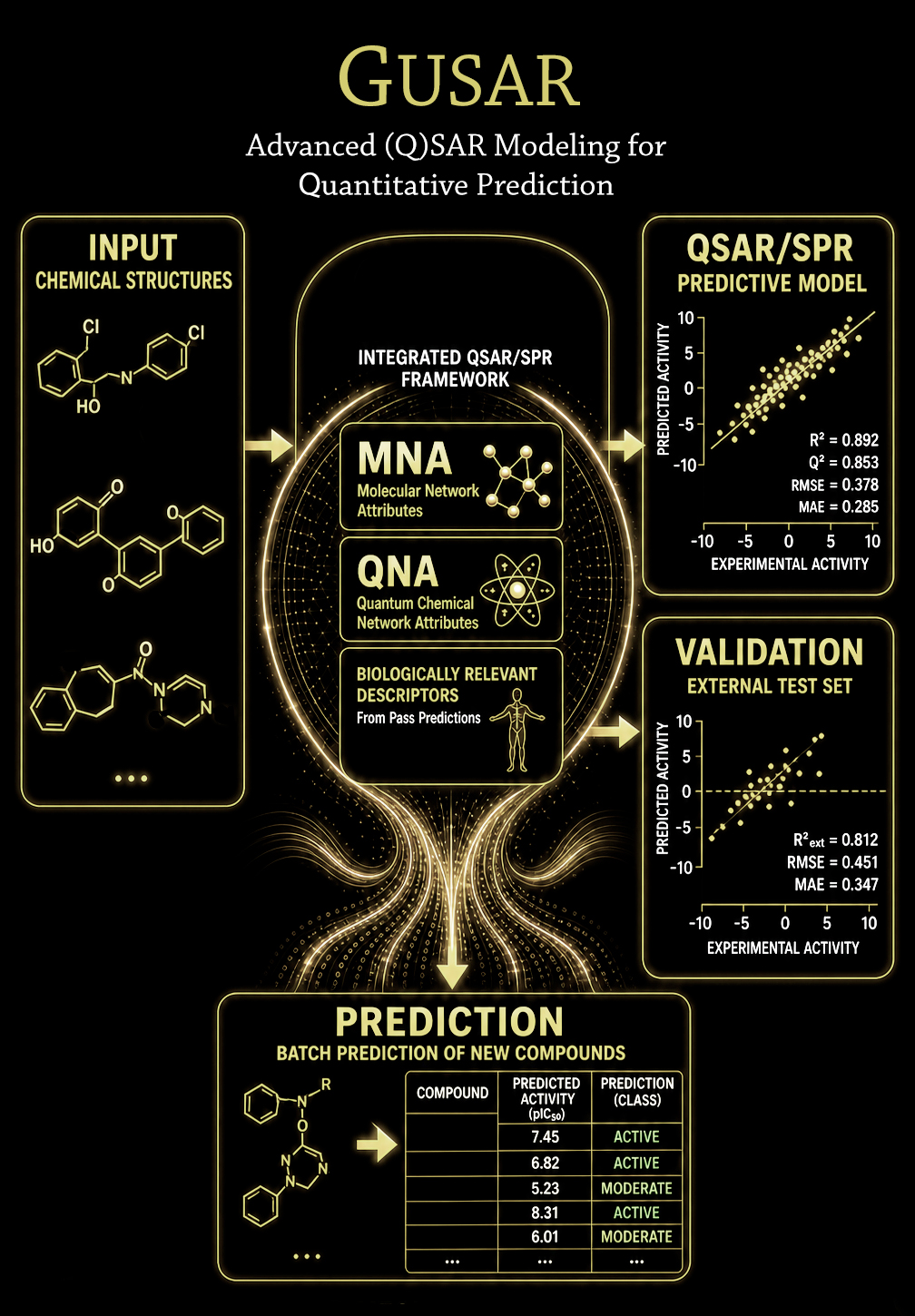
  • Role:GUSAR (General Unrestricted Structure–Activity Relationships) is a software tool for building quantitative structure–activity relationship (QSAR) and structure–property relationship (SPR) models using user-provided experimental data. The program accepts an in-house training set consisting of chemical structures and measured quantitative values of biological activities or physicochemical properties, and produces statistically validated predictive models suitable for further virtual screening and property estimation. GUSAR is designed to support the development of robust and reliable quantitative models even for structurally heterogeneous datasets, making it useful in pharmacology, toxicology, medicinal chemistry, and materials-related applications.
  • Background:The methodological core of GUSAR is based on a unique self-consistent regression algorithm that selects the most informative descriptor sets for model generation. These descriptors include MNA (Multilevel Neighborhoods of Atoms), which encode structural fragments and atom-centered environments; biologically relevant descriptors calculated on the basis of PASS-predicted activity profiles; and QNA (Quantitative Neighborhoods of Atoms) descriptors, which represent molecular structure in a form convenient for quantitative modeling. The combination of these descriptor types allows GUSAR to capture both structural and biologically meaningful information, thereby improving model interpretability and predictive performance. The software supports the use of SD files for batch prediction, which makes it suitable for processing large compound collections and applying prebuilt models to external libraries.
Software Primary function Input data Output
PASS Qualitative activity profiling Chemical structures in MOL/SDF format Probabilistic activity hypotheses
PharmaExpert Rule-based activity-profile interpretation PASS output Research-oriented interpretation and compound prioritization
GUSAR QSAR model development Chemical structures and measured quantitative values Custom quantitative models