
Chemical Named Entity Recognition is a web service that automatically identifies and extracts names of chemical compounds from texts of scientific publications.
The service is built on a Naive Bayes classifier combined with a set of specially developed filters. Input text is tokenized, and for each token a context window of one token before and one token after (context −1/+1) is assembled into a fragment of text. Each text fragment is represented as a set of multi-n-grams, which are all contiguous sequences of one to five symbols. These multi-n-grams serve as descriptors that are analogous to substructural fingerprints used in QSAR studies. The classifier computes the probability of each token belonging to one of six classes: Abbreviation, Formula, Family, Systematic (IUPAC), Trivial (trade/common names), CNE (the merged chemical entity class), or non-CNE.
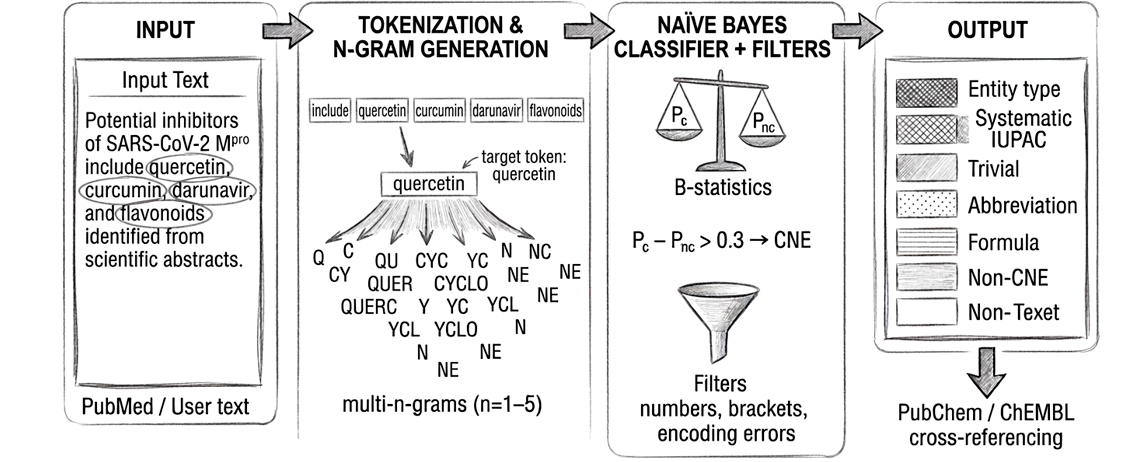
The method was validated on the publicly available CHEMDNER corpus (10,000 PubMed abstracts, >80,000 labelled entities) using five-fold cross-validation. Key accuracy metrics for the integrated CNE class are:
Predictive Performance
| Metric | Value |
|---|---|
| Sensitivity (Recall) | 0.95 |
| Precision | 0.74 |
| Specificity | 0.88 |
| Balanced Accuracy | 0.92 |
| Invariant Accuracy (IA, LOO-CV) | 0.98 |
These results are comparable to many deep learning-based approaches (BiLSTM-CRF, BioBERT), while requiring no vector pre-training or retraining when the corpus is extended.
The key features of the web service are:
accepts plain text input (e.g., abstracts of scientific papers) and returns color-annotated output highlighting recognized chemical names;
results are presented as three-token fragments with the target token in uppercase, enabling easy visual inspection;
does not require linguistic preprocessing (no part-of-speech tagging or grammar analysis), making it robust to varied text styles;
Handles highly imbalanced datasets effectively - non-CNE tokens outnumber CNE tokens ~50:1, yet accuracy remains high;
supporting Python scripts for batch processing are available on GitHub.
CNER can be applied to large-scale literature mining tasks in cheminformatics, medicinal chemistry, and drug discovery. A demonstrated use case involves processing collections of PubMed abstracts to extract candidate compound names for a given biological target — for example, potential inhibitors of the SARS-CoV-2 main protease (Mpro). Algorithm was applied to 1,528 abstracts on SARS-CoV-2 main protease (Mpro) inhibitors retrieved from PubMed. It extracted 2,649 unique chemical named entities, and cross-referencing with PubChem and ChEMBL databases confirmed the precision of 0.72. Among the correctly identified compounds were known Mpro inhibitors and candidates such as quercetin, curcumin, darunavir, flavonoids, and dihydromyricetin The extracted CNEs can be directly linked to chemical databases such as PubChem and ChEMBL to retrieve structural and bioactivity data, supporting downstream virtual screening or QSAR modeling workflows.

Rapid extraction of compound names from literature — instead of reading hundreds of abstracts manually, CNER automatically identifies all chemical entities in a text corpus, saving significant time in systematic reviews, meta-analyses, or target-focused compound collection.
No preprocessing or retraining required - unlike deep learning methods that rely on pre-trained word vectors or domain-specific corpora, CNER processes raw text directly using multi-n-gram descriptors, making it straightforward to apply to new topics or text styles without additional model training.
Recognition of diverse chemical name types - the service classifies entities into Systematic (IUPAC), Trivial, Abbreviation, Formula, and Family categories, providing structured output that can be used for database cross-referencing, data curation, or building chemical–target association networks.
Olga A. Tarasova et al. (2022)
Chemical named entity recognition in the texts of scientific publications using the Naive Bayes classifier approach.
Journal of Cheminformatics, 14:55.
If you need to evaluate a large dataset, or if you need to maintain confidentiality of structural formulas transmitted via unsecured data channels, you can contact us to discuss the licensing opportunities.

© 2011 - 2026 Way2Drug. All rights reserved.