
is a web service designed for in silico prediction of rodent organ-specific carcinogenicity from the structural formula of organic compounds.
The service uses structure–activity relationship (SAR) models built with PASS (Prediction of Activity Spectra for Substances) software, which applies a Bayesian-like algorithm combined with Multilevel Neighborhoods of Atoms (MNA) descriptors to encode molecular structure. Training sets were constructed from data on 1,011 organic compounds evaluated in standard two-year rodent carcinogenicity bioassays, sourced from the Carcinogenic Potency Database (CPDB), also available through the EPA's DSSTox network.
ROSC-Pred predicts carcinogenicity with specificity for species (rats or mice), sex (male or female), and target organ or tissue, making it considerably more informative than binary (carcinogen/non-carcinogen) classifiers. The average prediction accuracy, estimated by leave-one-out cross-validation, reached 79%, while 10-fold cross-validation yielded 78.2%.
You can submit a compound's structural formula directly through the web interface to obtain probabilistic estimates of organ-specific carcinogenic risk. The service supports batch predictions via SD file uploads. Each prediction result is accompanied by a Pa (probability to be active) value, which researchers can interpret using built-in guidance on the site. As part of the broader Way2Drug platform, ROSC-Pred integrates seamlessly with complementary predictive tools for ADMET properties, gene expression profiling, and biological activity spectra.
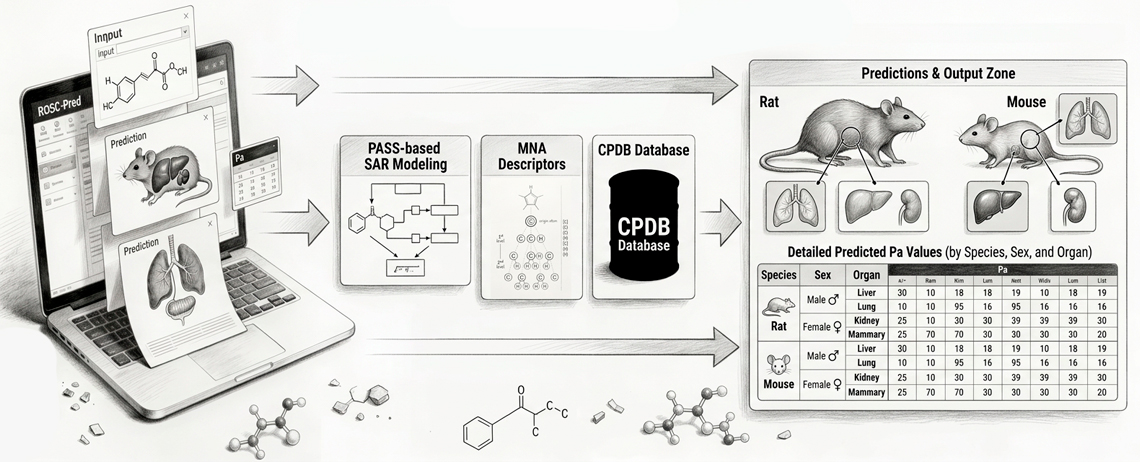
ROSC-Pred is particularly valuable during early-stage drug discovery and preclinical safety assessment, where experimental carcinogenicity testing is resource-intensive and time-consuming. Researchers can rapidly screen for potential organ-specific carcinogenic risk in rats and mice by submitting a candidate compound's structural formula, long before committing to costly two-year in vivo bioassays. The service supports both single-compound queries and batch processing via SD file uploads, making it equally suitable for individual lead optimization studies and large-scale virtual screening campaigns. Results are delivered with probabilistic confidence scores (Pa values), enabling prioritization of compounds with the most favorable safety profiles for further development.
Early toxicity flagging - ROSC-Pred identifies potential carcinogenic liabilities at the molecular design stage, allowing medicinal chemists to deprioritize hazardous scaffolds and redirect synthetic efforts before any biological testing begins.
Organ- and species-specific resolution - unlike binary classifiers that only label a compound as carcinogenic or not, ROSC-Pred specifies the likely target organ and affected species (rat or mouse, male or female), providing actionable mechanistic context for structure optimization.
Seamless integration into ADMET workflows - As part of the Way2Drug platform, ROSC-Pred can be used alongside tools for biological activity, metabolism, and toxicity prediction, enabling a comprehensive in silico safety profile within a single ecosystem.
Anastasia V. Rudik et al. (2016)
Prediction of reacting atoms for the major biotransformation reactions of organic xenobiotics.
Journal of Cheminformatics, 8:68.
If you need to evaluate a large dataset, or if you need to maintain confidentiality of structural formulas transmitted via unsecured data channels, you can contact us to discuss the licensing opportunities.

© 2011 - 2026 Way2Drug. All rights reserved.