
is web service designed for the in silico prediction of compound cytotoxicity against human breast cancer cell lines. The web service was developed using consensus (Q)SAR models created from ChEMBL v.30 data for nine breast cancer cell lines, including T47D, ZR-75-1, MX1, Hs-578T, MCF7-DOX, MCF7, Bcap37, MCF7R, and BT-20, including drug-resistant variants such as MCF7-DOX and MCF7R. Its main purpose is to support the early selection and optimization of potential antitumor agents by reducing the time and cost of experimental screening.
The models implemented in BC CLC-Pred show reasonable predictive performance, with mean 5-fold cross-validation values of R2=0.599, RMSE = 0.679, and balanced accuracy = 0.875 for the selected models. This combined prediction format is useful because it provides both a binary assessment of potential activity and a numerical estimate of cytotoxic or growth-inhibitory strength.
The tool is built on a set of 24 consensus (Q)SAR models created using the GUSAR software and experimental data extracted from the ChEMBL v.30 database. For each supported cell line, BC CLC-Pred delivers two complementary types of output:
Qualitative SAR prediction - classifies a compound as active or inactive based on a cytotoxicity threshold of 1000 nM, separately for IC50 and IG50 endpoints;
Quantitative QSAR prediction - estimates the numerical pIC50 and pIG50 values, reflecting the strength of the cytotoxic or cytostatic effect.
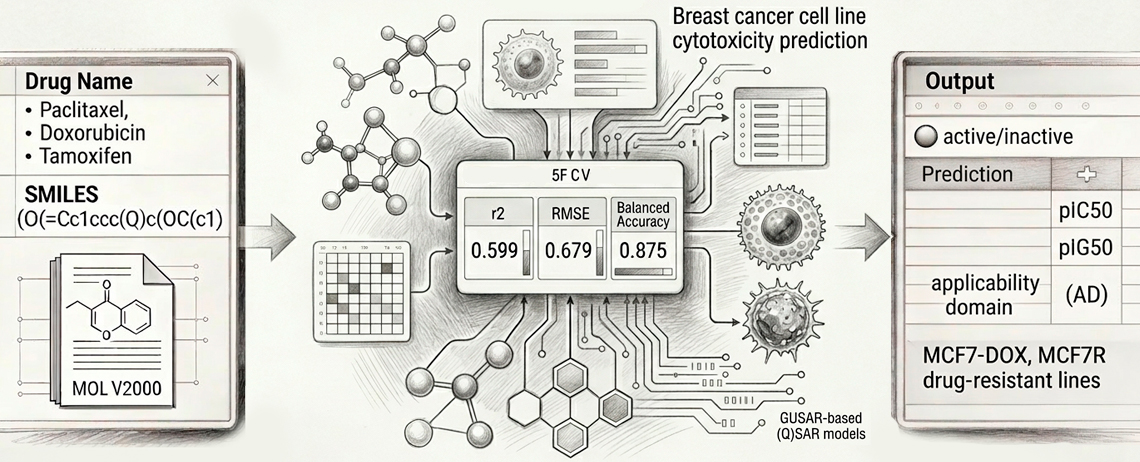
BC CLC-Pred has a user-friendly web interface that allows a compound to be submitted in several ways: by drawing the structure in Marvin JS, entering a SMILES string, typing a drug name, or uploading a MOL file. The output is presented as a results table showing the cell line name, the predicted value, and whether the compound is inside the applicability domain of the corresponding model. The prediction results can also be exported in CSV, Excel, or PDF format, and the service additionally provides access to training set descriptions and prediction interpretation information.
BC CLC-Pred is intended for use at the early stages of anticancer drug discovery, where rapid in silico filtering of compound libraries can significantly reduce experimental workload. A typical workflow involves submitting a candidate structure, such as a newly synthesized molecule, natural product, or virtual screening hit, and interpreting the combined qualitative and quantitative outputs across all nine breast cancer cell lines. A compound predicted as active by multiple SAR models and assigned pIC50 or pIG50 values above 6 by the QSAR models can be prioritized for experimental cytotoxicity assays, while compounds with weak or out-of-domain predictions can be deprioritized or structurally modified. The service also supports the analysis of drug-resistant cell lines (MCF7-DOX, MCF7R), which makes it applicable to the study of multidrug resistance mechanisms and the search for agents capable of overcoming them. We demonstrated using paclitaxel as a reference compound, BC CLC-Pred correctly predicted broad-spectrum cytotoxic activity across most supported cell lines, confirming the practical reliability of the models for known antitumor agents.

Simultaneous multi-cell-line profiling - a single query returns both qualitative (active/inactive) and quantitative (pIC50/pIG50) predictions for up to nine breast cancer cell lines at once, saving time compared to running individual experimental assays for each subtype.
Coverage of drug-resistant subtypes - the inclusion of MCF7-DOX and MCF7R cell lines enables early assessment of whether a compound may retain activity against doxorubicin- and tamoxifen-resistant tumor cells, a critical factor in developing next-generation antitumor agents.
Applicability domain transparency - every prediction is accompanied by an AD indicator, allowing users to immediately judge how reliable a given result is based on the structural similarity of the query compound to the training set, reducing the risk of acting on extrapolated predictions.
A.A. Lagunin et al. (2023)
BC CLC-Pred: a freely available web-application for quantitative and qualitative predictions of substance cytotoxicity in relation to human breast cancer cell lines.
International Journal of Molecular Sciences, 24(2), 1689.
If you need to evaluate a large dataset, or if you need to maintain confidentiality of structural formulas transmitted via unsecured data channels, you can contact us to discuss the licensing opportunities.

© 2011 - 2026 Way2Drug. All rights reserved.