
Single Amino acid Variants Predictor is a specialized web service for predicting the clinical effect of single amino acid substitutions in proteins associated with monogenic hereditary diseases included in newborn screening panels. It was developed as a supportive tool for the interpretation of missense variants and is based on protein-specific models trained for 25 genes associated with diseases covered by newborn screening.
SAV-Pred is based on the sequence–structure–property relationships (SSPR) approach, in which an amino acid substitution is analyzed not in isolation, but together with its local amino acid environment in the protein. For this purpose, the authors represent protein sequence fragments as structural formulas and apply a modified version of PASS/MultiPASS with MNA descriptors and a Naive Bayes classifier to estimate the probability of variant pathogenicity.
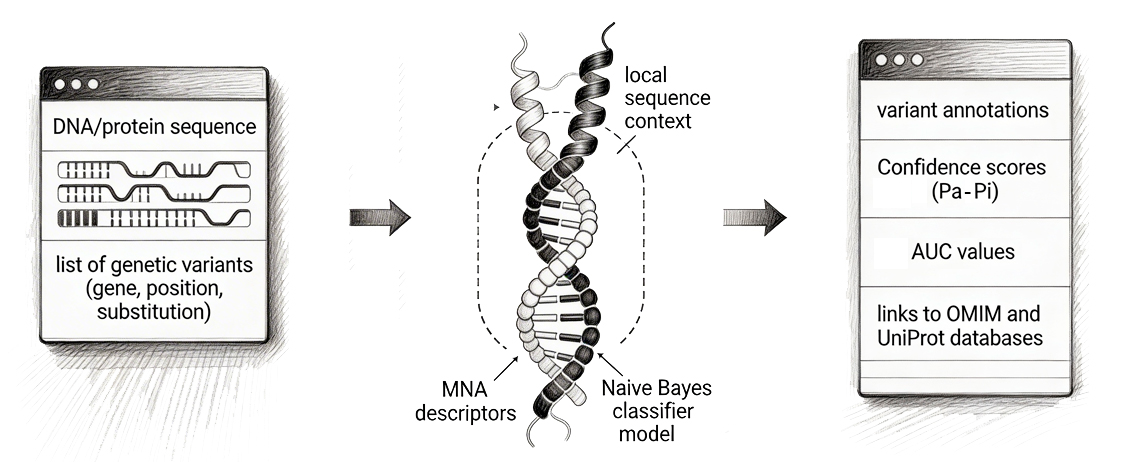
From a practical point of view, the user selects a disease set, a gene, a substitution position, and a new amino acid, or uploads a list of variants in the format “gene position substitution”. As output, the service provides the predicted variant annotation, the Confidence value calculated as Pa−Pi, and the AUC of the corresponding model, which helps assess not only the direction of the prediction but also its reliability.
Positive confidence values are interpreted as indicating probable pathogenicity of the variant, whereas negative values suggest that the variant is likely benign. The results can be sorted, filtered, and exported in CSV or XLS format; the interface also contains links to OMIM and UniProt and visually displays the position of the substitution within the protein sequence.
The service is built on 25 SSPR models trained on 2,124 clinically annotated missense variants, with 8,397 non-pathogenic polymorphisms added to the negative class. The average performance of the approach reached an AUC of 0.804 ± 0.040, and for 15 of the 25 proteins, SAV-Pred showed better predictive performance than SIFT 4G, PolyPhen-2 HDIV, MutationAssessor, PROVEAN, and FATHMM.
In practice, SAV-Pred can be used as a supportive tool for the interpretation of newly identified missense variants in genes related to inherited metabolic and other monogenic disorders included in newborn screening. It may help researchers and clinicians prioritize variants for further analysis, compare potentially pathogenic and likely benign substitutions, and support decision-making in genetic studies when experimental evidence is limited.
The service is also useful in research workflows focused on genotype–phenotype relationships, variant annotation, and the preliminary assessment of amino acid substitutions before deeper bioinformatic or laboratory validation. Because the interface allows both individual queries and batch submission, SAV-Pred can be integrated into routine analysis of sequencing results and candidate variant review.

Variant prioritization - the service helps quickly identify which missense substitutions are most likely pathogenic, saving time when reviewing large lists of candidate variants from sequencing data.
Additional evidence for interpretation - SAV-Pred provides an independent computational prediction that complements other tools such as SIFT, PolyPhen-2, or PROVEAN, strengthening the overall confidence in variant annotation.
Batch processing capability - multiple variants can be submitted simultaneously in a simple text format, making the service practical for high-throughput genetic studies and routine clinical screening workflows.
Anton D. Zadorozhny et al. (2023)
SAV-Pred: A Freely Available Web Application for the Prediction of Pathogenic Amino Acid Substitutions for Monogenic Hereditary Diseases Studied in Newborn Screening.
International Journal of Molecular Sciences, 24(3), 2463.
doi: 10.3390/ijms24032463
If you need to evaluate a large dataset, or if you need to maintain confidentiality of structural formulas transmitted via unsecured data channels, you can contact us to discuss the licensing opportunities.

© 2011 - 2026 Way2Drug. All rights reserved.