
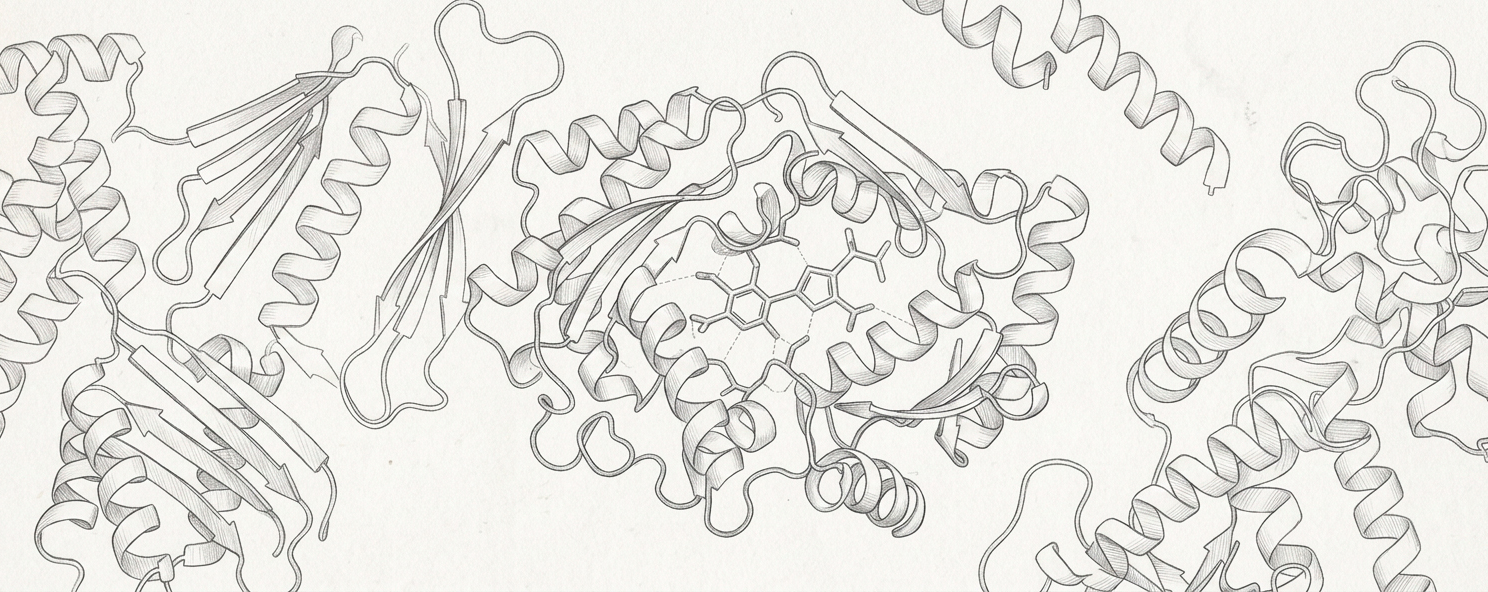
Molecular docking and ligand–protein interaction analysis occupy a central place in structure-based drug design. The Way2Drug platform offers a suite of tools that integrate seamlessly into this workflow. These tools cover everything from target prediction and protein sequence specificity analysis to receptor-ligand interaction assessment in an immunological context.
The key service on the platform for molecular docking tasks is PASS Targets, designed to predict interactions between small molecules and molecular targets. Predicting targets from ligand structure enables rational selection of protein receptors for subsequent docking calculations, substantially narrowing the search space and reducing computational costs. This approach is complemented by KinScreen, a specialized service for predicting compound interactions with human protein kinases — one of the most widely studied target classes in docking research. The combined use of PASS Targets and KinScreen prior to docking calculations aligns with the concept of complementary ligand-based and structure-based drug design methods, actively developed with the involvement of Way2Drug authors
For the analysis of protein targets at the level of primary and secondary structures, the Way2Drug platform provides two specialized tools. The SprOS (Specificity Projections on Sequence) service identifies the amino acid positions that determine the functional and inhibitory specificity of proteins, particularly protein kinases. The predicted positions can be used to interpret molecular docking results and to rationally design inhibitors with defined selectivity. The MNA-PSS-Pred (MNA-based Protein Secondary Structure Predictor) service predicts protein secondary structure using MNA descriptors. Knowledge of the secondary structure of a target is an important prerequisite for homology modeling and molecular docking tasks, especially when working with proteins for which no experimental 3D structure is available.
Point mutations in a protein's active site directly affect ligand affinity, which is a central problem in drug resistance studied using molecular docking methods. The SAV-Pred service predicts the pathogenicity of single amino acid variants in proteins, making it possible to assess how a specific mutation disrupts the ligand-binding function of the target. The HVR service predicts HIV-1 resistance to antiretroviral drugs based on the nucleotide sequences of protease and reverse transcriptase. The relationship between the mutational profile of a protein and the altered pattern of ligand–target interactions was thoroughly examined, where docking data were systematically compared with predictions of HIV-1 resistance to reverse transcriptase inhibitors.
For tasks that go beyond the classical "small molecule–protein" paradigm, the Way2Drug platform offers more specialized tools. The Proteochemometrics service predicts interactions between small molecules and proteins by simultaneously accounting for descriptors of both the ligand and the protein target. Unlike classical docking, which requires a three-dimensional protein structure, Proteochemometrics relies on amino acid sequences, substantially broadening the applicability domain and enabling analysis of entire families of related proteins. The method has been successfully applied to predict inhibitors of viral proteases, complementing docking approaches when working with proteins that have inaccurate or unavailable 3D structures. Finally, the TCR-Pred service addresses molecular binding prediction in an immunological context: it predicts the interaction of CDR3 sequences from the α- and β-chains of the T-cell receptor with antigenic epitopes and MHC types, achieving a mean AUC of 0.857–0.884 in cross-validation. Thus, Way2Drug's services cover a broad spectrum of molecular binding tasks, including the interaction of small-molecule ligands with enzymes and the recognition of peptide antigens by immune receptors.
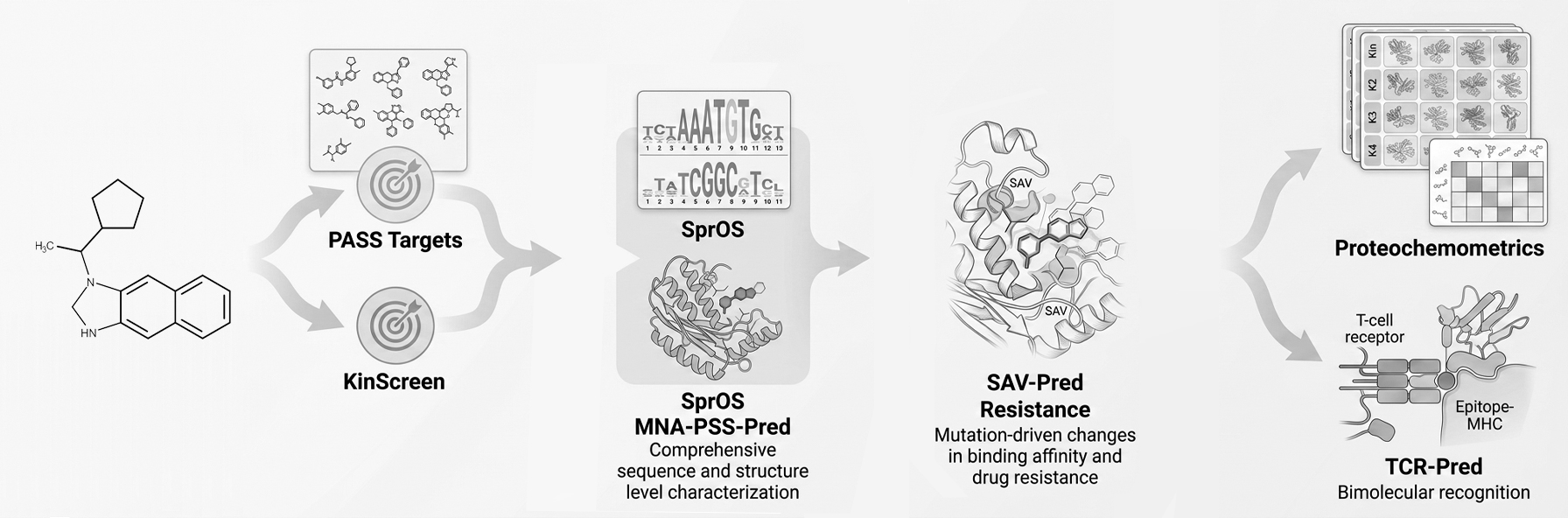
The Way2Drug platform implements a coherent multi-stage computational workflow in which ligand-based and structure-based approaches reinforce one another at every step of drug discovery. In a typical integrated pipeline, PASS Targets or KinScreen first identify the most probable molecular targets for a compound of interest; SprOS and MNA-PSS-Pred then provide sequence- and structure-level characterization of those targets; SAV-Pred and Resistance assess how mutational variation in the target alters binding affinity and may confer drug resistance; and Proteochemometrics or TCR-Pred extend the analysis to protein families or immune recognition scenarios where conventional docking is insufficient. This layered strategy, which moves from ligand-oriented prediction to structural target profiling to mutation-aware binding analysis, mirrors the best practices of modern computational drug discovery.
Research in the field of immunology and sequence-based analysis is represented by tools designed for highly specific biomedical tasks. TCR-Pred is intended for predicting T-cell receptor specificity to antigenic epitopes and major histocompatibility complex molecules, supporting research at the interface of immunoinformatics and antigen recognition. SAV-pred is aimed at predicting the clinical effect of single amino acid substitutions in proteins associated with monogenic hereditary diseases included in newborn screening panels. TIP is likewise focused on the prediction of the clinical significance of single amino acid substitutions in proteins linked to monogenic inherited disorders relevant to newborn screening. Proteochemometrics provides a framework for analyzing ligand–target relationships using combined descriptions of chemical compounds and biological targets, while SprOS serves as a specialized resource within the platform for structure-based analysis in a protein- and sequence-related biomedical context.
Rounding out the ecosystem, MNA-PSS-Pred enables prediction of protein secondary structures. CNER is more accurately described as a knowledge-based resource designed to support the exploration of relationships among chemicals, genes, proteins, diseases, and biological pathways, thereby helping users interpret compound action in a broader systems-biology and network-pharmacology context. In this role, CNER complements the predictive services of the platform by connecting individual molecular predictions with wider biological and biomedical associations.
Taken together, the services of Way2Drug platform form an integrated computational environment for early-stage drug discovery and biomedical research. Rather than providing isolated predictions, the platform enables users to move from molecular structure to a connected interpretation of biological activity, target interactions, metabolism, toxicity, gene expression effects, disease relevance, and sequence-associated variation. This combination of complementary machine learning models supports a more systematic evaluation of compounds, metabolites, and biomolecular features within a single research framework. As a result, Way2Drug helps researchers generate hypotheses faster, prioritize experiments more rationally, and reduce the cost and time associated with exploratory screening. In this sense, the platform represents not only a collection of predictive services, but also a practical platform for transforming chemical and biological data into actionable scientific insight.

© 2011 - 2026 Way2Drug. All rights reserved.


