
is web application developed for the in silico prediction of xenobiotic metabolites and the comprehensive assessment of their biological activity profiles. It represents a significant update over the original MetaTox application, extending its scope from mere metabolite generation and acute toxicity prediction to a full, aggregated biological activity spectrum (BAS) analysis that accounts for both parent compounds and all their probable metabolites.
The core engine of MetaTox 2.0 predicts metabolic transformations using a Naive Bayes classifier implemented within the PASS (Prediction of Activity Spectra for Substances) framework. The service covers 19 biotransformation reactions, including aliphatic and aromatic hydroxylation, hydrolysis, N-dealkylation, O-glucuronidation, methylation, N-hydroxylation, and O-phosphorylation. Each reaction is modeled with high predictive accuracy, with IAP values ranging from 0.80 to 0.99. To prevent server overload, the number of generated metabolites per level is capped at 10.
For every compound in the generated metabolic network, MetaTox 2.0 uses a PASS model trained on over 1.5 million molecules to predict more than 1,900 types of biological activity, organized into seven categories: mechanisms of action, pharmacological effects, toxic and adverse effects, antitargets, transporters-related actions, metabolism-related actions, and gene expression regulation. Three values are reported for each activity: Pa (probability to be active), Pi (probability to be inactive), and Pamax (the maximum Pa across the parent compound and all its metabolites). This enables the user to identify cases in which a metabolite exhibits higher activity than the parent drug.
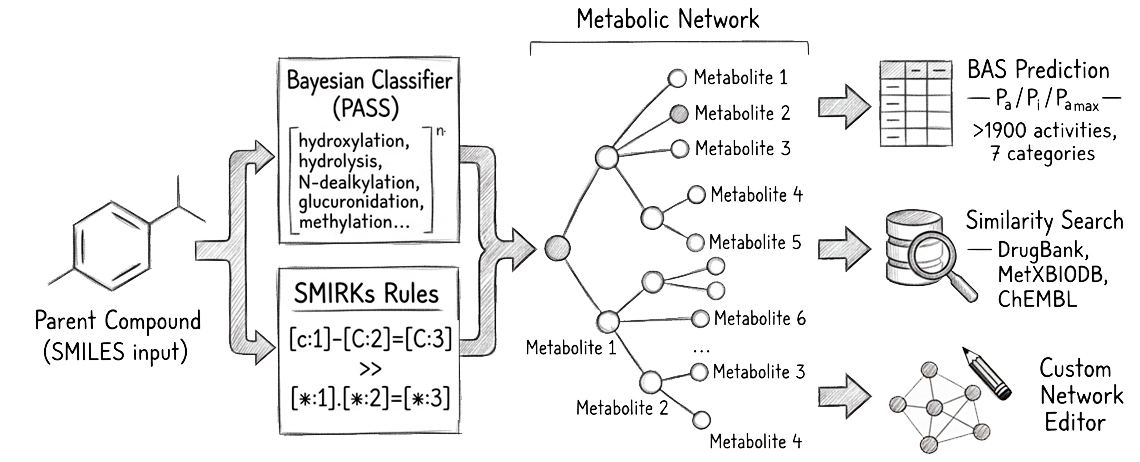
MetaTox 2.0 includes a similarity search feature that compares the submitted query structure against more than 2,000 known metabolic networks extracted from DrugBank, MetXBIODB, and ChEMBL databases. Structural similarity is computed using two complementary methods: MNA (Multilevel Neighborhoods of Atoms) descriptors with the Tanimoto coefficient, and QNA (Quantitative Neighborhoods of Atoms) descriptors with a modified Tanimoto coefficient. Clicking on a similar drug from the results table displays its complete, experimentally known metabolic pathway directly in the interface.
A notable feature of MetaTox 2.0 is the ability to manually draw custom metabolic networks by entering SMILES strings and compound labels. Once edges (metabolic links) are added between nodes, the system immediately computes the aggregated BAS prediction for all compounds in the user-defined network. Each constructed network is assigned a unique task ID, allowing users to retrieve and revisit their schemas in future sessions.
Prediction interface allows to use different internal mechanisms for applying biotransformation rules:
Predict metabolite for drawn structure - mode uses a Bayesian classifier (the PASS algorithm) to predict metabolites. The probability of each metabolite being formed is computed as an integrated score: first, the probability of a given biotransformation reaction class is estimated, then the probability of that reaction occurring at a specific site on the molecule. This is a statistical, data-driven approach trained on structural descriptors derived from real substrate–metabolite pairs.
Predict the metabolite for the given structure using the SMIRKS mode, which applies deterministic SMIRKS rules. These are formally and chemically precise reaction templates written in SMIRKS notation, an extension of SMILES designed to describe reaction transformations. SMIRKS unambiguously encodes which atoms and bonds participate in the reaction and how the structure changes as a result. The outcome is therefore not probabilistic but rule-based: if a fragment of the molecule matches the template, the metabolite is generated.
In practice, the standard mode is better suited for screening new compounds with an unknown metabolic profile, while the SMIRKS mode is preferable when the goal is to accurately simulate specific biotransformations according to formally defined chemical reaction rules.
MetaTox 2.0 is particularly valuable during the early stages of drug development, where understanding the metabolic fate of a candidate compound is critical before costly in vitro or in vivo experiments are conducted. A researcher can submit a single SMILES string and instantly obtain the full predicted metabolic tree alongside a ranked list of biological activities for each node in the tree. This allows researchers to identify whether a hydroxylated metabolite carries unexpected hepatotoxic or mutagenic signals that the parent molecule does not. The service is equally applicable to environmental toxicology and food safety, where xenobiotics such as pesticides or natural plant constituents need to be screened for hazardous transformation products before regulatory submission. For medicinal chemists engaged in lead optimization, MetaTox 2.0 provides a rapid, zero-cost computational filter that can guide structural modifications aimed at minimizing the formation of toxic or pharmacologically undesirable metabolites.
Integrated ADMET-aware metabolite profiling - unlike standalone metabolite predictors, MetaTox 2.0 combines metabolic network generation with a >1,900-activity BAS prediction in a single workflow, giving a holistic safety and pharmacology picture without switching between multiple tools.
Proactive detection of bio-activated hazards - the Pamax metric immediately flags cases where a downstream metabolite surpasses the parent compound in toxic or adverse-effect probability, enabling proactive structural intervention rather than reactive troubleshooting late in development.
Leverage of curated experimental data - the built-in similarity search against more than 2,000 experimentally validated metabolic networks from DrugBank, MetXBIODB, and ChEMBL grounds computational predictions in real-world metabolic evidence, increasing confidence in the generated hypotheses.
Anastasia V. Rudik et al. (2023)
MetaTox 2.0: Estimating the Biological Activity Spectra of Drug-like Compounds Taking into Account Probable Biotransformations.
ACS Omega, 8(48):45774-45778.
If you need to evaluate a large dataset, or if you need to maintain confidentiality of structural formulas transmitted via unsecured data channels, you can contact us to discuss the licensing opportunities.

© 2011 - 2026 Way2Drug. All rights reserved.