
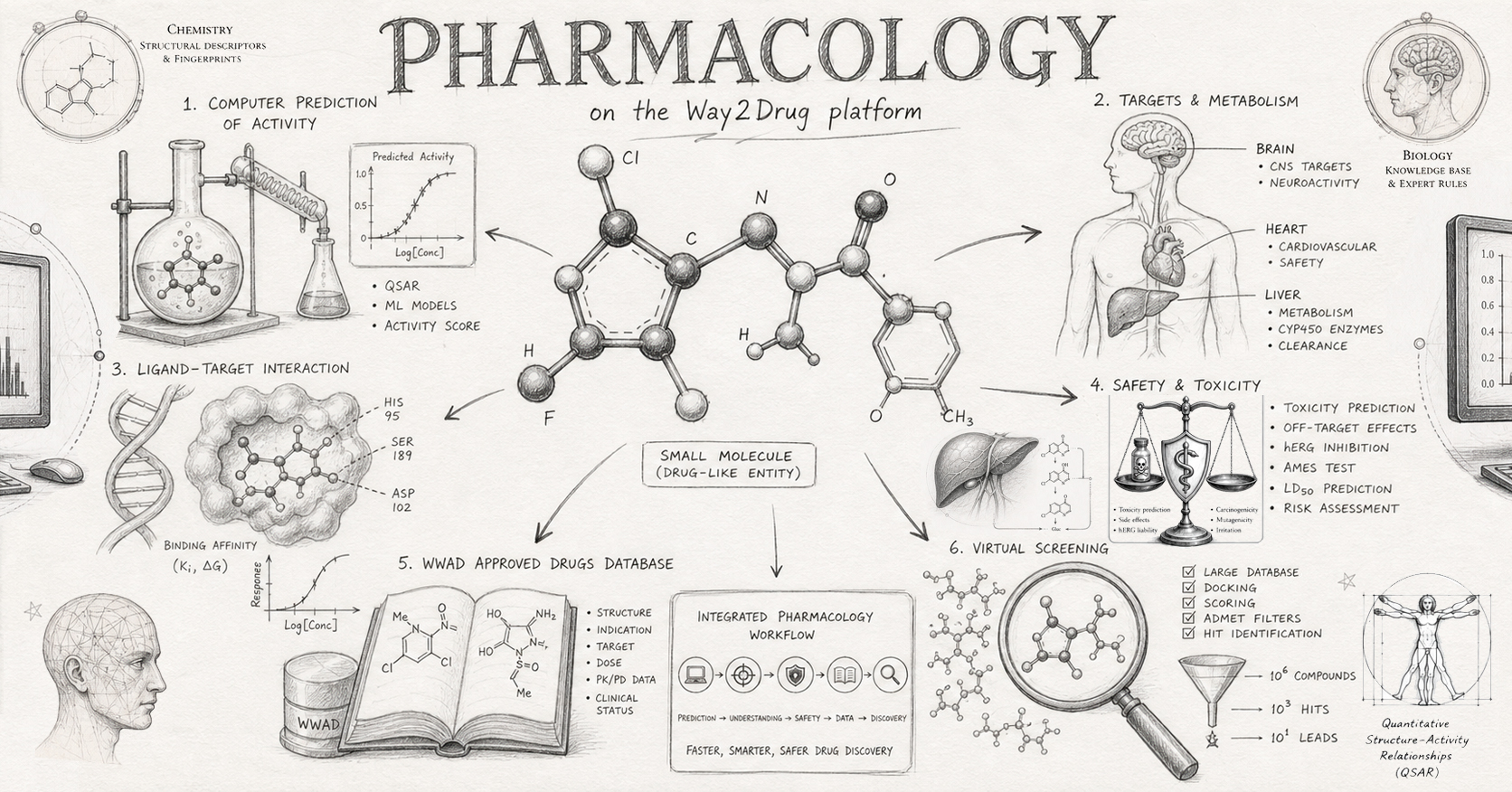
In silico methods in pharmacology are computational modeling and prediction approaches used to assess the biological properties of chemical compounds without direct laboratory experimentation, based on the analysis of structure–activity relationships. Their importance stems from the fact that developing a single new drug traditionally takes more than a decade and costs billions of dollars, while the probability of successfully passing through all stages of testing remains extremely low. Computational models make it possible to assess a molecule's pharmacological potential, toxicity, and metabolism even before it is synthesized, fundamentally changing the logic of drug discovery, shifting it from empirical trial-and-error to rational, data-driven design. This is why in silico approaches have become an integral stage of pharmaceutical R & D today.

We don’t know a single drug discovered solely in silico, but we don’t know a single drug discovered without in silico methods.

The Way2Drug platform represents a systematic approach to analyzing, predicting, and interpreting the pharmacological effects of chemical compounds and already approved drugs, based on their structure and the "ligand–target–disease" relationships. Way2Drug functions as a computational platform for understanding chemical-biological interactions: the links between diseases, molecular targets, and ligands, mechanisms of action, and drug indications. In a pharmacological context, the platform serves as a bridge between a molecule's structure and its potential therapeutic effect, adverse actions, toxicity, gene expression, transporters, metabolism, and drug-drug interactions.
This section of the Way2Drug platform serves as a guide that brings together the platform's various web services, such as biological activity prediction, analysis of approved drugs, and safety and metabolism assessment, into a unified pharmacological picture of a substance. As users work within this section, they move from computational activity prediction based on structure toward interpreting the pharmacological profiles of real drugs, including their indications, mechanisms of action, and possible new areas of application. The core idea is that every chemical structure is treated as a source of a potential pharmacological profile that can be predicted before experiments are conducted, using specialized algorithms and knowledge bases.
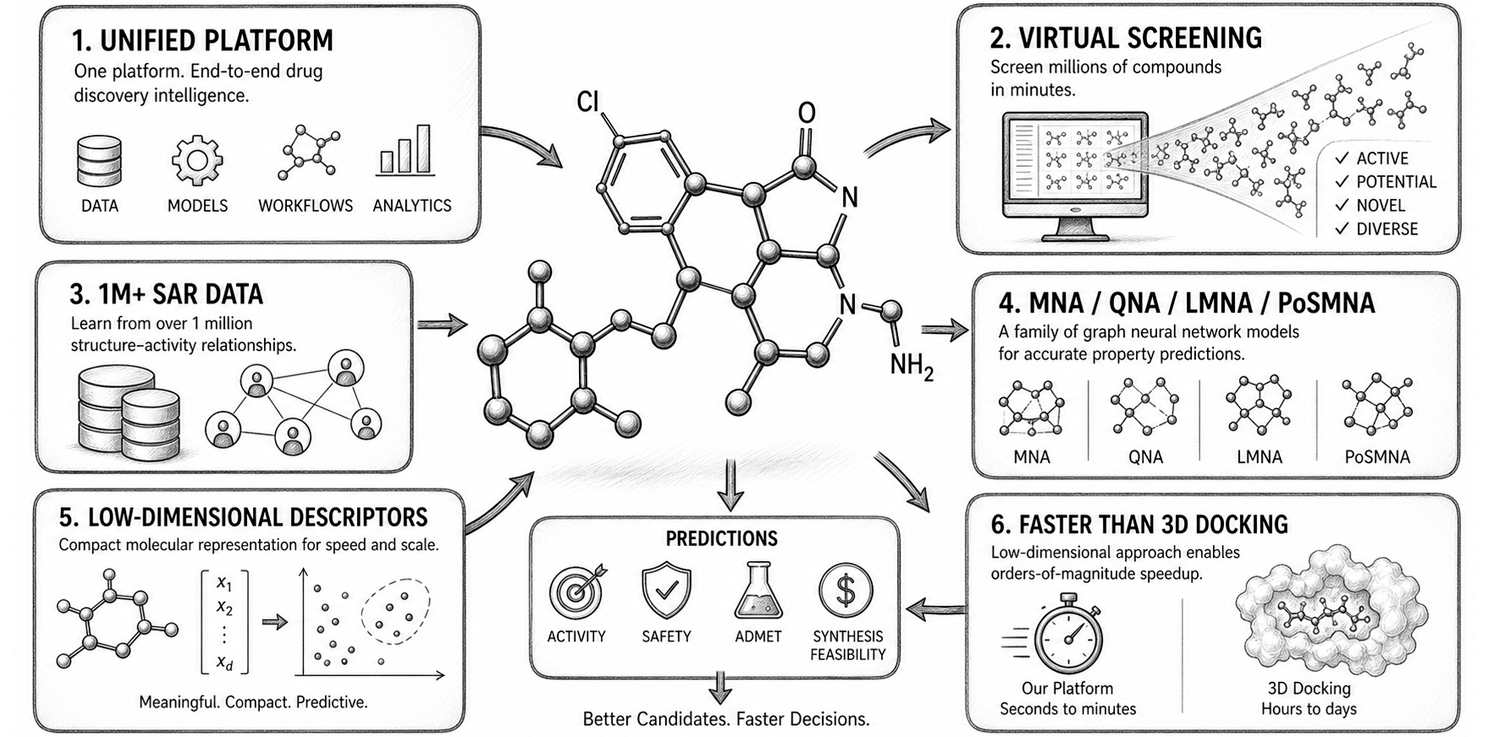
At the heart of the platform's pharmacological section is PASS Online (Prediction of Activity Spectra for Substances) — a web service, based solely on a structural formula, predicts more than 4,000 types of biological activity, including pharmacological effects, mechanisms of action, and side effects, with an average accuracy above 95%. PASS models were trained on structural and activity data for more than 300,000 organic compounds, making it possible to assess a molecule's potential before its synthesis and laboratory testing. PASS algorithm, based on MNA descriptors and a Naive Bayes classifier, serves as the methodological foundation for an entire family of specialized platform services.
The PharmaExpert expert system systematizes PASS-predicted activity spectra using a formalized knowledge base of relationships between activities, known drug interactions, protein targets, signaling pathways, and therapeutic or adverse effects. This makes it possible to select compounds with a specified combination of desired pharmacotherapeutic properties while simultaneously excluding substances with toxic characteristics, generating structured reports for candidate prioritization. GUSAR Online complements this analysis with quantitative modeling: it evaluates acute toxicity (LD50 across four administration routes), anti-target interactions, and ecotoxicity based on QNA descriptors and a self-consistent regression method.
Computational prediction of pharmacological properties is a task far removed from simply "searching for similar molecules": biological activity is determined not by overall structural similarity, but by a subtle correspondence between individual atoms of the ligand and the target, which makes classical structure-comparison methods insufficient. This is precisely the basis of the local correspondence concept proposed at Way2Drug as an original scientific paradigm stating that most biological effects of drug-like compounds result from molecular recognition at the level of local atomic environments, rather than the molecule as a whole. An additional layer of complexity is that a single prediction must simultaneously account for hundreds or thousands of potentially competing activity types, the compound's metabolic transformation in the body, and possible drug interactions, tasks that in a laboratory setting would require separate, costly experiments spanning months.
Unlike most narrowly specialized approaches, Way2Drug integrates numerous independent predictive models into a unified working tool, reducing time and resource costs compared to the sequential use of disparate tools and enabling comparative analysis of large compound libraries. PASS algorithm operates on a database of more than one million experimentally confirmed structure–activity relationships, and its computational speed (roughly 1,000 compounds in 10 seconds) enables full-scale virtual screening of corporate chemical collections — a task unattainable for methods requiring three-dimensional docking of every molecule. The platform's proprietary descriptors — MNA, QNA, LMNA, and PoSMNA — require a dramatically lower dimensionality of feature space (for instance, just two parameters per atom in QNA versus thousands in classical QSAR), while retaining physically interpretable and grounded structural information.
The platform covers narrow therapeutic areas through its own dedicated predictive web services:
| Domain | Service | What It Predicts |
|---|---|---|
| Antidepressants, antipsychotics | PASS Online, DIGEP-Pred | CNS activity spectrum and gene expression changes |
| Geroprotection | PASS GERO | 117 aging-related mechanisms, accuracy ~0.97 |
| Oncology | CLC-Pred 2.0, BC CLC-Pred | Cytotoxicity against tumor and normal cell lines |
| HIV/antiviral therapy | AntiHIV-Pred, HVR | Activity against HIV proteins and drug resistance |
| Drug-drug interactions | DDI-Pred, P450-Analyzer | Interactions via cytochrome P450 isoforms |
| Mutagenicity | Ames Mutagenicity Predictor | Mutagenicity across 69 Salmonella typhimurium strains |
| Metabolism | MDM-Pred | The influence of gut microbiota on drugs |
A compound's pharmacological profile on Way2Drug is inseparable from an analysis of its biotransformation: the MetaPASS service accounts for the compound's metabolic pathways and calculates the maximum activity probability (Pamax) among the parent substance and its metabolites, revealing effects that only manifest after transformation in the body. In parallel, ADVERPred and GUSAR Online assess the risks of cardiovascular and hepatobiliary adverse reactions, while DDI-Pred models predict drug interactions directly for compound pairs via key CYP450 isoforms, with an average IAP accuracy of around 0.92.
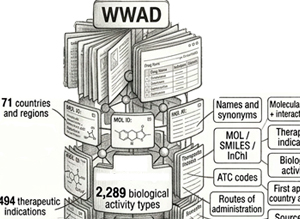
Way2Drug's information resources, such as the World Wide Approved Drugs (WWAD) database, expand the platform's pharmacological component with data on drugs approved in various countries. Most widely used databases, contain information primarily on medicines approved in the United States and Europe, even though up to 30% of drugs receive their first approval in other countries. To solve this problem, the we manually aggregated data from the national medicine registers and official regulatory documentation of 71 countries and regions, including the US, EU member states, Russia, China, Japan, Brazil, and many others, later expanding coverage to 88 countries. A defining feature of WWAD within the Way2Drug platform is that every collected drug structure is also processed through PASS software, generating predicted biological activity spectra alongside the curated experimental data. This allows researchers to directly compare a drug's officially documented pharmacological profile with computationally predicted additional activities, creating a natural bridge between curated pharmacology and in silico hypothesis generation. This makes it possible to analyze opportunities for pharmacological repositioning and the search for new indications.
The combined use of PASS, PharmaExpert, WWAD, and specialized predictors forms a closed research cycle: from virtual screening of compound libraries and identification of promising pharmacological effects to comparison with data on approved drugs and safety assessment long before synthesis and clinical trials. This approach significantly reduces the time and financial costs of early-stage drug development, making pharmacological analysis accessible to both academic researchers and pharmaceutical industry partners.

© 2011 - 2026 Way2Drug. All rights reserved.


